As I See It
Vayu Putra
Chapter 1
A Brain Built to Survive, Not to Understand
The human brain was not designed to discover truth.
It was designed to keep a fragile body alive.
This single fact explains more about human behaviour than most philosophies ever have.
For most of human history, survival mattered more than accuracy. A mistaken belief could be corrected later. A delayed reaction could end a life. Over millions of years, the brain adapted to favour speed over precision, emotion over analysis, and certainty over doubt.
This is not a failure of intelligence.
It is an evolutionary solution.
And it is still operating inside your head right now.
What the brain actually is
The brain is not a thinking spirit. It is a physical object.
It weighs about one and a half kilogrammes. It is soft, wet, and electrically active. It is made of ordinary matter — carbon, hydrogen, oxygen, nitrogen — the same elements found in the rest of the universe. There is nothing special or sacred in its material. And yet, from this material process comes every thought you have ever had.
Every hope. Every fear. Every belief.
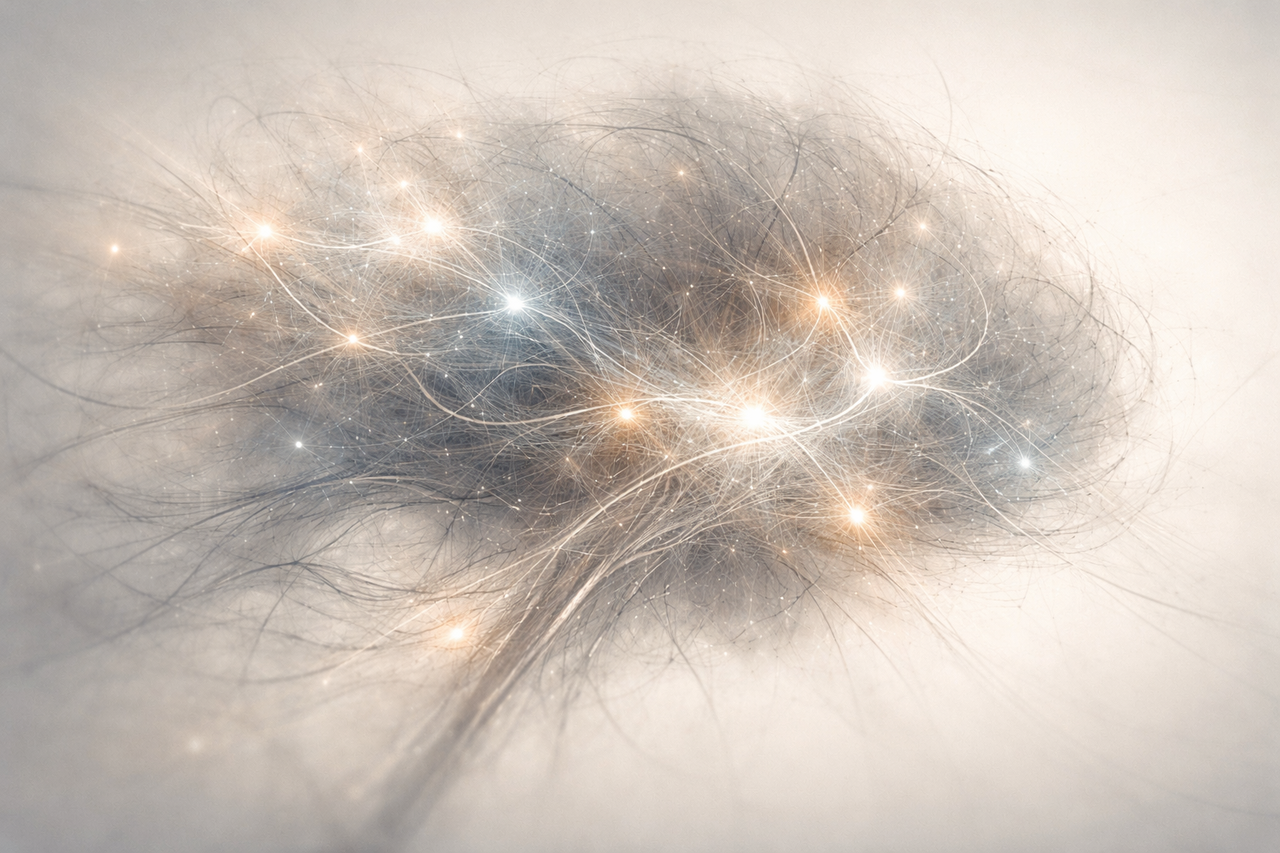
The brain is made of billions of cells called neurones. Each neurone is a living cell with branches that receive signals and a long extension that sends them onward. Neurones do not touch. Between them is a microscopic gap called a synapse.
Thought happens across these gaps.
When a neurone fires, it sends an electrical signal along its length. At the synapse, this electrical signal triggers the release of chemicals. These chemicals drift across the gap and bind to receptors on the next neurone, increasing or decreasing the chance that it will fire too.
This is how information moves.
This is how memory forms.
This is how belief settles.
There is no separate substance for fear, love, faith, or doubt. They all emerge from the same physical process: neurones firing and chemicals flowing.
Every thought you have is a physical event.
Every belief leaves a trace in matter.
When a pattern of neurones fires repeatedly, the connections between them strengthen. This is how learning happens. It is also how habits form. Over time, frequently used pathways become easier to activate. Rarely used ones weaken.
Think about that for a moment.
The brain does not ask whether a thought is true. It reinforces what is repeated, rewarded, or emotionally charged. A false belief repeated often enough becomes as entrenched as a true one. The brain cannot tell the difference.
It only knows: this pathway is well-worn, so it must be important.
Chemistry before meaning
The brain runs on chemistry before it runs on ideas.
Several chemicals play a central role in shaping belief and behaviour.
Dopamine is involved in reward, motivation, and pattern recognition. It is released when the brain predicts something correctly or believes it has found an explanation. This is why certainty feels good. A belief that "explains everything" can trigger dopamine even if it is completely wrong.
Finding a pattern — any pattern — feels satisfying. The brain does not distinguish between real patterns and imagined ones. Both produce the same chemical reward.
Serotonin helps regulate mood and social stability. It is linked to feelings of belonging and acceptance. When people feel included in a group, serotonin levels rise. When excluded, anxiety increases. Social rejection is processed by the brain as real pain.
This is not metaphor. Brain scans show that social exclusion activates the same regions as physical injury.
Anandamide and related chemicals are involved in calm, connection, and emotional regulation. They contribute to feelings of peace, unity, and transcendence — the sensations often described in religious or spiritual experiences.
These chemicals did not evolve to verify reality.
They evolved to guide behaviour.
When an idea reduces anxiety, creates belonging, or produces calm, the brain chemically rewards it. Over time, the brain begins to prefer that idea. Challenging it then feels uncomfortable, not because it is false, but because it threatens a chemical balance the brain has learnt to rely on.
This is how beliefs become emotionally anchored.
And here is the uncomfortable truth: the brain's chemical systems cannot distinguish between a comforting lie and an uncomfortable truth. Both are just patterns of neurones firing. The brain rewards the one that feels safer.
Faith as hypothesis, not fact
This distinction matters: faith is not the same as fact.
A fact is verifiable. It can be tested, measured, repeated, and confirmed by independent observers. Gravity is a fact. Water boiling at 100°C at sea level is a fact. The speed of light in a vacuum is a fact. These hold regardless of belief.
Faith, by contrast, is acceptance without verification. It is belief held in the absence of proof, sometimes despite contrary evidence.
Religious claims about the nature of reality — the existence of deities, the afterlife, divine intervention, miracles — are not facts. They are hypotheses. And they are largely untestable hypotheses.
This is not an attack. It is a clarification.
Some religious believers acknowledge this openly. They call it faith precisely because it requires trust beyond evidence. Faith is belief when you cannot know. That is its definition.
Others claim their beliefs are factual — that miracles occurred, that prayers work, that divine beings intervene in human affairs. They present religious claims as equivalent to scientific facts.
The evidence for these claims is not zero. There is circumstantial evidence: personal experiences, historical accounts, cultural continuity, and the transformative power of belief on individuals and societies.
But circumstantial evidence is not proof.
Personal testimony is not replicable.
Ancient texts are not scientific verification.
Correlation is not causation.
Sincerity is not truth.
When millions report feeling the presence of a deity, that tells us something real about human experience. It does not tell us that the deity exists outside the brain.
When prayer seems to bring comfort or even healing, that tells us something powerful about the mind-body connection, the placebo effect, and the brain's ability to influence physical states. It does not prove divine intervention.
Faith can be meaningful, comforting, and transformative without being factual. Many people find deep value in faith precisely because it operates outside the realm of empirical proof. That is their right.
But when faith is presented as fact, enforced as law, or used to override evidence, it becomes dangerous.
Belief is not evidence.
Experience is not proof.
Sincerity is not truth.
Understanding this distinction allows us to respect faith as a personal choice whilst still demanding evidence for claims about objective reality.
You can believe the universe has purpose. You cannot claim to know it as fact.
You can find meaning in prayer. You cannot prove it alters external reality.
You can live by religious principles. You cannot enforce them as universal truth.
The line between personal faith and claimed fact is where freedom ends and control begins.
An ancient brain in a modern world
The structure of the human brain reflects its history.
Older regions — the brainstem and limbic system — handle survival, fear, instinct, and emotion. These structures evolved hundreds of millions of years ago. They are fast, automatic, and powerful.
Newer regions — particularly the prefrontal cortex — support planning, reflection, and abstract thought. This area evolved much more recently. It is slower, requires more energy, and is easily overridden.
These newer areas did not replace the old ones. They were layered on top.
Imagine a modern house built on an ancient foundation. The foundation still determines much of the structure. You cannot ignore it just because you added new rooms.
When there is no threat, humans can reflect, doubt, imagine, and reason. The prefrontal cortex can do its work. This is when science, philosophy, art, and careful thinking happen.
When threat appears, the older systems take control. The prefrontal cortex is sidelined. Reflection gives way to reaction.
This explains a simple but uncomfortable truth:
Stress reduces intelligence.
Not permanently, but functionally. Under pressure, people rely more on habits, identities, and familiar beliefs. Novel thinking becomes difficult. Questioning feels dangerous. Certainty feels necessary.
You have experienced this yourself.
When you are calm, you can consider multiple perspectives, weigh evidence, admit uncertainty. When you are frightened, threatened, or overwhelmed, thinking narrows. You fall back on what feels familiar. You defend what feels safe.
This is not a personal failing. It is how the brain is built.
And this is why fear is such an effective tool of control.
If you want people to stop thinking and start obeying, you do not need to convince them. You just need to frighten them.
How faith hacks the survival brain
Faith does not override the brain's survival systems.
It exploits them.
This is not metaphor. It is mechanism.
The brain evolved to prioritise:
- Safety over accuracy
- Certainty over ambiguity
- Belonging over isolation
- Authority over autonomy
Faith-based systems align perfectly with these priorities. They offer exactly what the survival brain craves.
Certainty where there is none
"God has a plan" replaces "I don't know why this happened."
"Everything happens for a reason" replaces "randomness is terrifying."
"Trust in divine will" replaces "I have no control."
The brain prefers the first answer in each case, even if it is false. Certainty reduces anxiety. Anxiety is a threat signal. The brain will accept almost any explanation to turn that signal off.
This is the first hack: faith offers certainty in an uncertain world.
Authority when overwhelmed
"Trust the scripture" replaces "figure this out yourself."
"Follow the prophet" replaces "navigate moral complexity alone."
"Obey divine command" replaces "decide what is right."
When decisions feel impossible, outsourcing them reduces cognitive load. The brain experiences relief.
This is the second hack: faith offers authority when autonomy is overwhelming.
Belonging through conformity
"Believe what we believe" creates instant community.
"Share our rituals" creates synchronised behaviour.
"Accept our identity" creates in-group bonds.
The brain rewards group cohesion with chemical comfort. Serotonin rises. Anxiety falls. Belonging feels like safety.
This is the third hack: faith offers belonging at the cost of conformity.
Protection through obedience
"Follow these rules and you will be safe."
"Disobey and you will suffer."
"We are protected; they are not."
This creates a simple moral map in a complex world. The brain prefers simple maps. They require less energy and produce less anxiety.
This is the fourth hack: faith offers protection through rule-following.
From the brain's perspective, faith works.
It calms fear. It provides answers. It creates structure. It builds identity. All of this happens at a chemical level before any philosophical consideration.
This is why faith is so powerful.
This is why it spreads so easily.
This is why it persists even when evidence contradicts it.
The brain is not failing when it accepts faith. It is succeeding at survival — just not at truth.
Understanding this hack does not make faith evil. But it does explain why faith-based systems can be exploited for control.
When leaders understand that humans crave certainty, authority, and belonging, they can manufacture belief for political ends. They can turn frameworks for meaning into tools for power.
Faith becomes dangerous when it stops serving human well-being and starts serving control.
Identity, belonging, and religion
Religion does not only offer explanations.
It offers identity.
Identity is one of the brain's strongest anchors. Knowing who you are — and who you belong with — reduces uncertainty. It answers questions before they are asked.
Religion provides:
- A name for the self
- A story of origin
- A moral map
- A group to belong to
- A boundary between "us" and "them"
From the brain's perspective, this is extremely attractive.
Belonging is not abstract. It is chemical. Group acceptance reduces stress. Shared belief synchronises behaviour. Ritual creates predictability. Predictability calms the nervous system.
This is why people defend religious identity as fiercely as their own name.
To attack the belief feels like an attack on the self. The body reacts. Heart rate increases. Defensiveness appears. The prefrontal cortex shuts down. The older brain takes over.
This is not ignorance.
It is biology.
Think about your own identities. Imagine someone attacking something central to who you are — your profession, your nationality, your family, your values. Notice the feeling that arises. That feeling is your brain interpreting the challenge as danger.
Now imagine that identity is tied to eternal salvation, moral goodness, and cosmic purpose. Imagine that leaving it means social exile, family rejection, and the threat of damnation.
The brain does not process this as a neutral debate. It processes it as life or death.
This is why arguments about religion rarely work. You are not debating ideas. You are threatening someone's survival system.
Pattern, fear, and the unknown
The universe is vast, complex, and indifferent to human concerns. The brain, by contrast, is small, local, and deeply concerned with meaning.
It evolved in environments where recognising patterns mattered for survival. A rustle in the grass could be wind or a predator. Those who assumed predator and were wrong lived to reproduce. Those who assumed wind and were wrong did not.
Over time, the brain became extremely good at finding connections — sometimes real, sometimes imagined.
Seeing a pattern reduced uncertainty.
Uncertainty produced anxiety.
As a result, the brain often prefers a false explanation to no explanation at all. Chaos is terrifying. Meaning is calming.
This is where belief begins.
When early humans faced storms, disease, death, or disaster, the brain demanded meaning. Random suffering is unbearable. Explained suffering is manageable.
Stories created order where none was visible. They softened fear and restored a sense of control. These stories were not foolish. They were survival tools.
"The storm is angry" is easier to process than "atmospheric pressure differential."
"The gods are displeased" is easier to act on than "statistical variation in crop yield."
"The ancestors are watching" creates behavioural regulation without police.
Religion emerged as a way to stabilise the nervous system in a dangerous world.
It answered unanswerable questions.
It explained unexplainable events.
It created order from chaos.
And in doing so, it helped humans survive.
But survival and truth are not the same thing.
Delusion, fixation, and faith
A belief becomes dangerous when it stops being flexible.
When an idea is repeated often, tied to identity, rewarded socially, and protected by fear, it can harden into fixation. At that point, the belief is no longer examined. It is defended.
Fixation feels like truth.
But truth invites questioning. Fixation forbids it.
Once a belief reaches fixation:
- Contradictory evidence is ignored
- Doubt feels immoral
- Questioning feels threatening
- Alternative explanations feel hostile
This is how collective delusions form — not necessarily clinical delusions, but shared beliefs protected by emotion rather than tested by evidence.
Religion can become one of these fixations. So can nationalism, political ideology, conspiracy theory, or any belief system that forbids doubt.
The mechanism is the same.
Repeat it often enough.
Tie it to identity.
Reward conformity.
Punish dissent.
Make questioning feel like betrayal.
And the brain will defend it as if it were survival itself.
This is not unique to religion. It is human.
Atheism can become a fixation. Capitalism can become a fixation. Science, when treated as ideology rather than method, can become a fixation.
Any belief that cannot tolerate doubt has stopped being a tool for understanding and become a tool for control.
Fear, possession, and superstition
Historically, experiences that felt overwhelming — seizures, hallucinations, extreme emotion, dissociation — were often explained as possession by spirits or external forces.
These explanations were not malicious. They were attempts to interpret experiences without scientific tools.
When someone convulsed, spoke in strange voices, or behaved in ways that seemed alien to their personality, the brain demanded an explanation. "A spirit has entered them" made sense in a world without neurology.
To date, no controlled scientific experiment has demonstrated the existence of external evil entities possessing human beings.
What science has documented instead are:
- Epilepsy and other seizure disorders
- Dissociative identity disorder
- Schizophrenia and psychotic episodes
- Trauma responses and PTSD
- Altered states from fever, infection, or substances
- Sleep paralysis and hypnagogic hallucinations
The experience was real.
The explanation evolved.
This does not mean people were lying or foolish. It means they were interpreting real phenomena with the frameworks available at the time.
As scientific understanding of the brain has grown, many phenomena once described as possession have been explained in biological and psychological terms.
The pattern repeats throughout history: Mystery → Supernatural explanation → Scientific understanding → Naturalistic explanation.
What was once demonic possession is now temporal lobe epilepsy.
What was once divine vision is now migraine aura.
What was once prophetic madness is now bipolar mania.
The experience does not become less real. The explanation becomes more accurate.
And yet, the old explanations persist. Not because they are true, but because they serve psychological and social functions that scientific explanations do not.
"You have a neurological condition" is accurate but offers no meaning.
"You are touched by the divine" is inaccurate but offers purpose.
The brain often prefers purpose over accuracy.
Addiction and belief
Addiction is not limited to substances.
Drugs hijack the brain's reward systems by artificially stimulating dopamine and related chemicals. Over time, the brain adapts. It demands more stimulation to feel the same effect. Tolerance develops. Withdrawal produces anxiety and distress.
Belief can function in a similar way.
If a belief consistently reduces fear or provides certainty, the brain can become dependent on it. The belief becomes part of the brain's chemical regulation system.
Removing or questioning that belief then produces discomfort, confusion, or panic — not because the belief is true, but because the brain has adapted to rely on it.
This is why leaving a belief system can feel like withdrawal.
This is why people return to beliefs even when they doubt them.
This is why faith can feel addictive.
Consider how similar these experiences are:
| Substance addiction | Belief addiction |
|---|---|
| Craving for the substance | Craving for certainty |
| Relief when using | Relief when believing |
| Anxiety without it | Anxiety when doubting |
| Return despite knowing harm | Return despite evidence against |
| Social isolation when quitting | Social isolation when leaving |
| Identity tied to the substance | Identity tied to the belief |
The brain does not distinguish between chemical dependency and belief dependency. Both involve neural pathways, reward systems, and emotional regulation.
The brain is not attached to truth.
It is attached to stability.
Whatever provides that stability — substance, ritual, doctrine, or certainty — becomes something the brain defends.
What this means
Religion persists not because humans are irrational, but because it aligns well with how the brain works.
Pattern-seeking.
Fear-avoiding.
Belonging-oriented.
Chemically rewarded by certainty.
Understanding this does not require contempt. It requires honesty.
Belief is not a failure of intelligence. It is a response to uncertainty shaped by biology.
Humans are not defective for believing. They are adaptive. The brain is doing exactly what it evolved to do: seek safety, reduce anxiety, and create belonging.
But here is the critical distinction:
Biology explains behaviour. It does not excuse harm.
A brain built to survive can create beauty, cooperation, and care. The same brain can also produce fear, violence, and control when it is overwhelmed or exploited.
The difference lies in environment, pressure, and incentives.
When belief remains personal, symbolic, and flexible, it can coexist with reason. It can provide meaning without demanding control.
When belief becomes fixed, unquestionable, and enforced, it stops serving human well-being and begins to serve power.
That is not a spiritual failure.
It is a human one.
The foundation of everything that follows
This book begins here because everything else rests on this foundation.
Crowds.
Indoctrination.
Religion.
Capitalism.
Distraction.
Radicalisation.
All of them succeed or fail based on how they interact with fear, certainty, and belonging in the human brain.
Before judging belief, we must understand biology.
Before blaming people, we must understand pressure.
The human brain did not evolve to understand the universe. It evolved to survive inside it.
Everything that follows in this book — the analysis of crowds, the mechanisms of indoctrination, the exploitation of belief, the manufacture of distraction — all of it works because of what we have discussed here.
You cannot understand why people believe what they believe without understanding the brain.
You cannot understand why crowds behave as they do without understanding fear.
You cannot understand why systems of control work without understanding chemistry.
Understanding that the brain prioritises survival over truth is not pessimism. It is the beginning of responsibility.
Once we accept this, we can stop being surprised by history and start building systems that account for how humans actually function.
We can design societies that reduce fear instead of exploiting it.
We can create institutions that reward questioning instead of punishing it.
We can build frameworks that acknowledge uncertainty instead of demanding false certainty.
But first, we must be honest about what we are.
We are not rational beings who sometimes feel.
We are feeling beings who sometimes think.
We are survival machines that evolved the capacity for reason, not reasoning machines that sometimes fear.
Understanding that changes everything.
Everything else follows from here.
End of Chapter 1