As I See It
Vayu Putra
Chapter 3
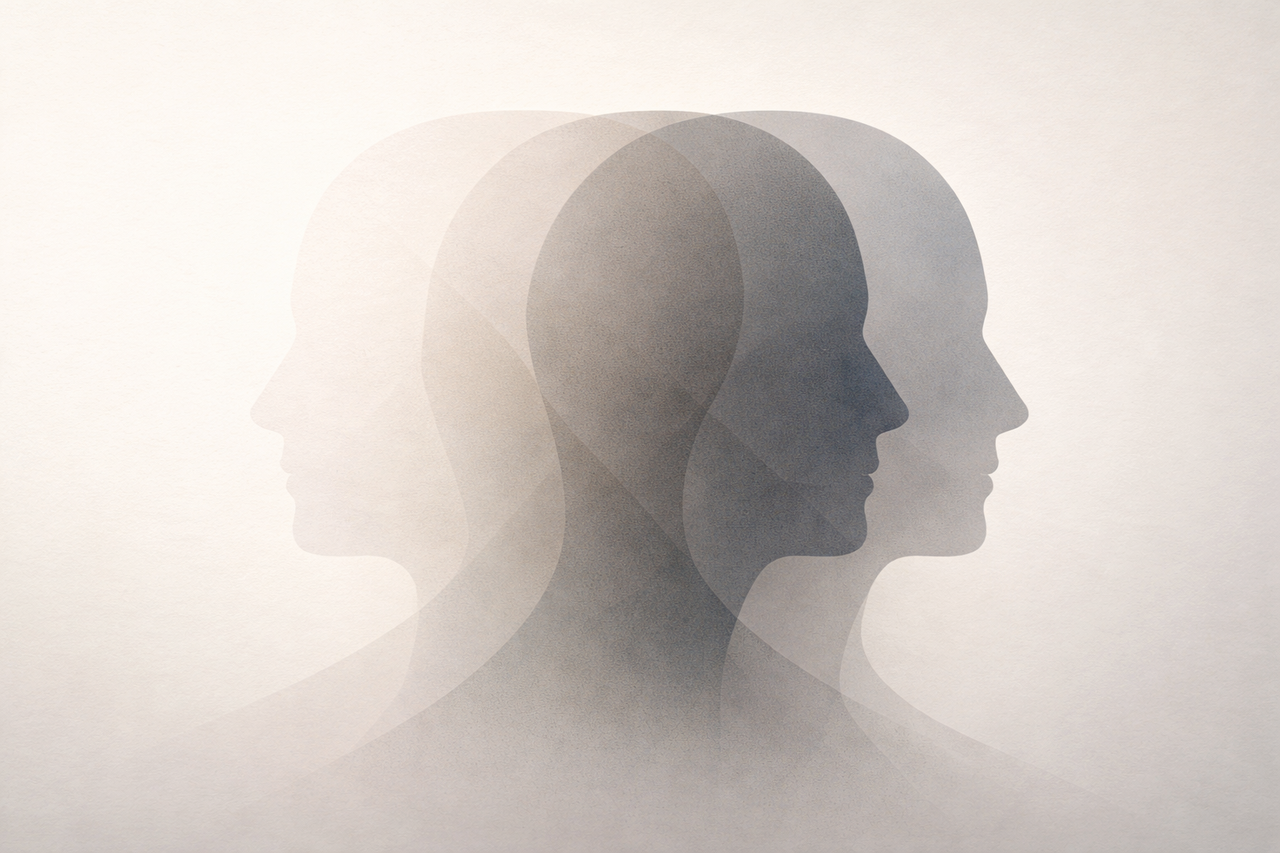
The Three Faces We All Wear
Humans like to believe they are consistent.
They are not.
What most people call hypocrisy is usually adaptation. We change because environments change. We speak differently at home, at work, in public, and when we are alone. This is not deception by default. It is how a social brain survives in a complex world where different contexts demand different versions of the self.
The person you are with your parents is not the person you are with your friends. The employee is not the same as the person who goes home at the end of the day. The public persona you project in professional settings bears little resemblance to the private thoughts you have whilst lying in bed at night. This is not pathological. This is normal. This is, in fact, necessary.
Long before laws or contracts, before written rules or formal institutions, humans learnt a simple rule that still governs behaviour today: how you behave depends on who is watching.
This is not cynicism. This is observation. And understanding it explains more about human behaviour than most moral philosophies ever will.
The three faces
In Japanese thought, there is an old idea that a person has three faces. It is not a scientific model. It is a cultural observation that captures something true about how humans actually function in the world.
The first is the public face. This is the version shown to the world at large. To strangers, colleagues, acquaintances, and anyone who might judge, reward, or punish based on what they see. This face is shaped by expectation, reputation, and consequence. It is careful, filtered, and socially acceptable. It does not lie, necessarily, but it certainly does not tell the whole truth. It reveals only what is safe to reveal, only what serves the purpose of maintaining standing in whatever social context it finds itself.
When you present yourself in a job interview, this is the face you show. When you interact with authority figures, when you post on social media knowing others will see it, when you attend formal events or professional gatherings, this face is active. It monitors constantly. It adjusts tone, word choice, posture, expression. It is exhausting to maintain, but it is also essential for navigating the social world without constant conflict.
The second is the private face. This is the version shown to family, close friends, and people who have earned enough trust that the public performance can relax somewhat. This face contradicts itself. It reveals doubt, fatigue, humour, frustration, and vulnerability that the public face would never admit. It complains about things the public face pretends to accept. It expresses opinions the public face keeps hidden. It allows messiness that the public face must conceal.
This is the face you show when you come home from work and vent about the day. When you confide in a trusted friend about your actual feelings rather than your official position. When you let your guard down enough to be imperfect, uncertain, or simply tired. This face is more honest than the public one, but it is still curated. Even with people you trust, you do not reveal everything. There are thoughts and feelings you keep private even from those closest to you.
The third is the inner face. This is the version shown to no one, not even those you love most. This is where fear lives without justification. Where desire exists without social acceptability. Where contradictions are not resolved but simply held simultaneously. Where unedited thoughts occur without the filter of consequence or judgement.
This is the face that contains thoughts you would never speak aloud. Impulses you would never act on. Judgements you know are unfair but feel anyway. Fears you would be embarrassed to admit. Desires that contradict your stated values. This face is not more true than the others, necessarily. But it is more complete. It contains everything the other faces must edit out.
Most people spend their lives pretending the first face is the real one. They identify with the public performance and feel fraudulent when the other faces surface. But the truth is more complex. All three faces are real. All three are you. The question is not which one is authentic. The question is which one is appropriate for the current context.
Why masks exist
Masks are not lies. They are responses to environments that demand different things from us.
The human brain is deeply, fundamentally social. This is not a cultural choice. It is biological reality. For most of human evolutionary history, survival depended absolutely on acceptance by the group. Exclusion meant vulnerability to predators, starvation, lack of mates, and early death. The penalty for social rejection was not discomfort. It was death.
Over hundreds of thousands of years, the brain evolved to be exquisitely sensitive to social context. It scans environments constantly, reading faces, interpreting tone, detecting status hierarchies, assessing threats, and adjusting behaviour accordingly. This happens mostly below conscious awareness. By the time you notice you are behaving differently in different contexts, your brain has already made thousands of micro-adjustments based on who is present and what the social stakes are.
The question the brain asks is not "what is true?" It is "what is safe here?" And different environments answer that question very differently.
At home with people who love you unconditionally, safety might mean honesty. You can express doubt, admit failure, reveal weakness. The relationship can withstand it.
At work where your livelihood depends on perception, safety might mean restraint. You cannot express every frustration, challenge every decision, or reveal every uncertainty. Doing so has professional consequences.
In public where strangers are watching and judging, safety might mean conformity. You moderate your opinions, adjust your presentation, and avoid standing out in ways that invite hostility or rejection.
Alone, where no one is watching and there are no social consequences, safety might mean release. You can think thoughts you would never speak, feel emotions you would never show, and be messy in ways the social world does not tolerate.
Consistency across all these contexts is not rewarded. It is punished. The person who is brutally honest in all settings loses jobs, relationships, and social standing. The person who maintains the same filtered persona in private that they show in public becomes exhausted and disconnected. Adaptation is what allows functioning across multiple social contexts without constant crisis.
This is why masks exist. Not because humans are dishonest by nature, but because different contexts genuinely require different responses. The mask is not false. It is contextual truth.
Morality and audience
Here is where things become uncomfortable. Morality, which most people experience as internal principle, often shifts with context in ways people do not like to admit.
People who believe they are principled, who think of themselves as having firm values that guide behaviour regardless of circumstances, are often surprised by themselves when contexts change. Under observation, they behave one way. Under pressure, another way. In anonymity, something else entirely.
This is not theoretical. It has been demonstrated repeatedly in psychological research. The same person who expresses progressive values in surveys behaves in discriminatory ways when they think no one is watching. The person who condemns cruelty in the abstract excuses it when it benefits their group. The individual who claims to value honesty lies when the stakes are high enough.
This does not mean people have no values. It means values are filtered through risk assessment. The brain is constantly weighing ethics against consequence, principle against safety, moral ideals against practical realities.
Consider a common scenario. Someone witnesses injustice happening to another person. In private conversation later, they express outrage. They say what should have been done. They position themselves as people who would have intervened. But in the moment, when intervention carried social risk, they stayed silent.
This is not because they are evil or cowardly, necessarily. It is because the brain, in real time, calculated the cost of intervention and decided it was too high. The public face stayed silent to preserve safety. The private face later expressed the moral position that could not be voiced when it mattered. The inner face might feel shame about the silence, or might justify it, or might not think about it at all.
The same person who speaks kindly in private may stay silent during public injustice. The same person who condemns cruelty may excuse it when it benefits their group. The brain is constantly weighing ethics against consequence. This is not because humans are fundamentally immoral. It is because survival, both physical and social, comes first. Morality is important, but it is not the brain's first priority.
This creates a strange situation where people genuinely believe in their stated values whilst consistently behaving in ways that contradict them. The contradiction is resolved by context. The values are real in low-stakes situations. But when stakes rise, when consequences become significant, other priorities take over.
Understanding this does not excuse moral failure. But it does explain why moral failure is so common, even among people who sincerely believe they are good.
Identity as performance
Identity is not a fixed object you discover within yourself. It is a role you perform repeatedly until the performance feels natural.
Think about how identity actually forms. A child does not emerge from the womb knowing they are Christian or Muslim, conservative or liberal, British or American, working class or middle class. These identities are acquired through performance. The child watches others, imitates their behaviour, receives approval or correction, and gradually internalises the role.
Religion, profession, nationality, ideology, all of these are not just beliefs you hold. They are scripts that tell you how to speak, what to value, what to show, and what to hide. They provide frameworks for interpreting experience and templates for behaviour. Over time, as you perform the role repeatedly, it hardens into what feels like essential identity.
Eventually, the mask feels like the self. You forget it was ever put on. It becomes so familiar, so automatic, that removing it feels like losing part of yourself rather than simply changing behaviour.
This is why challenges to identity feel deeply personal rather than abstract. When someone questions your religious belief, your profession, your political ideology, or your national identity, your brain does not experience it as intellectual critique of an idea you happen to hold. It experiences it as threat to survival.
Because if identity is performance, and performance determines social acceptance, and social acceptance determines safety, then threats to identity are threats to safety. The brain responds accordingly. Defensiveness, anger, anxiety, all the responses that seem disproportionate to an abstract disagreement make perfect sense when you understand that the brain is defending what it perceives as necessary social infrastructure.
To remove the mask, or even to acknowledge it is a mask rather than your true self, feels like exposure. It feels like standing naked in public. It feels like losing the protection that the role provides.
This is why people cling to identities even when those identities cause suffering. The familiar mask, even if uncomfortable, feels safer than the unknown of existing without it.
The cost of wearing faces
Living with multiple faces creates tension that most people carry without fully recognising its source.
The inner face knows things the public face cannot say. It holds thoughts that would be socially unacceptable, opinions that would cause conflict, desires that would invite judgement. The private face negotiates between the two, revealing some of what the inner face contains but still filtering for safety. Over time, this constant navigation between what you think, what you say to trusted people, and what you show the world produces exhaustion.
People describe this in different ways. "I am tired of pretending." "I cannot be myself." "I feel like a fraud." What they are experiencing is the cost of maintaining multiple faces simultaneously whilst pretending only one exists.
When the distance between faces grows too large, people feel divided. They speak of "not being themselves" without realising that there is no single self to return to. The self is not a fixed essence obscured by performance. The self is multiple, contextual, and adaptive. The feeling of not being yourself is actually the feeling of the distance between your public performance and your private experience becoming too great to navigate comfortably.
Some people respond by trying to align all their faces. They pursue "authenticity" by attempting to express their inner face in all contexts. This rarely ends well. The inner face contains things that are genuinely inappropriate for public expression. Some filtering is not dishonesty. It is necessary social functioning.
Others respond by trying to eliminate the inner face entirely, attempting to become the public persona fully. This is perhaps even more damaging. Without private space for thoughts and feelings that do not fit the public role, psychological pressure builds. The result is often breakdown, burnout, or explosion.
The problem is not having masks. The problem is being forced to pretend one of them is the whole truth whilst suppressing awareness that the others exist. The problem is societies that demand perfect consistency whilst creating contexts that make consistency impossible.
Why systems rely on masks
Large systems, institutions, organisations, and bureaucracies depend on masks to function smoothly.
Institutions reward predictable behaviour. They prefer roles over individuals. A teacher is expected to perform "teacher" consistently. An employee performs "professional worker." A citizen performs "law-abiding member of society." When people behave according to these scripts, systems run smoothly. Information flows through proper channels. Hierarchies remain stable. Procedures are followed.
When inner faces surface, when people bring their full complexity into institutional settings, systems become unstable. Unpredictability increases. Conflicts arise. The smooth functioning of bureaucracy depends on people playing their assigned roles without too much individual variation.
This is why conformity is praised as professionalism. Why silence about problems is called maturity. Why questioning authority is framed as immaturity or troublemaking. Why obedience to role is treated as virtue whilst resistance to role is treated as character flaw.
The mask becomes a requirement, not a choice. You are not free to simply be yourself in institutional settings. You are required to perform the role the institution assigns. Deviation from role carries consequences. Loss of position, social penalties, formal discipline.
Systems do not care about your inner face. They care that you perform your designated function. The more you can separate your sense of self from the role, the easier institutional life becomes. But this separation has psychological costs that systems do not account for and do not care about.
When masks collapse
Masks are most visible when they fail, when the performance cannot be maintained and the inner face breaks through.
In moments of crisis, panic, or anonymity, the carefully constructed public face collapses. People say things they later deny. They act in ways that seem completely out of character. Groups behave in ways that individual members cannot explain or justify afterwards.
This is why people are shocked by crowds, and by themselves in crowds. The anonymity of the group removes individual accountability. The presence of others doing the same thing normalises behaviour that would be unthinkable alone. The public face that normally regulates behaviour loses its function because there is no individual reputation to protect.
We see this in riots, where ordinary people loot and destroy. In online comment sections where anonymity allows cruelty that the same people would never express face to face. In group situations where diffusion of responsibility allows behaviour no one would engage in individually.
The brain, under stress or in anonymity, prioritises belonging and protection over coherence. It stops asking "what should I do?" and starts asking "what is everyone else doing?" The answer to that question becomes the guide for behaviour, regardless of what the individual's stated values might be.
This is not people revealing their "true nature." It is people responding to environmental cues in the same way humans always have. The inner face is not more true than the public face. It is simply unfiltered. And unfiltered does not mean authentic. It means unregulated by social consequence.
Masks collapse when the environmental cues that maintain them disappear. Remove accountability, add emotional intensity, create anonymity, and the performance stops. What emerges is not a more honest self. It is simply a different response to different circumstances.
We will return to this when we examine crowds in detail. For now, it is enough to understand that the collapse of masks does not reveal truth. It reveals what happens when the usual constraints on behaviour are removed.
Living honestly with faces
The goal is not to remove masks entirely. That would be unrealistic and, in many contexts, genuinely harmful. The goal is to recognise them.
When people understand that they wear faces, that they perform different versions of themselves in different contexts, they gain distance from the performance. They can observe themselves adjusting to environments without identifying completely with any single version. They can choose when to adapt and when to resist. They can notice when a role begins to consume the self, when the performance stops being a tool and starts being a prison.
This awareness is rare. Most people move through life completely identified with whichever face they are currently wearing, experiencing each as the real self and feeling confused or ashamed when contradictions surface.
But awareness, once developed, is liberating. Because once you see the mask, you stop confusing it with truth. You recognise that the public face is a response to public context, not your essential nature. You understand that the private face is different not because you are being more honest, but because the context allows different honesty. You accept that the inner face contains things that do not need to be expressed to be real.
And once you stop confusing performance with identity, something important becomes possible: responsibility.
Not responsibility to be pure. Not responsibility to be perfectly consistent. Not responsibility to have one authentic self that is the same in all contexts.
But responsibility to be conscious of which face you are using and why. Responsibility to notice when you are performing a role that contradicts your stated values. Responsibility to recognise when environmental pressures are pushing you to behave in ways you will later regret. Responsibility to choose, as much as possible, which masks to wear and when, rather than simply reacting to social cues without awareness.
This is harder than it sounds. The brain automates these adjustments for efficiency. Bringing them to conscious awareness requires sustained effort. But it is possible. And it is necessary if you want to maintain any sense of agency in a world full of contexts that demand different performances.
The next step
Understanding individual masks is essential foundation. But it is only the beginning.
Because what happens when the individual face disappears entirely? What happens when personal identity is subsumed by group identity? When the "I" becomes "we" and individual judgement is replaced by collective behaviour?
That is where the crowd begins.
And that is where masks stop being individual adaptations and become something far more dangerous: collective permission to abandon individual responsibility entirely.
The next chapter examines how consciousness, which we explored as individual burden, transforms when absorbed into the group. How the three faces collapse into one collective face. How morality shifts when diffused across many people. And how systems exploit this transformation to produce behaviour that no individual would choose alone.
But first, you must understand that you wear masks. That everyone does. That this is not pathology. It is adaptation.
And that the real danger is not the masks themselves, but refusing to see them.
End of Chapter 3