As I See It
Vayu Putra
Chapter 6
Before Religion Had Armies
Religion did not begin with power.
It began with people trying to live together without destroying each other.
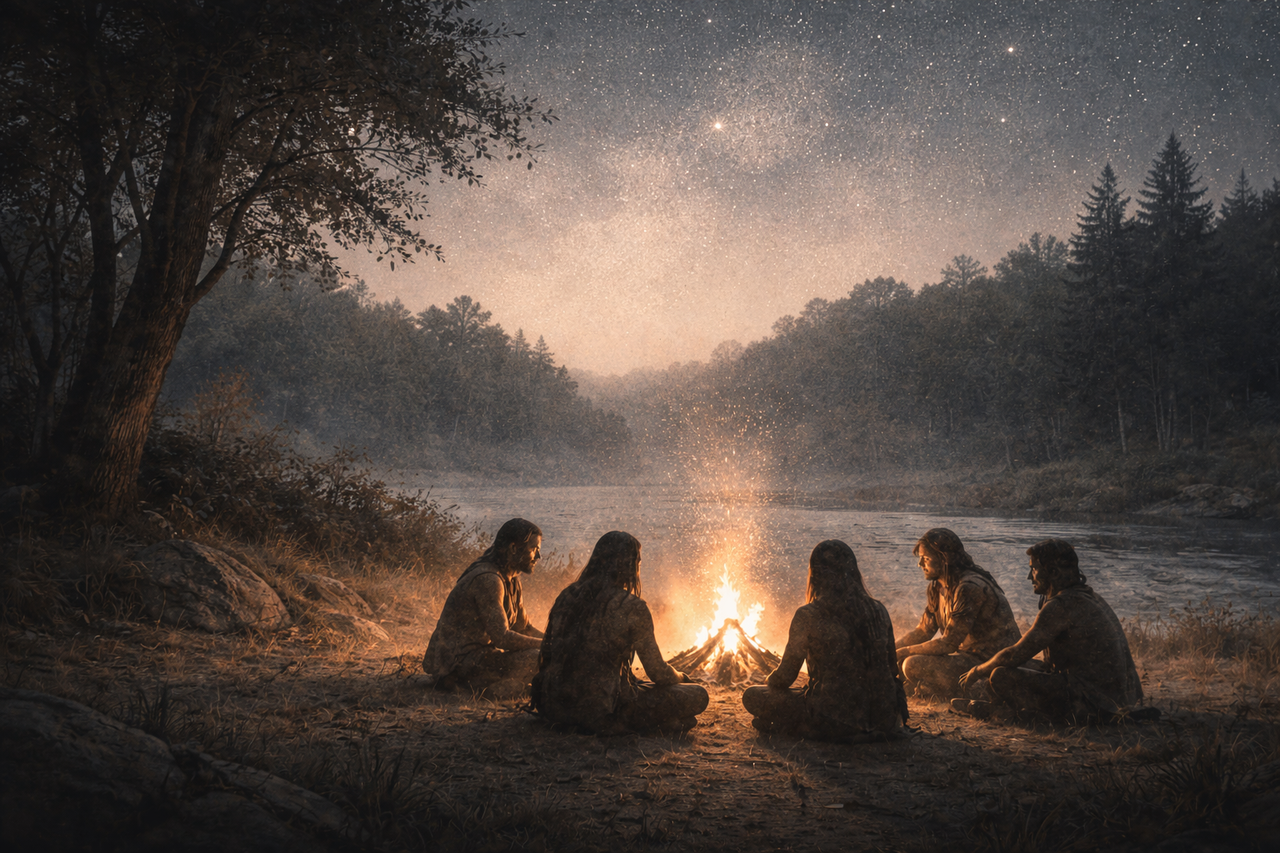
Long before flags, borders, states, or standing armies, humans lived in small groups bound by proximity and necessity. Survival was fragile. Food was uncertain. Injury could be fatal. Isolation meant death.
In that world, cooperation was not a moral ideal. It was a condition of survival.
No individual was strong enough to dominate indefinitely. No leader could rule by force alone without eventually being overwhelmed by coalition. Violence within the group weakened everyone who depended on collective action for defence, hunting, and resource gathering. A group that turned inward on itself, that consumed its energy in internal conflict, did not last long in competition with more cohesive neighbours.
Early belief systems emerged inside this reality. Not as commands from distant authorities, not as codified laws, but as shared understandings about how to live together without collapse. They were adaptive cultural technologies that helped small groups solve coordination problems that pure rationality could not easily address.
Before religion had armies, it had a different job. Before it commanded obedience through threat of violence, it facilitated cooperation through shared meaning.
It helped people restrain themselves when no external force could compel restraint.
Life before enforcement: the archaeology of small-scale societies
Early human communities, for the vast majority of our species' existence, had no police, no courts, no prisons, and no professional enforcers. Archaeological evidence from Palaeolithic and early Neolithic sites shows no indication of permanent authority structures standing above the group with monopoly on violence.
This is not romanticisation. It is what the material record reveals. Christopher Boehm's extensive cross-cultural study "Hierarchy in the Forest" (1999) examined 48 hunter-gatherer societies and found that the overwhelming majority were what he termed "reverse dominance hierarchies." Individuals who attempted to dominate were actively suppressed by coalitions of other group members. Leadership was situational, task-specific, and constrained by group consensus.
Control in these societies was social, not institutional. Order was maintained through reputation, memory, and social consequence rather than through codified law backed by force.
When someone acted violently without justification, stole resources, refused to share, or violated group norms, the response came from the collective itself. Trust was withdrawn. Cooperation stopped. Access to mates, to shared resources, to protection, all depended on maintaining standing within the group. In extreme cases of repeated violation, the person was excluded entirely.
Robin Dunbar's research on cognitive limits suggests that humans can maintain stable social relationships with roughly 150 people. Below this threshold, reputation tracking is possible. Everyone knows everyone. Behaviour is remembered. Patterns of reciprocity and defection are visible. Social regulation works because memory works.
In such contexts, belief did not need to be imposed from above. It was woven into the fabric of daily life, emerging from the practical requirements of cooperation.
Spiritual ideas at this stage did not arrive as rules carved in stone or delivered from mountaintops by prophets. The archaeological record from sites like Göbekli Tepe in Turkey, dating to approximately 9600 BCE, shows ritual spaces but no evidence of residential hierarchy or centralised authority. T-shaped pillars carved with animal reliefs suggest symbolic thinking and collective ritual practice, but the site predates agriculture, cities, and state formation by millennia.
What we can infer from such sites is that early humans engaged in symbolic behaviour, created shared ritual spaces, and invested collective labour in projects beyond immediate survival needs. But the organisation appears to have been communal rather than hierarchical.
The beliefs encoded in these early practices were not abstract philosophy divorced from practical life. They were survival logic expressed in symbolic form, memorable narratives that helped people remember what worked and what threatened group survival.
Do not take more than the land can sustain. Do not break the bonds of reciprocity that keep the group alive. Do not act as if you exist in isolation when survival depends on others. These were not presented as divine commands requiring obedience to authority. They were shared understandings about how to live without destroying the conditions of collective existence.
Why belief came before law: the functional origins of religion
Law requires enforcement. Enforcement requires power. Power requires hierarchy. Power must be maintained, defended, and reproduced across generations through institutions that outlast individual leaders.
Early small-scale societies had none of these in stable, permanent form. Leadership was fluid. Decisions were collective. Authority was earned through competence in specific domains and could be withdrawn if leaders overstepped.
Belief, however, requires only agreement. A shared story can guide behaviour without requiring enforcement infrastructure. A taboo can prevent harmful action without needing punishment. A ritual can reinforce social bonds without coercion.
This is not to claim that early belief systems were somehow "better" or more "authentic." It is to recognise their different functional context. Religion in small-scale societies served different purposes than religion in large-scale state societies, and understanding this difference is essential.
Émile Durkheim, in "The Elementary Forms of Religious Life" (1912), argued that religion's primary function in early societies was not explaining the natural world but creating social cohesion. Through shared ritual, shared symbols, and shared narratives, the group reinforced its collective identity and generated the emotional bonds necessary for cooperation.
Clifford Geertz, in "The Interpretation of Cultures" (1973), described religion as a cultural system that provides both a worldview (how things are) and an ethos (how one should act). In small-scale societies, these two functions were integrated. Stories about how the world works inherently carried implications for how to live within it.
This is why early spirituality relied heavily on myth, symbol, and metaphor rather than explicit instruction or codified law.
A story about ancestors punishing those who violate reciprocity norms teaches restraint more effectively than an abstract rule against hoarding. The story is memorable. It carries emotional weight. It can be told and retold, adapted to circumstances, whilst maintaining core meaning.
A myth about cosmic balance being disrupted by human excess explains ecological consequence in terms that resonate emotionally and stick in memory. It does not require understanding of complex systems. It translates consequence into narrative.
Stories encode cultural knowledge in forms that emotion can carry across generations. Facts are forgotten. Data degrades. But stories, especially stories linked to identity and meaning, endure. They are rehearsed in ritual, retold to children, embedded in social practice.
These early belief systems were not primarily concerned with factual accuracy in the modern empirical sense. They were concerned with social continuity, with keeping the group alive long enough for children to mature and knowledge to transfer.
Pascal Boyer's "Religion Explained" (2001) argues from cognitive science that religious ideas persist because they are minimally counterintuitive. They violate just enough expectations to be memorable whilst remaining plausible enough to transmit. A tree that watches you is more memorable than an ordinary tree, but not so bizarre that it becomes incredible.
Early belief was not about controlling physical reality through supernatural means. It was about navigating social reality through shared symbolic frameworks that made cooperation possible and predictable.
Nature as teacher, not property: animistic and reciprocal worldviews
In early spiritual frameworks, nature was not something to be conquered, owned, or dominated. It was observed, respected, and engaged with as an active participant in existence.
Archaeological evidence from burial sites, cave paintings, and material culture suggests that early humans understood themselves as embedded within nature rather than separate from or superior to it. The famous cave paintings at Lascaux, France (approximately 17,000 years old) and Chauvet, France (approximately 32,000 years old) depict animals with extraordinary detail and apparent reverence, suggesting relationships more complex than simple predation.
Graham Harvey's "Animism: Respecting the Living World" (2017) describes animistic worldviews, common in many indigenous societies, as understanding personhood as distributed throughout the living world. Trees, rivers, animals, and landscape features are not objects but subjects, possessing agency and deserving respect.
Fire was sacred not because people worshipped it abstractly but because it literally sustained life and could destroy it. Control of fire enabled cooking, warmth, protection from predators, and tool-making. Losing control meant death. The practical importance generated symbolic meaning.
Water was revered because communities depended on it absolutely. Too little meant death from thirst. Too much meant floods that destroyed settlements. The relationship was one of dependency and respect, not ownership.
Animals were respected because the relationship was complex. They provided food, materials for tools and clothing, but they also competed for resources and posed dangers. Successful hunting required understanding animal behaviour, which in cognitive terms means modelling animals as intentional agents with their own perspectives. This cognitive modelling easily generates attribution of spirit or personhood.
The sky governed seasons, weather patterns, and agricultural success. Observing celestial patterns allowed prediction of when to plant, when to harvest, when migrations would occur. The practical importance of astronomical knowledge in pre-industrial societies cannot be overstated, and this practical knowledge was typically encoded in mythological frameworks.
Meaning in these systems arose from relationship and reciprocity, not from domination or extraction. The anthropologist Philippe Descola, in "Beyond Nature and Culture" (2013), argues that the nature-culture divide that feels natural to modern Western thinking is actually a historical and cultural peculiarity. Many societies do not conceptualise such a division.
Nature in early spiritual frameworks was not moral in human terms. It did not care about human welfare. But it was instructive. It demonstrated consequences without explanation. Actions had results. Balance maintained survival. Excess brought disaster.
Early belief systems responded to these observed patterns by creating symbolic frameworks that made the patterns memorable and transmissible. Personification was not primitive confusion but effective pedagogy.
A storm is a meteorological event, easily forgotten in the absence of recording technology. An angry sky deity that must be respected is a mnemonic device, a way of encoding the importance of reading weather patterns and preparing accordingly.
This was not ignorance. It was practical knowledge encoded in memorable symbolic form, allowing transmission across generations without writing.
Shared patterns across independent origins: evolutionary convergence in religious ideas
Anthropological and archaeological research reveals something profound about early religious systems that is often misunderstood or misrepresented.
Cultures separated by vast oceans and thousands of years, with no possibility of contact or direct transmission, developed remarkably similar spiritual ideas and practices. This pattern appears repeatedly across the ethnographic and historical record.
Common elements include:
Reverence for ancestors and continuation of relationship with the dead, evidenced by burial practices that include grave goods, positioning of bodies, and ongoing ritual attention to burial sites.
Rituals marking significant life transitions, particularly birth, coming of age, marriage, and death. Every documented human society marks these transitions symbolically, though the specific forms vary enormously.
Taboos against internal violence and murder, nearly universal sanctions against killing members of one's own group except under specific justified circumstances.
Stories and moral frameworks warning against arrogance, excess, and violation of reciprocity norms. These appear in myths from Australian Aboriginal Dreamtime stories to Native American oral traditions to ancient Mesopotamian literature.
Symbolic emphasis on balance, reciprocity, and restraint. The concept of cosmic or social balance requiring human behaviour to maintain appears independently across unconnected cultures.
For religiously motivated readers, this pattern might seem to support the existence of a single divine source revealing truth across cultures. But the anthropological and evolutionary explanation is more parsimonious and better supported by evidence.
These similarities do not require a single supernatural origin. They require shared human constraints and shared evolutionary psychology.
Humans everywhere face the same fundamental existential and social problems. Death is universal and psychologically challenging. Scarcity requires cooperation and resource management. Internal conflict threatens group survival. Sexual jealousy and competition for mates create social tension. Cooperation requires mechanisms for detecting and punishing free-riders. Uncertainty about the future generates anxiety that must be managed.
Similar problems generate similar symbolic solutions, not because of divine revelation but because of convergent cultural evolution. Just as unrelated species in similar environments evolve similar physical adaptations, unrelated cultures facing similar challenges develop similar symbolic and social technologies.
Scott Atran's "In Gods We Trust" (2002) argues that religious ideas emerge from ordinary cognitive processes applied to extraordinary problems. Theory of mind, the capacity to understand others as intentional agents, extends naturally to attributing agency to natural phenomena when patterns appear non-random or meaningful. Causal reasoning seeks explanations for events, and in the absence of scientific frameworks, supernatural causation fills the explanatory gap.
Pascal Boyer's cognitive approach, mentioned earlier, emphasises that religious concepts are constrained by human psychology. Certain types of ideas are easier to remember, transmit, and believe. These include minimal violations of intuitive ontology (a person who can read minds, not a person who is simultaneously alive and dead and a rock), and concepts that activate emotional and social reasoning systems.
The cross-cultural similarity of religious ideas reflects shared human psychology more than divine monopoly on truth. This does not necessarily disprove theological claims, but it does mean that such similarity cannot serve as evidence for them. The pattern is exactly what we would expect from cultural evolution operating under universal psychological constraints.
Belief without exclusivity: religious pluralism in small-scale societies
One of the most significant differences between early spiritual systems and later institutionalised religions is the question of exclusivity and universal truth claims.
In small-scale societies, spiritual beliefs were typically local, flexible, and adaptive. There was no single orthodox truth that must be accepted universally. No universal doctrine that invalidated alternative understandings. No insistence that one group's spiritual interpretation rendered all others false or demonic.
Belief was understood as contextual rather than absolute. It belonged to a particular people, a particular place, a particular set of relationships. The idea that spiritual truth must be universal, applying to all humans everywhere regardless of context, is a later development associated with empire and state formation.
Karen Armstrong, in "The Great Transformation" (2006), traces how the Axial Age (roughly 800 to 200 BCE) saw the emergence of universal religions with claims to transcendent truth applicable to all humanity. But before this period, most religious systems were ethnic and local. They explained how this particular people should live in this particular place. They made no claims about what others should believe elsewhere.
Disagreement between groups about spiritual matters was not experienced as theological crisis requiring resolution through conversion or elimination. It was simply difference, no more threatening than the fact that different groups spoke different languages or wore different clothing.
Religion at this stage was not identity in the modern sense. It was orientation. A way of being in the world, interpreting experience, organising social life. You did not belong to a religion as a membership category exclusive of other possibilities. Belief belonged to life, integrated with kinship, ecology, subsistence practices, and social organisation.
The concept of heresy, of belief that is not just wrong but dangerous and requiring suppression, emerges only when religion becomes institutional and aligned with political power. In small-scale societies without such power structures, there was no mechanism or motivation for enforcing belief uniformity.
This is not to idealise these societies as perfectly tolerant or peaceful. Conflict between groups occurred, often violently. But the conflicts were typically over resources, territory, or specific grievances, not over abstract theological differences or the need to spread true belief.
The ethnographic record from anthropologists like Claude Lévi-Strauss, who studied indigenous societies in the Amazon, and from scholars of Native American religions, consistently shows respect for spiritual diversity and absence of proselytising impulse. Each people has its own stories, its own rituals, its own relationship with the sacred. These are not seen as competing claims about universal truth but as different paths appropriate to different peoples.
This religious pluralism was not a conscious philosophical position but a practical reality of decentralised societies without institutions capable of or interested in enforcing belief uniformity.
The moment scale changed everything: Dunbar's number and the transition to complexity
The transformation of religion from shared meaning to enforced doctrine did not happen arbitrarily. It followed structural changes in human societies driven by population growth, ecological pressures, and technological development.
As populations increased beyond the threshold where face-to-face accountability was possible, everything changed. Robin Dunbar's research suggests humans can maintain stable social relationships with approximately 150 people. This number emerges from the ratio of neocortex size to total brain volume and appears to be a genuine cognitive constraint.
Below this threshold, reputation-based social control works. Everyone knows everyone. Individual behaviour is visible to the group. Reciprocity is tracked through memory. Free-riding is detectable and punishable through social sanctions.
Above this threshold, different mechanisms become necessary. Memory alone cannot track everyone's behaviour. Reputation becomes harder to establish and maintain. Trust thins as networks become too complex for direct monitoring.
Jared Diamond, in "Guns, Germs, and Steel" (1997), describes how agricultural development allowed population density to increase dramatically. Sedentary agriculture produces food surpluses that can support specialists, people who do not directly produce food but provide other services. This creates occupational differentiation and the possibility of social hierarchy.
Archaeological evidence from sites like Çatalhöyük in Turkey (7500 to 5700 BCE) shows the transition from egalitarian to hierarchical social organisation. Early levels of occupation show relatively uniform housing without obvious elite quarters. Later levels show increasing differentiation in house size, burial goods, and apparent wealth concentration.
Hierarchy emerged not primarily because humans desired domination but because coordination at scale required structure. When thousands of people must cooperate, from irrigation management to defence, decision-making cannot remain purely consensus-based. It becomes too slow and cumbersome.
Leaders appeared, initially perhaps as coordinators of specific large-scale tasks. Over time, these leadership roles became more permanent, more powerful, and more heritable. Resources concentrated in leadership hands. Inequality followed.
And belief changed function fundamentally.
Stories that once helped small groups maintain cooperation became tools for organising large populations. Metaphor hardened into doctrine. Interpretation became instruction. Shared meaning became required belief.
Kent Flannery and Joyce Marcus, in "The Creation of Inequality" (2012), trace this process archaeologically through changes in burial practices, residential architecture, and iconography. Leaders increasingly claimed special relationships with supernatural forces, legitimising their authority through divine sanction rather than through competence alone.
Once belief became tied to political leadership, it became useful in entirely new ways. It could legitimise social hierarchy by claiming divine ordination. It could stabilise inequality by promising cosmic justice or afterlife rewards. It could justify obedience by framing leadership as intermediary between human and divine realms.
And eventually, it could justify violence against those who threatened the system or refused to accept its claims.
When belief met force: the emergence of religious coercion
The moment belief required enforcement through threat or violence, something fundamental shifted in the nature of religion itself.
A story that must be defended with weapons is no longer functioning primarily as shared meaning. A belief that must be obeyed under threat of punishment is no longer guidance but command. When questioning becomes dangerous, when dissent means exile or death, when interpretation is forbidden and replaced by required acceptance, religion has become something entirely different from its origins.
This transformation is visible in the archaeological and historical record. Early cities in Mesopotamia, developing from approximately 4000 BCE, show increasing evidence of centralised religious institutions aligned with political power. Temples become larger, more elaborate, and clearly associated with administrative functions. Priestly classes emerge as specialists controlling ritual knowledge.
The Code of Hammurabi, from approximately 1750 BCE in Babylon, represents one of the earliest written legal codes and explicitly links law to divine authority. The text begins with Hammurabi claiming that the gods chose him to bring justice to the land, framing legal authority as divine mandate.
This pattern repeats across early civilisations. Egyptian pharaohs claimed divine status or direct divine appointment. Chinese emperors held the Mandate of Heaven. Rulers in the Indus Valley, Mesoamerica, and elsewhere claimed special relationships with supernatural forces that legitimised their temporal power.
Religion did not become violent because spirituality is inherently authoritarian or aggressive. It became violent because it was institutionalised and aligned with state power that required enforcement mechanisms.
Armies did not arise from belief itself. Religious ideas about reciprocity, balance, and respect for forces beyond human control do not logically or necessarily lead to military conquest. Armies arose from the needs of states to expand territory, control populations, extract resources, and defend against rivals. Belief was then recruited by armies to provide moral legitimisation and to maintain soldier morale and civilian compliance.
The Crusades were not inevitable developments from Jesus's teachings about loving enemies and turning the other cheek. They required centuries of institutional development, alignment of church with state power, and specific political circumstances in medieval Europe. The violence came from political and economic interests that used religion as justification, not from the spiritual content itself.
Similarly, Islamic expansion in the centuries after Muhammad cannot be explained purely as religious imperative. It involved complex political, economic, and military factors related to state formation, resource competition, and power struggles among elite factions. Religion provided frameworks for understanding and justifying these processes, but it was not their sole or primary cause.
Once belief systems aligned with political power, questioning them became questioning the political order itself. Heresy was not just theological error but political rebellion. Enforcing belief uniformity became a tool of state control, ensuring population compliance with authority.
This is the critical turning point. And once crossed, it created a template that has persisted, in various forms, ever since.
The inversion of function: from restraint to control
When belief became law, backed by institutional force, its original social function inverted.
In small-scale societies, belief helped individuals restrain themselves when no external authority could compel restraint. It provided shared frameworks for cooperation that made coercion unnecessary. It generated meaning that made sacrifice for the group feel purposeful rather than imposed.
In large-scale hierarchical societies, belief became a tool for authorities to control populations. Instead of helping people regulate themselves, it was used to regulate them from above. Instead of emerging from shared experience, it was imposed by institutions claiming privileged access to truth.
Interpretation, which in earlier contexts was fluid and adaptive, was replaced by orthodoxy enforced by specialists. Religious authorities claimed monopoly on correct understanding, declaring alternative interpretations heretical and dangerous.
Shared meaning was replaced by required doctrine. What you believed became subject to external verification and punishment. Inner conviction became less important than outer conformity.
Moral reflection was replaced by obedience to codified rules. Instead of understanding principles and applying them contextually, people were expected to follow specific commands regardless of circumstance or consequence.
The original function of belief, helping humans live together cooperatively, was inverted. Belief now served power first, people second. It maintained hierarchies rather than preventing them. It justified inequality rather than constraining it. It enforced compliance rather than enabling voluntary cooperation.
Robert Bellah, in "Religion in Human Evolution" (2011), traces this transformation through what he calls "archaic religion" emerging with the first states. Unlike earlier "tribal religion" which was embedded in kinship and community life, archaic religion became specialised, hierarchical, and aligned with political power. Priests became intermediaries whose role was to maintain correct relationship between divine and human realms, a relationship that conveniently supported the existing political order.
This does not mean all religious institutions are purely cynical manipulations. Many religious leaders genuinely believe their teachings and seek to serve both spiritual and social goods. But the structural alignment with power creates systematic pressures toward control and away from liberation, toward uniformity and away from diversity, toward obedience and away from questioning.
Once belief marched with armies, once questioning meant risking death, once interpretation became heresy, religion could no longer function as it had in its earlier forms. It had become something new, something that required terms like "organised religion" or "institutional religion" to distinguish it from earlier practices.
What was lost in the transformation
The transformation from early belief systems to institutional religions involved genuine losses that are worth acknowledging, not from nostalgia but from understanding.
Loss of interpretive flexibility. In early systems, stories were adaptable. Elders and storytellers could modify narratives to address current circumstances whilst maintaining core meanings. Interpretation was distributed across the community. In institutional religions, interpretation became monopolised by specialists who declared their readings authoritative and alternatives heretical.
Loss of democratic participation. Early ritual practices involved the entire community. Everyone participated in ceremonies. Knowledge was widely shared. In institutional religions, specialisation created priesthoods that controlled ritual knowledge and mediated between believers and the sacred, creating dependency.
Loss of ecological integration. Early spiritual systems were embedded in local ecologies. They reflected specific relationships with particular landscapes, plants, animals, seasons. Institutional religions, especially those claiming universal truth, often divorced spiritual life from ecological context, making belief abstract rather than embedded.
Loss of reciprocity with the sacred. In animistic and reciprocal worldviews, relationships with supernatural forces were bilateral. Humans had obligations, but spirits and deities also had obligations. The relationship was negotiable. In later monotheistic systems, the power differential became absolute. Humans could only obey, never negotiate.
Loss of religious pluralism. The acceptance that different peoples might have different spiritual paths was replaced by claims of exclusive truth requiring universal acceptance. This generated centuries of religious conflict and persecution.
These losses were not total or uniform. Many religious traditions retained elements of earlier practices. Mystical branches of major religions often preserved interpretive flexibility and direct spiritual experience. Folk religious practices maintained local, ecological, and reciprocal elements despite official doctrine. Liberation theology and similar movements attempt to reclaim religion's role in restraining power rather than serving it.
But structurally, the alignment of religion with state power created systematic pressures toward control, uniformity, and enforcement. These pressures persist wherever religious institutions hold political power or seek to regain it.
The persistence of early patterns: why they matter
Despite millennia of institutional development, early religious patterns persist in ways that reveal their psychological and social power.
Even in modern contexts, people create informal spiritual communities that function more like early belief systems than like institutional religions. They seek direct experience rather than mediated doctrine. They value interpretive flexibility rather than orthodox uniformity. They build reciprocal relationships rather than hierarchical ones.
New religious movements often begin with early-pattern characteristics: egalitarian participation, direct spiritual experience, adaptive interpretation, resistance to hierarchy. Over time, if they grow and succeed, they typically develop institutional features: specialised leadership, codified doctrine, enforcement of belief. But the initial appeal comes from recapturing something of earlier forms.
The environmental movement often functions quasi-religiously, expressing values of reciprocity with nature, respect for ecological limits, and restraint in resource use. These are not coincidentally similar to early spiritual frameworks. They address similar problems with similar symbolic tools.
Secular ethics that emphasise cooperation, reciprocity, and collective flourishing draw on the same psychological and social mechanisms that early belief systems activated. The content is different, but the function is analogous: creating shared frameworks for living together without destroying one another.
Understanding early religious patterns matters because it reveals that certain human needs and capacities are relatively constant across time. The need for meaning, for community, for shared values that transcend individual interest, for ways of managing existential anxiety about death and uncertainty. These are not created by institutional religions. They are what early belief systems addressed, and what institutional religions then channelled and sometimes exploited.
Recognising this helps distinguish between human spiritual needs, which are real and legitimate, and particular institutional forms, which are contingent and often problematic. You can acknowledge the value of meaning-making whilst critiquing authoritarian control. You can respect people's needs for transcendence whilst opposing theocracy.
The fact that religion existed before it had armies reveals that armies are not essential to spirituality. They are additions made when religion aligned with power. And what was added can, in principle, be removed.
Modern implications: recognising the pattern
The transformation from early belief to institutional religion is not merely historical. The same pattern operates in modern contexts, and recognising it provides tools for analysis and resistance.
Whenever a belief system that begins with shared meaning and voluntary participation starts demanding enforcement, whenever interpretation becomes forbidden and orthodoxy required, whenever questioning becomes heresy, the pattern is repeating.
This happens in political movements that begin as liberation struggles but become authoritarian regimes. It happens in social movements that start with grassroots participation but become hierarchical organisations controlled by professional activists. It happens in corporate cultures that begin with genuine shared values but become compliance mechanisms serving executive interests.
The warning signs are consistent: increasing hierarchy, specialists claiming monopoly on correct interpretation, punishment of dissent, alignment with power, transformation from "this helps us live together" to "you must believe this or face consequences."
Understanding that belief once existed without coercion, that it served cooperation before it served control, provides a reference point for evaluation. Any claim that obedience, hierarchy, or enforcement is essential to religious or spiritual life can be measured against the fact that religion existed for thousands of years without these features.
This does not mean early forms were perfect or that we should attempt to recreate them. Small-scale egalitarian societies had their own problems and limitations. But it does mean that authoritarian forms are not inevitable or divinely mandated. They are historical developments driven by specific social conditions, and they can be questioned, resisted, and replaced.
The fact that religion did not begin with power means it does not require power to function. The fact that belief once guided voluntary cooperation means enforcement is an addition, not an essence. The fact that spirituality existed before it became institutionalised means institutional forms are not sacred or necessary.
This recognition is valuable for believers who want to reclaim liberating elements of their traditions from authoritarian institutional forms. It is valuable for secular people who want to understand why religious institutions behave as they do. It is valuable for anyone trying to build communities based on shared meaning without replicating patterns of domination.
The scholarly consensus: what we can know
It is important to acknowledge the limits of what we can know about early religious systems whilst also recognising what the evidence does support. We have no written records from pre-literate societies that extend back tens of thousands of years. What we know comes from archaeology, ethnography of contemporary small-scale societies, comparative analysis of religious systems, and increasingly from cognitive science and evolutionary psychology.
Archaeological evidence provides material remains: burial practices, ritual sites, symbolic artifacts, settlement patterns, artistic representations. The record is substantial and growing.
Burial sites from Qafzeh Cave in Israel, dating to approximately 100,000 years ago, show Neanderthals and early Homo sapiens burying their dead with apparent care, sometimes with grave goods. This suggests symbolic thinking about death and possibly afterlife beliefs, though the specific content of those beliefs remains unknown.
Cave paintings at Chauvet, France (32,000 years old), Lascaux, France (17,000 years old), and Altamira, Spain (14,000 to 20,000 years old) demonstrate sophisticated artistic ability and symbolic representation. The paintings predominantly feature animals, often in contexts suggesting ritual significance rather than simple decoration or instruction.
Göbekli Tepe in Turkey, dated to approximately 9600 BCE, represents perhaps the most significant archaeological find for understanding early religion. This massive ritual complex predates agriculture, predates permanent settlement, predates pottery. It required coordinated labour from hundreds of people over extended periods. The T-shaped pillars, carved with animal reliefs and abstract symbols, indicate complex symbolic systems and collective ritual practices. Importantly, there is no evidence of domestic structures or residential hierarchy at the site. People came to this place for ritual purposes, then returned to their dispersed communities.
Klaus Schmidt, the archaeologist who excavated Göbekli Tepe, argued that it fundamentally changes our understanding of the relationship between religion and civilisation. The standard narrative suggested that agriculture led to settlement, settlement led to cities, cities led to complex religion. Göbekli Tepe suggests instead that religion might have driven the transition to agriculture and settlement. People gathered for ritual, needed to feed themselves whilst there, began cultivating wild grains, gradually shifted toward sedentary agriculture.
Whether this specific causal sequence is correct remains debated. But Göbekli Tepe definitively demonstrates that complex symbolic systems and large-scale ritual sites emerged before state formation, before hierarchy, before writing. Religion in some form predates civilisation, not the reverse.
Ethnographic evidence from anthropological studies of contemporary hunter-gatherer and small-scale horticultural societies provides detailed information about how such societies function, though with important caveats. Contemporary small-scale societies have their own histories, have been influenced by contact with state societies, and cannot be treated as unchanged representatives of ancient humans.
Nevertheless, consistent patterns emerge. Christopher Boehm's analysis of 48 hunter-gatherer societies found that the overwhelming majority actively suppressed individual attempts at domination. Egalitarianism was maintained through coalitional action against would-be dominators, through ridicule and ostracism of those who claimed superiority, through distribution of meat and resources that prevented accumulation.
Marshall Sahlins, in "Stone Age Economics" (1972), challenged the notion that early humans lived in desperate poverty, constantly struggling for survival. His analysis of contemporary hunter-gatherers like the !Kung San suggests they often worked fewer hours than agricultural or industrial workers whilst maintaining adequate nutrition and substantial leisure time. This does not mean life was easy, but it was not the Hobbesian nightmare of constant violent competition that social contract theorists imagined.
Eleanor Leacock's work on egalitarian societies demonstrated that gender relations were often more equitable in hunter-gatherer contexts than in agricultural or state societies. This is not universal, and variation exists, but the archaeological record shows increasing gender inequality correlating with agriculture and state formation.
Religious practices in these societies are diverse but share certain features. Anthropologist Roy Rappaport, in "Ritual and Religion in the Making of Humanity" (1999), argued that ritual in small-scale societies serves multiple functions: regulating ecological relationships, maintaining social cohesion, transmitting cultural knowledge, managing anxiety about uncontrollable forces.
The shamanistic practices found across many hunter-gatherer societies involve specialists who enter altered states to communicate with spirit realms, heal illness, divine future events, or intercede with supernatural forces. But shamans in egalitarian contexts typically have no political power outside their spiritual domain. They cannot command obedience or accumulate wealth. Their authority is specific and limited.
Cognitive and evolutionary approaches to religion, developed over the past few decades, provide frameworks for understanding why humans universally develop religious ideas and practices. This work, drawing on cognitive science, evolutionary biology, and experimental psychology, identifies psychological mechanisms that generate religious thinking.
Deborah Kelemen's research on "promiscuous teleology" shows that children and many adults naturally interpret events as purposeful even when they occur through mindless physical processes. We see intentions where none exist. This cognitive bias makes supernatural explanations intuitively appealing.
Justin Barrett's work on "agent detection" demonstrates that humans are hypersensitive to detecting intentional agents in the environment. Better to mistake wind for a predator than to mistake a predator for wind. This tendency makes us prone to attributing agency to natural phenomena, a foundation for supernatural beliefs.
Paul Bloom's research on intuitive dualism shows that even young children naturally conceptualise minds and bodies as separate, making afterlife beliefs psychologically natural despite lack of evidence.
These mechanisms are not bugs in human cognition but adaptive features. They kept our ancestors alive in dangerous environments where false positives (seeing agents that were not there) were less costly than false negatives (missing agents that were there). As byproducts, they make humans universally prone to religious thinking.
Comparative religious studies reveal patterns across traditions that inform our understanding of early belief systems. Mircea Eliade's work on the "sacred and profane" identified consistent ways humans differentiate sacred space, time, and objects from ordinary experience. His analysis of myth, ritual, and symbol across cultures found recurring patterns: creation myths explaining origins, hero journeys describing transformation, sacred centres representing cosmic order.
Joseph Campbell's work on comparative mythology, whilst sometimes overstated, identified genuine cross-cultural patterns in mythological narratives. These patterns reflect shared human experiences and shared narrative structures more than they reflect literal historical accuracy or divine revelation.
What we can say with reasonable confidence, based on converging evidence from these multiple sources:
First, early human societies were predominantly small-scale and relatively egalitarian compared to later state societies. This is supported by archaeological evidence showing relatively uniform burial practices and housing, by ethnographic evidence from contemporary societies, and by theoretical models of how cooperation emerges and is maintained in small groups where reputation tracking is possible.
Second, symbolic behaviour, including ritual burial of the dead and creation of ceremonial sites, emerged very early in human history, certainly by 100,000 years ago and possibly earlier. This indicates that meaning-making and symbolic thought are ancient features of human cognition, not recent developments.
Third, cross-cultural patterns in religious ideas and practices exist and are substantial. They reflect shared human psychology, shared existential challenges, and convergent cultural evolution more than they reflect either pure cultural diffusion or single divine revelation.
Fourth, the emergence of agriculture, population growth, and increasing social complexity correlate reliably with the development of more hierarchical and institutionalised religious forms. The causal relationships are complex and bidirectional, but the correlation is clear.
Fifth, the alignment of religious institutions with political power transforms religion's social function from facilitating voluntary cooperation to enforcing compliance with authority. This is visible in the archaeological record, in historical texts, and in comparative studies of societies at different scales of organisation.
These conclusions represent genuine scholarly consensus based on extensive empirical research across multiple disciplines. They are not speculative reconstructions or ideological positions. They are as well-supported as any claims about human prehistory can be, given the necessary limitations of evidence.
They remain subject to revision as new evidence emerges, as analytical frameworks develop, and as interdisciplinary conversations continue. But they provide solid foundation for understanding how religion has functioned differently in different social contexts and how institutional forms represent specific historical developments rather than timeless essences.
The mechanisms of transformation: how religion changed function
Understanding that religion transformed from one thing to another raises the question: how did this transformation actually occur? What were the specific mechanisms that changed religion from shared meaning in small groups to enforced doctrine in large hierarchies?
Several interrelated processes drove the transformation, each reinforcing the others in what social scientists call positive feedback loops.
Population growth and the breakdown of reputation-based control. When groups grow beyond approximately 150 people, maintaining reputational knowledge of everyone becomes impossible. You cannot personally know everyone in a group of 1,000 or 10,000 people. This creates opportunities for free-riding, for defection from cooperative norms without immediate social consequence.
Symbolic markers of group membership become more important. You need ways to identify who is part of your community and who is not, who can be trusted to follow the rules and who might defect. Religious affiliation becomes one such marker. Shared beliefs, shared rituals, shared prohibitions signal group membership and commitment to cooperative norms.
But this creates pressure toward standardisation. If belief signals membership, then belief must be visible, verifiable, and uniform enough to function as a reliable signal. Interpretation must narrow. Orthopractic (correct practice) or Orthodox (correct belief) must be established and maintained.
Agricultural intensification and resource accumulation. Hunting and gathering in most environments does not allow substantial resource accumulation. Food spoils. Storage is limited. Mobility prevents hoarding. Inequality is constrained by these material realities.
Agriculture changes this fundamentally. Grain can be stored. Land can be owned. Surpluses can accumulate. Wealth becomes transferable across generations. Those who control more land, more tools, more stored grain gain advantages that compound over time.
This creates class differentiation. Elites emerge who control disproportionate resources. They need mechanisms to legitimise and maintain their position. Religion provides those mechanisms. Claims of divine favour, special relationships with gods, priestly mediation between human and supernatural realms, all serve to justify why some people have more than others.
Émile Durkheim noted that religion often makes the social order appear natural and inevitable, part of cosmic order rather than human construction. When wealth inequality is framed as divinely ordained or karmically justified, resistance becomes not just politically difficult but cosmically wrong.
Military competition and the need for cohesion under pressure. As societies grow, they come into conflict with neighbouring societies over territory and resources. Military success requires coordinating large numbers of people in dangerous activities where individual incentives (staying safe) conflict with group interests (fighting effectively).
Religion becomes a powerful tool for maintaining military cohesion. If soldiers believe they fight for sacred causes, that death in battle leads to paradise, that their gods support their side and condemn enemies, they fight more effectively. They overcome individual fear through transcendent meaning.
This is visible throughout history. Sacred warriors, holy wars, divine mandates for conquest, all use religious frameworks to motivate military action. The content varies enormously, but the function is consistent: religion generates cohesion and motivation for collective violence.
Once religion is mobilised for military purposes, it must become more rigid and uniform. Soldiers must share the same beliefs for the same motivational effects. Doubt undermines military effectiveness. Questioning must be suppressed. Obedience becomes sacred duty.
Literacy and textual standardisation. The development of writing transforms religion profoundly. Oral traditions are fluid, adaptive, varying in the telling. Written texts fix meaning, create canonical versions, enable standardisation across space and time.
The first writing systems emerged in Mesopotamia around 3200 BCE, in Egypt around 3100 BCE, in the Indus Valley around 2600 BCE, in China around 1200 BCE. These were not invented for religious purposes primarily but for accounting, administration, record-keeping. But once writing existed, it was quickly applied to religious content.
Sacred texts create new forms of authority. Priests who can read and interpret texts gain power over those who cannot. Texts can be declared divinely inspired, making their content unchallengeable. Interpretation becomes specialised, requiring training, creating professional religious classes.
Karen Armstrong notes that sacred texts in Judaism, Christianity, and Islam are all products of literate religious elites compiling, editing, and standardising oral traditions into fixed canonical forms. This process necessarily involved choices about what to include, what to exclude, how to resolve contradictions. These were human editorial decisions, but the resulting texts were then declared divinely authored and unchangeable.
The emergence of specialised priesthoods. In small-scale societies, religious functions are typically distributed. Elders tell stories. Shamans perform healings. Everyone participates in rituals. Knowledge is widely shared.
As societies grow and stratify, religious knowledge becomes specialised. Priests emerge as full-time specialists who control ritual knowledge, perform ceremonies, mediate between humans and gods. They do not produce food or goods but are supported by the surplus production of others.
This creates dependency. Ordinary people lose access to sacred knowledge and must rely on priests for rituals marking birth, marriage, death, for interventions with supernatural forces, for interpretation of divine will. Priests gain power through this monopoly on sacred knowledge and practice.
Moreover, priesthoods develop institutional interests distinct from the general population's wellbeing. They accumulate wealth, land, political influence. They become invested in maintaining the systems that privilege them. Religion becomes less about facilitating cooperation and more about maintaining priestly power and the hierarchies that support it.
Alliance with political rulers. The crucial transformation occurs when religious institutions align with political power. This can happen through various mechanisms: priests claiming political authority directly (theocracy), political rulers claiming divine sanction (divine kingship), or institutions developing complementary relationships where each legitimises the other (Christendom, Islamic caliphates).
Once this alignment occurs, religion acquires state backing. Questioning religious doctrine becomes sedition. Heresy becomes treason. Religious minorities become political threats. The state's coercive apparatus enforces religious conformity.
Simultaneously, political power gains religious legitimacy. Rebellion against unjust rulers becomes not just politically risky but spiritually condemned. Inequality is framed as divinely ordered. Obedience is sacred duty.
This alliance is extraordinarily powerful and self-reinforcing. Religious institutions gain wealth, land, political influence, and protection from persecution. Political rulers gain legitimacy, moral authority, and mechanisms for social control that require less direct coercion than pure force would demand.
Breaking such alliances requires enormous social upheaval, often violent revolution, or slow reformation over generations. The pattern, once established, persists tenaciously.
These mechanisms did not operate identically across all societies. The specific pathways varied based on ecology, technology, external pressures, cultural traditions. But the general pattern repeats: population growth, resource accumulation, military competition, literacy, specialisation, and political alliance transform religion from shared meaning facilitating cooperation into institutional doctrine enforcing hierarchy.
Understanding these mechanisms makes the transformation comprehensible as historical process rather than mysterious inevitability. It shows that authoritarian religion is not essential spirituality gone wrong through human sin but institutional development responding to specific social pressures.
And crucially, understanding the mechanisms suggests how they might be resisted or reversed. If religion changes function in response to social structure, then changing social structures could enable different forms of religious and spiritual practice. The transformation is not irreversible destiny but contingent history that could have gone differently and might still change.
Case studies: tracking the transformation across cultures
Examining specific historical examples reveals how the transformation from early belief to institutional religion occurred in different contexts, providing concrete evidence for the general patterns discussed above.
Mesopotamia: from local spirits to imperial gods. The archaeological record from Mesopotamia, spanning from approximately 10,000 BCE to the first millennium BCE, provides perhaps the clearest documentation of religion's transformation.
Early Neolithic settlements like Jarmo (7000 BCE) show evidence of ritual practices but no monumental religious architecture and no indication of specialised priesthoods. Religious practice appears integrated into domestic life.
By the Ubaid period (5000 to 4000 BCE), we see the first temple structures appearing. These are still relatively modest, but they represent the beginning of architectural differentiation between sacred and profane space.
The Uruk period (4000 to 3100 BCE) witnesses explosive growth in both city size and temple complexity. The White Temple at Uruk is a massive structure requiring enormous coordinated labour and substantial surplus to support the non-productive specialists who maintained it. Cuneiform writing emerges, initially for accounting temple goods and land holdings.
By the Early Dynastic period (2900 to 2350 BCE), temples are major economic institutions controlling vast land holdings, employing thousands, engaging in trade, and accumulating wealth. Priestly classes are clearly differentiated from general population. Kings claim divine sanction or divine descent.
The transformation is visible in religious content as well. Early Mesopotamian religion featured numerous local deities associated with specific places, natural features, and human activities. These were not organised into clear hierarchies. Different cities had different patron deities without clear supremacy.
As political power centralised, so did religious organisation. The creation epic Enuma Elish, probably composed during the Babylonian period (1800s BCE), establishes Marduk, patron deity of Babylon, as supreme over all other gods. This mirrors and legitimates Babylon's political supremacy. The myth explains that Marduk achieved supremacy through defeating chaos (Tiamat) and creating order, justifying hierarchical authority as cosmic necessity.
The Code of Hammurabi explicitly frames law as divine command transmitted through the king. This moves far beyond shared understandings emerging from community practice. It establishes top-down authority claiming supernatural mandate.
Egypt: from animism to state religion. Pre-dynastic Egypt (before 3100 BCE) shows evidence of local religious practices focused on animals and natural forces. Different regions venerated different animals: crocodiles, hippos, cats, bulls, birds. These appear to be local traditions without centralised organisation.
The unification of Egypt under the First Dynasty (approximately 3100 BCE) coincides with the emergence of national religious frameworks. The pharaoh becomes not just a ruler but a living god, identified with Horus in life and Osiris in death. This divine status provides ultimate legitimation for absolute power.
The construction of pyramids, beginning in the Third Dynasty (2686 to 2181 BCE), represents a staggering mobilisation of resources for religious purposes. The Great Pyramid of Khufu required perhaps 100,000 workers over 20 years. This is only possible in a highly stratified society where elites control sufficient surplus to support massive non-productive labour.
Egyptian religion became intimately tied to state power. Priests controlled enormous wealth and land. They legitimised pharaonic authority and were in turn supported by it. Challenges to religious orthodoxy were challenges to political order.
The Amarna period under Akhenaten (1353 to 1336 BCE) provides fascinating evidence of how religion and politics intertwined. Akhenaten attempted to replace traditional polytheism with monotheistic worship of Aten. This was not primarily theological preference but political strategy to break the power of the Amun priesthood which had become too powerful and independent. After his death, traditional religion was restored and Akhenaten condemned as heretic, demonstrating the political nature of religious conflict.
Ancient China: from ancestor veneration to Mandate of Heaven. Early Chinese religious practice, visible in Neolithic Yangshao culture (5000 to 3000 BCE) and Longshan culture (3000 to 1900 BCE), centred on ancestor veneration and natural forces. Archaeological evidence shows ritual vessels, burial practices indicating belief in afterlife, but no evidence of large temples or specialised priesthoods.
The Shang Dynasty (1600 to 1046 BCE) marks a transformation. Oracle bones provide evidence of elaborate divination practices controlled by specialists. Kings claimed privileged access to ancestors and supernatural powers. Di, a supreme deity, emerges at the top of a divine hierarchy mirroring and legitimating the earthly one.
The Zhou Dynasty (1046 to 256 BCE) developed the concept of the Mandate of Heaven, an explicitly political theology. The Mandate justified Zhou's overthrow of Shang by claiming that Heaven withdraws its mandate from corrupt or ineffective rulers and grants it to the virtuous. This legitimates rebellion against bad rulers whilst maintaining divine sanction for rightful authority.
Confucianism, emerging in the later Zhou period, represents an attempt to create ethical frameworks for governance whilst maintaining social hierarchy. Confucius himself was somewhat ambivalent about supernatural matters, focusing on proper ritual, social harmony, and virtuous behaviour. But Confucianism as it developed became deeply conservative, legitimating hierarchical authority through claims about natural order and cosmic harmony.
The transformation from early ancestor veneration to imperial state religion is clear. What began as family practices became tools for legitimating imperial power and maintaining social stratification.
Mesoamerica: independent development of the same pattern. The civilisations of Mesoamerica developed independently of Old World societies, providing crucial comparative evidence that the pattern is not culturally specific but emerges from similar social pressures.
Early agricultural societies in Mesoamerica show evidence of ceremonial centres but not the massive pyramids and temples of later periods. The Olmec civilisation (1500 to 400 BCE) begins building larger ceremonial complexes, but these are modest compared to what follows.
The Classic Maya period (250 to 900 CE) witnesses extraordinary elaboration of religious architecture and ritual. Pyramids at Tikal, Palenque, and Chichen Itza demonstrate enormous resource mobilisation. Priestly classes control sophisticated astronomical knowledge encoded in calendars that regulate both agricultural practice and ritual cycles.
Maya rulers claimed divine descent and portrayed themselves in art as communicating directly with gods. Bloodletting rituals, where rulers pierced their own bodies to offer blood to deities, demonstrated both piety and the special relationship between ruler and supernatural realm that ordinary people could not access.
Human sacrifice, practised on large scale particularly by the Aztecs (1300 to 1521 CE), represents the extremity to which state religion can develop. The Aztec claim that the sun required human blood to continue rising generated constant need for war captives to sacrifice, justifying military expansion as cosmic necessity. Religion becomes fully integrated with military conquest and social control.
The pattern is consistent with Old World developments despite independent origin. Religion begins integrated with community life, becomes increasingly elaborate as societies stratify, aligns with political power, and develops specialist priesthoods claiming monopoly on sacred knowledge.
The Axial Age: partial resistance and ultimate co-optation. Between approximately 800 and 200 BCE, multiple societies independently developed what philosopher Karl Jaspers termed "Axial Age" religious and philosophical movements: Zoroastrianism in Persia, Buddhism and Jainism in India, Confucianism and Taoism in China, philosophical schools in Greece, prophetic Judaism in Israel.
These movements shared some common features: emphasis on individual ethical responsibility, critique of ritual formalism, universalising tendencies moving beyond ethnic particularity, and often critical stances toward existing religious and political authorities.
The Buddha explicitly rejected the Brahmanical caste system and priestly authority, teaching that enlightenment comes through individual practice not through ritual or birth status. Early Buddhism was arguably a reformation movement attempting to return religion to facilitating liberation rather than maintaining hierarchy.
The Hebrew prophets in texts like Amos, Hosea, and Isaiah criticised both religious and political establishments, condemning empty ritual whilst poor suffered, demanding justice rather than sacrifice. This prophetic tradition challenged the alignment of religion with royal power.
Greek philosophers like Socrates questioned traditional religion and emphasised rational inquiry and ethical reasoning independent of divine command. His execution for impiety demonstrates how threatening such challenges were to establishments.
These Axial Age movements represent partial resistance to the pattern this chapter describes. They attempted to recover or reimagine religion as about individual transformation, social justice, and universal ethical principles rather than about maintaining hierarchy and legitimating power.
But crucially, most of these movements were eventually institutionalised, bureaucratised, and aligned with power. Buddhism, which began as a reform movement rejecting caste and ritual, developed monastic institutions that accumulated wealth and aligned with royal power across Asia. Confucianism became state ideology legitimating imperial authority. Judaism, despite prophetic critique, developed rabbinic institutions and eventually the modern state of Israel. Christianity, which began as a marginal Jewish sect preaching radical equality, became the state religion of Rome and developed all the institutional features it inherited.
The Axial Age shows that religious reform attempting to resist hierarchy and power alignment is possible and repeatedly emerges. But it also shows how difficult it is to maintain such resistance once movements grow and succeed. The pressures toward institutionalisation, toward alignment with power, toward developing priesthoods and orthodoxies, are systematic and powerful.
Contemporary parallels: recognising the pattern today
The transformation from shared meaning to enforced doctrine is not merely historical. The same pattern operates in modern contexts, often in secular guise, providing evidence that the mechanisms are about social structure and power dynamics rather than about religion specifically.
Political ideology functioning as religion. Modern political movements often replicate religious patterns despite secular content. Marxism-Leninism in the Soviet Union and Maoist thought in China functioned as state religions complete with sacred texts, orthodox interpretations, heresy trials (denunciation sessions, show trials), and enforcement of belief.
These systems began with genuine insight about exploitation and calls for liberation. Marx's analysis of capitalism contained substantial truth. But once institutionalised and aligned with state power, Marxism became dogma requiring enforcement. Questioning was not intellectual disagreement but counter-revolutionary activity requiring punishment.
The transformation parallels exactly what happened to early Christianity. A movement beginning with radical equality and critique of power became, once institutionalised, a tool for maintaining hierarchy and suppressing dissent.
Corporate culture as ersatz spirituality. Modern corporations increasingly use language and practices borrowed from religion: mission statements as creeds, company values as commandments, team-building retreats as revival meetings, devotion to brand as faith.
These begin innocuously as attempts to create shared purpose and meaning at work. But they often become enforcement mechanisms, where questioning company culture marks you as not a "culture fit," where cynicism about the mission is grounds for dismissal, where performance reviews evaluate not just work quality but attitudinal conformity.
The pattern is familiar: shared meaning hardens into required doctrine, interpretation becomes forbidden, questioning becomes betrayal, enforcement mechanisms punish deviation.
Social movements becoming authoritarian. Many social movements begin with grassroots participation, shared values emerging from lived experience, flexible tactics adapted to circumstances. As they grow and achieve success, they often develop institutional features: professional activist classes, orthodox positions that must be maintained, purges of those who deviate, alignment with political power.
The pattern repeats across the political spectrum. Conservative movements that begin as grassroots resistance to government overreach develop rigid orthodoxies about guns, abortion, and taxation. Progressive movements that begin as fights for liberation develop rigid speech codes and cancel culture policing thought.
The content differs dramatically. But the structure is the same: from shared meaning facilitating voluntary cooperation to enforced doctrine requiring compliance.
The persistence of early patterns in resistance movements. Despite these pressures toward institutionalisation and authoritarian forms, early patterns persist in movements that consciously resist hierarchy.
Quaker meetings, with their emphasis on direct experience, lack of clergy, consensus decision-making, and resistance to creed, maintain something of early religious form despite centuries of existence.
Anarchist and horizontalist movements explicitly reject hierarchy and seek to organise cooperation without enforcement. Their success is mixed and their scale limited, but their persistence demonstrates that alternatives to authoritarian forms remain possible.
Indigenous religious traditions that survived colonisation often maintain features of earlier religious forms: integration with ecology, lack of orthodoxy, resistance to centralised authority, emphasis on direct experience rather than mediated doctrine.
These examples prove that the transformation from early to institutional religion is not inevitable or irreversible. It is driven by specific social pressures that can be resisted through conscious effort and appropriate social structures.
Why this chapter matters: context for everything that follows
This chapter is not an argument for returning to pre-state existence or abandoning modern religious traditions. It is context for understanding how belief systems function differently in different social structures.
Understanding that religion existed before it was institutionalised and aligned with power reveals that the authoritarian and violent aspects of institutional religion are not intrinsic to spirituality or to human needs for meaning and transcendence. They are products of specific historical developments.
This context is essential for what follows in this book. When examining how belief systems enable violence, support oppression, or suppress questioning, it is important to recognise that these features are not inevitable or divinely mandated. They are institutional developments that serve power.
When believers defend their traditions by claiming that questioning or reform is impossible because beliefs are sacred and unchangeable, they are typically defending institutional forms developed to serve power, not spiritual truths revealed to early humans.
When secular critics attack religion as inherently authoritarian or violent, they are typically critiquing institutional forms rather than the human needs and capacities that generated early belief systems.
The distinction matters. It allows more precise analysis and more effective resistance. You can acknowledge the value of meaning-making, community, and transcendent purpose whilst opposing religious authoritarianism. You can respect spiritual seeking whilst critiquing religious institutions. You can understand why people need belief systems whilst questioning the specific forms those systems take.
Religion did not need armies to exist. It acquired them when authority needed legitimacy and control. This fact undermines claims that obedience to religious authority is divinely required. It reveals institutional enforcement as political choice, not spiritual necessity.
The next chapter examines in detail how this transformation occurred, how belief met power, and how meaning stopped being shared and started being enforced. That is where faith hardened into doctrine. That is where obedience replaced interpretation. That is where violence became normalised as defence of truth.
And once that line was crossed, once religion marched with armies, the pattern became difficult to break. It persists wherever religious institutions align with political power, wherever belief becomes grounds for exclusion or violence, wherever questioning is treated as betrayal.
But understanding that it was not always thus, that religion functioned differently in different contexts, provides hope that it could function differently again. Not by returning to an imagined past, but by consciously building communities based on shared meaning rather than enforced doctrine, on voluntary cooperation rather than hierarchical control, on interpretive flexibility rather than orthodox rigidity.
The fact that humans once created belief systems that helped them live together without coercion proves that such systems are possible. The task is creating modern forms that serve cooperation and meaning without enabling domination and violence.
That is the task this understanding makes possible.
End of Chapter 6