




April Dispatch 42 Articles · April 2026
April 2026 Edition
April 2026 Edition · The Meridian
April 2026 — War Economy Edition
The full April edition bringing together conflict systems, military spending, sanctions, maritime risk, resources, reconstruction and the structural economics of war.
The War Economy Briefing
Start Here · April 2026
The War Economy Briefing
Begin with the edition's central framework across arms, budgets, sanctions, logistics, resources, maritime disruption and information warfare.
The Ledger of Iron
Cover Story · War Economy
The Ledger of Iron: Machinery of Survival
A structural introduction to war as an economic system of budgets, logistics, contracts and industrial power.
A World of War, Money and Supply
Global Map · Conflict Systems
A World of War, Money and Supply
A strategic reading of today's war zones, showing how conflict, shipping routes and resource corridors now intersect.
The 21st-Century Military-Industrial System
Lead Analysis · Industry
The 21st-Century Military-Industrial System
How conflict has reasserted itself as a modern industrial system linking procurement, manufacturing, lobbying and state power.
The Rise of Global Military Spending
Military Spending · State Power
The Rise of Global Military Spending
Why defence expenditure has returned to the centre of industrial strategy, fiscal planning and geopolitical competition.
Who Pays for War?
Fiscal Architecture · War
Who Pays for War?
How conflict is financed through taxation, debt, deficits and the absorption of military cost into public budgets.
Ammunition, Drones and the New Economics of Warfare
Production · Battlefield Economics
Ammunition, Drones and the New Economics of Warfare
How drones, ammunition and cost asymmetries are reshaping the production logic of modern battlefields.
The Algorithmic Front
Technology · Defence
The Algorithmic Front: Big Tech's Defence Pivot
How major technology firms are moving deeper into defence systems, data infrastructure and dual-use capability.
Who Builds the Machinery of Modern War?
Arms Industry · Manufacturing
Who Builds the Machinery of Modern War?
A study of the firms and production chains that manufacture the material base of contemporary conflict.
The Global Arms Trade Network
Trade Networks · Arms
The Global Arms Trade Network
How weapons move through export channels, alliance systems and strategic client relationships across regions.
The Diplomacy-Arms Paradox
Diplomacy · Contradiction
The Diplomacy-Arms Paradox
How governments speak the language of peace while expanding defence exports and military procurement ties.
The Lobbying Ledger
Lobbying · Influence
The Lobbying Ledger
A ledger of influence linking contractors, public officials and the political structures that sustain military demand.
Sanctions and Financial Warfare
Sanctions · Financial Power
Sanctions and Financial Warfare
How sanctions operate as instruments of capital pressure, trade disruption and systemic coercion in the modern war economy.
Crypto, Black Markets and Shadow Financing
Shadow Systems · Finance
Crypto, Black Markets and Shadow Financing
How crypto channels, black markets and informal systems sustain conflict financing beyond official controls.
Insurance, Shipping and Maritime Risk
Shipping · Insurance
Insurance, Shipping and Maritime Risk
How maritime insecurity feeds freight costs, insurance repricing and the transmission of war into global trade.
Energy and War
Energy · Strategic Systems
Energy and War: The Fuel of Modern Conflict
How fuels, electricity systems and supply insecurity remain central to the economics and logistics of conflict.
Food Systems and Conflict
Food Systems · War
Food Systems and Conflict
How conflict transmits into food through fertiliser disruption, freight, fractured supply chains and public vulnerability.
The Water-Security Nexus
Water · Security
The Water-Security Nexus
Water scarcity and infrastructure vulnerability are increasingly merging into a single field of geopolitical pressure.
Strategic Minerals and Military Technology
Minerals · Military Technology
Strategic Minerals and Military Technology
How critical minerals and extraction zones now sit directly inside the architecture of modern defence capability.
Cyberwar and the Private Intelligence Market
Cyberwar · Private Intelligence
Cyberwar and the Private Intelligence Market
How surveillance software, private cyber capability and intelligence services are becoming central to the modern war economy.
Cognitive Warfare and Disinformation Economies
Disinformation · Influence
Cognitive Warfare and Disinformation Economies
An examination of influence operations, narrative engineering and the commercial structures behind cognitive conflict.
Reconstruction Capital
Reconstruction · Capital
Reconstruction Capital
Who finances rebuilding after war, under what conditions, and who owns the economy that emerges from the wreckage.
Debt, Development and Post-War Recovery
Sovereign Debt · Recovery
Debt, Development and Post-War Recovery
How debt restructurings determine whether recovery leads to genuine stability or prolonged economic constraint.
The Invisible Ruin
Governance · Fiscal Collapse
The Invisible Ruin
When war ends, the fiscal damage does not. How tax collapse, pension failure and corruption trap post-conflict societies in permanent fragility.
The Macroeconomics of War Spending
Research Essay · Military Spending
The Macroeconomics of War Spending
Defence budgets, inflation, debt expansion and the economics of mobilisation. The research frame beneath the edition's fiscal analysis.
The Global Arms Trade System
Research Essay · Arms Trade
The Global Arms Trade System
Regulation, procurement and the geopolitics of military exchange. A deeper analytical framework for the international order of arms flows.
The Invisible Ruin Research Essay
Research Essay · Post-Conflict Governance
The Invisible Ruin
Fiscal collapse, governance failure and the long cost of post-conflict societies. Why the war economy continues long after the shooting stops.
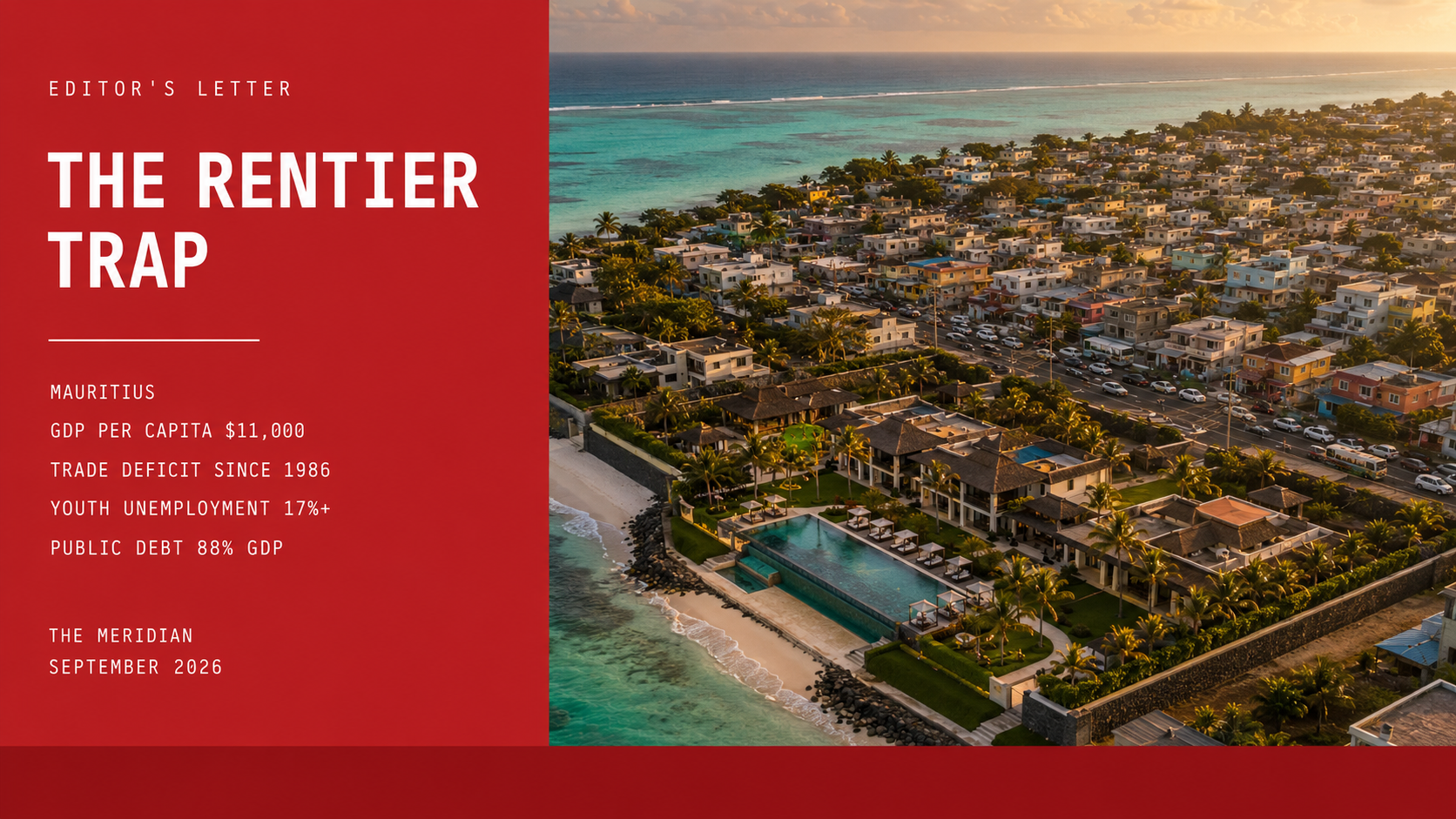
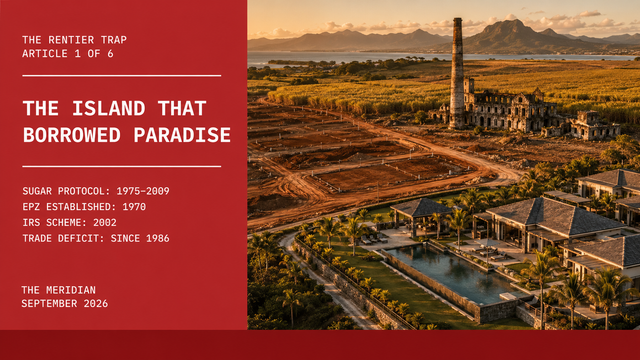
Dear Europe: The Mauritian Trap
April Dispatch · Mauritius
Dear Europe: The Mauritian Trap
An investigation into sugar, tuna, subsidy, energy dependence and the structural trap that leaves Mauritius exporting value while importing pressure.
A New Global Lockdown Is Coming. It Is Called the Energy Crisis
April Dispatch · Energy Crisis
A New Global Lockdown Is Coming. It Is Called the Energy Crisis
The next great constraint may not arrive through law, but through oil, freight, electricity, food and debt. What began as a chokepoint shock is turning into a system-wide economic squeeze.
Sugar Season Meets the Energy Crisis
April Dispatch · Mauritius Harvest
Sugar Season Meets the Energy Crisis
Mauritius is approaching cane harvest season under fuel stress, tighter public finances and rising operational costs that threaten the economics of cutting, transport and intervention.
The Basket Is Getting Heavier
April Dispatch · Cost of Living
The Basket Is Getting Heavier
Mauritian food prices may look modest in pounds, but they hurt far more relative to wages. A Meridian comparison of supermarket prices, UK benchmarks and the real cost of living.
Mauritians Do Not Reject Work. They Reject Work That Cannot Sustain Life
April Dispatch · Labour
Mauritians Do Not Reject Work. They Reject Work That Cannot Sustain Life
Mauritius does not face a simple labour shortage. It faces a deeper problem: too much work no longer offers wages, dignity or a viable life.
Mauritius Is Not Moving Forward
April Dispatch · Mauritius
Mauritius Is Not Moving Forward
A structural reading of a country caught in repetition, where political change is mistaken for economic progress and motion keeps replacing transformation.
The Room Costs What the Worker Earns in a Month
April Dispatch · Mauritius · New
The Room Costs What the Worker Earns in a Month. The Rupee Makes Sure That Never Changes.
A forensic investigation into the political architecture of Mauritian inequality. The hotel wage paradox, the weak rupee as transfer mechanism, the state subsidy that props up oligarchic margins, and the IMF prescription that would cut it.
Mauritius 2026 Pre-Budget Analysis: What Mauritius Truly Needs
Special Report · Mauritius 2026
Mauritius 2026 Pre-Budget Analysis: What Mauritius Truly Needs
A special report on Mauritius as a post-independence economy that diversified without fully securing command over its own terms of accumulation — examining sugar, tourism, textiles, offshore finance, the ocean economy, household stress, productive depth, budget dependence and political preservation.
The Anatomy of a Managed Decline
April Dispatch · Mauritius · New
The Anatomy of a Managed Decline
A structural reading of decline as management rather than rupture — how Mauritius absorbs pressure, preserves form and postpones transformation while the underlying model grows thinner.
Who Booked the Profit? The Mauritius Conglomerate Question
April Dispatch · Mauritius · New
Who Booked the Profit? The Mauritius Conglomerate Question
A structural investigation into profit, concentration and economic power in Mauritius — asking who captures the upside, how conglomerate dominance is sustained, and why the wider economy carries so much of the pressure.
Private Schools, Public Debt: The Mauritius Human Capital Trap
April Dispatch · Mauritius · New
Private Schools, Public Debt: The Mauritius Human Capital Trap
A structural analysis of education, inequality and state burden in Mauritius — how private schooling, weak human-capital formation and public finance strain have combined into a deeper social and economic trap.
One Rate for All? The Mauritius Foreign Exchange Question
April Dispatch · Mauritius · New
One Rate for All? The Mauritius Foreign Exchange Question
A structural examination of foreign exchange, price transmission and unequal access in Mauritius — asking whether one official rate can mask deeper distortions in who pays, who gains and how scarcity is managed.
A Minister Confirms It: The Private Sector Runs Mauritius
April Dispatch · Mauritius · New
A Minister Confirms It: The Private Sector Runs Mauritius
A structural reading of power in Mauritius through the minister’s own admission — examining how private capital, political dependency and economic concentration shape the real architecture of the state.
47 Years, 94% of the Vote, 52% in Poverty: The Sassou-Nguesso Record
April Dispatch · Congo-Brazzaville · New
47 Years, 94% of the Vote, 52% in Poverty: The Sassou-Nguesso Record
A forensic political-economic reading of Denis Sassou Nguesso’s long rule in Congo-Brazzaville, examining power, poverty, governance, electoral control and the structural consequences of political permanence.
1 / 42
THE STATE OF THE MIND
Human Intelligence Unit
Mind Economy
Indices · Human Intelligence · Fiscal Stress · Youth Opportunity · Public Priorities
Index Watch
HIIMalaysia 69.0 · Saudi Arabia 68.5 · India 65.2 · China 63.2 HPINigeria 10.00 · Ethiopia 9.38 · Indonesia 9.11 · China 8.71 YOSRussia 83.5 · China 78.8 · Pakistan 74.9 · Thailand 71.3 FSIChina 25.5 · Malaysia 30.6 · Philippines 35.3 · Bangladesh 37.6 mind economy indices · alternative economic intelligence · global south comparisons
Mind Economy · Special Data Page

Mind Economy Indices

The Mind Economy Indices provide an alternative reading of economic reality across the Global South. Rather than treating growth alone as proof of progress, they ask whether stability, social investment, youth transition and institutional quality are moving in the same direction.

The framework brings together four composite indicators: the Human Intelligence Index, the Human Priorities Index, the Fiscal Stress Index and the Youth Opportunity Score.

What the Measures Mean

A Simpler Reading of the Four Indices

The Mind Economy framework is built to read economies more like lived systems than abstract machines. Each measure captures a different part of the same question: whether development is producing stability, human priority, resilience and genuine opportunity rather than statistical growth alone.

Human Intelligence Index (HII)

HII asks whether macroeconomic performance is actually coherent. It brings together growth, inflation control, external balance and governance quality to test whether economic management is producing credible order rather than unstable expansion.

Human Priorities Index (HPI)

HPI asks what the budget appears to value. It compares education and health spending to military expenditure, offering a simple reading of whether the state is visibly prioritising human capability over coercive capacity.

Fiscal Stress Index (FSI)

FSI asks how exposed an economy is to pressure. It combines debt, fiscal deficits, external imbalances and reserve weakness into a single vulnerability measure. Unlike the others, lower scores indicate stronger resilience.

Youth Opportunity Score (YOS)

YOS asks whether the next generation can actually enter economic life. It focuses on the transition from schooling into work, measuring whether education systems and labour markets connect in a way that produces real opportunity.

Human Intelligence Index (HII)

A composite measure of macro stability and governance quality. Higher scores indicate stronger alignment between growth performance, inflation control, external balance and institutional effectiveness.

70 60 50 40 30 MYS SAU IND CHN IDN THA 69.0 68.5 65.2 63.2 62.7 62.1 Score
Top readings
🇲🇾 Malaysia
69.0
🇸🇦 Saudi Arabia
68.5
🇮🇳 India
65.2
🇨🇳 China
63.2
🇮🇩 Indonesia
62.7
This is the broadest index in the framework. It asks whether growth is accompanied by enough institutional order and macro discipline to feel credible rather than merely statistical.

Human Priorities Index (HPI)

A social-investment ratio measuring the relationship between education and health spending on one side, and military expenditure on the other. Higher scores imply a stronger formal emphasis on human capability.

10 8 6 4 2 NGA ETH IDN CHN THA VNM 10.00 9.38 9.11 8.71 8.47 8.03 Ratio
Top readings
🇳🇬 Nigeria
10.00
🇪🇹 Ethiopia
9.38
🇮🇩 Indonesia
9.11
🇨🇳 China
8.71
🇹🇭 Thailand
8.47
HPI is not a measure of service quality. It is a sharper question about formal priorities: how much of the budget is visibly tilted toward human capability rather than force.

Fiscal Stress Index (FSI)

A measure of fiscal vulnerability built from debt levels, fiscal balances, reserve cover and external pressures. Lower scores indicate stronger resilience and lower macro-funding stress.

25 35 45 55 65 CHN MYS PHL BGD MEX RUS 25.5 30.6 35.3 37.6 40.0 40.9 Lower is better
Lowest stress
🇨🇳 China
25.5
🇲🇾 Malaysia
30.6
🇵🇭 Philippines
35.3
🇧🇩 Bangladesh
37.6
🇲🇽 Mexico
40.0
Unlike the other indices, lower values are better here. FSI asks how easily an economy could come under pressure if funding conditions or external balances deteriorate.

Youth Opportunity Score (YOS)

A measure of whether education systems and labour markets connect successfully. Higher scores indicate stronger youth absorption into work and lower friction between schooling and employment.

85 75 65 55 45 RUS CHN PAK THA IDN MEX 83.5 78.8 74.9 71.3 70.5 70.2 Score
Top readings
🇷🇺 Russia
83.5
🇨🇳 China
78.8
🇵🇰 Pakistan
74.9
🇹🇭 Thailand
71.3
🇮🇩 Indonesia
70.5
YOS is among the most socially revealing measures in the framework because it tests whether the next generation is actually being integrated into economic life.
Regional Comparison

How the Regions Compare

The regional averages show that the Mind Economy framework is not measuring one thing only. Asia leads on broad macro coherence and youth opportunity, Africa scores more strongly on formal social priority, while Latin America and the Middle East present more mixed combinations of fiscal strain, institutional quality and human outcomes.

Asia

HII
60.6
HPI
6.63
FSI
44.1
YOS
66.2
The strongest overall profile in the sample, combining better macro coherence with stronger youth transition outcomes.

Africa

HII
48.2
HPI
7.72
FSI
57.5
YOS
35.6
Budgets often show stronger formal social priority, but fiscal pressure and weak youth absorption remain major structural constraints.

Latin America

HII
51.6
HPI
6.35
FSI
57.5
YOS
65.3
A mixed regional picture: stronger youth scores than Africa, but fiscal stress remains relatively elevated across the group.

Middle East

HII
49.8
HPI
4.70
FSI
53.9
YOS
56.6
Moderate macro readings and mid-range youth outcomes, but a lower social-priority ratio than the Asian and African averages.
Reading guide
Higher is better for HII, HPI and YOS
Lower is better for FSI
FSI rail is inverted so stronger resilience appears longer
Full Comparison

Complete Country Rankings

The table below brings the four measures together in one place. It should not be read as a final verdict on any economy, but as a structured comparison of how macro credibility, fiscal pressure, public priorities and youth transition interact across the current sample.

Economy HII HPI FSI YOS
🇲🇾 Malaysia69.05.0030.667.6
🇸🇦 Saudi Arabia68.52.7254.857.2
🇮🇳 India65.22.4360.566.1
🇨🇳 China63.28.7125.578.8
🇮🇩 Indonesia62.79.1152.870.5
🇹🇭 Thailand62.18.4753.071.3
🇧🇷 Brazil61.87.2671.761.8
🇰🇪 Kenya61.16.0149.759.5
🇷🇺 Russia59.93.1440.983.5
🇧🇩 Bangladesh58.96.3237.663.8
🇿🇦 South Africa58.85.9468.433.4
🇵🇭 Philippines57.16.5035.344.3
🇻🇳 Vietnam56.88.0346.858.6
🇪🇹 Ethiopia51.49.3854.821.4
🇵🇰 Pakistan50.55.1355.274.9
🇲🇽 Mexico48.57.8440.070.2
🇦🇷 Argentina44.63.9460.863.9
🇪🇬 Egypt36.57.2951.928.4
🇳🇬 Nigeria33.210.0062.535.6
🇹🇷 Turkey31.26.6853.056.1
Rankings combine four different dimensions and should be read comparatively rather than morally. Some economies score strongly on macro order but weakly on social priorities; others show the reverse.
Technical Notes

Data Boundaries and Interpretation

The framework is built from open, comparable annual data rather than proprietary modelling. It is designed to clarify patterns, not erase complexity. These scores should therefore be read as structured signals within a broader editorial architecture.

Sources

Built from open-source datasets, including IMF World Economic Outlook, World Bank indicators, ILOSTAT, UNESCO and governance-quality series.

Benchmark Year

The current release is anchored to the latest broadly comparable annual data set for 2024 across the covered economies.

Interpretation

The indices simplify complex realities. They should be read alongside country analysis, political context and distributional evidence, not as substitutes for them.