As I See It
Vayu Putra
Chapter 4
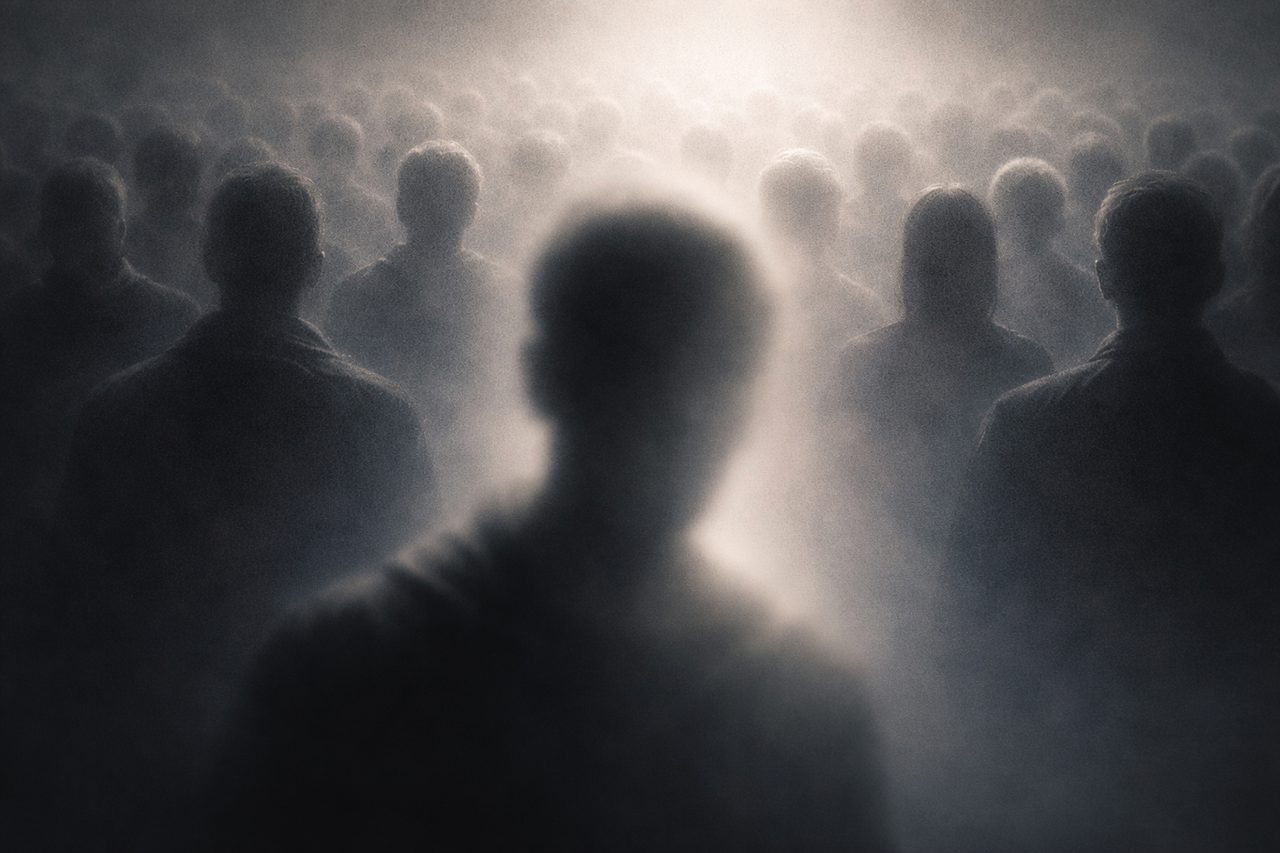
The Individual Disappears in the Crowd
An individual can think.
A crowd reacts.
This difference is not poetic. It is structural. Something fundamental changes when people move from being alone to being part of a group. Not gradually. Not subtly. Abruptly. The transformation is measurable in brain activity, observable in behaviour, and predictable in its consequences.
The same person who is cautious, reflective, and morally conflicted when alone can become loud, certain, and cruel when absorbed into a crowd. The same individual who carefully weighs decisions in private can act with frightening immediacy when surrounded by others moving in the same direction.
This is not because crowds reveal a hidden "true self." There is no secret monster lurking beneath civilised behaviour waiting for permission to emerge. The truth is simultaneously more mundane and more disturbing.
Crowds change how responsibility, fear, and identity are processed by the brain. They alter the fundamental calculations the survival brain makes about safety, belonging, and action. The individual does not become someone else. They become less of an individual entirely.
To understand crowds, we have to let go of the comforting idea that intelligence protects us. It does not. Education does not. Morality does not. Strong character does not. Under the right conditions, with the right emotional triggers and social dynamics, almost anyone can disappear into a group and do things they would later struggle to explain or justify.
History is full of this pattern. Ordinary people participating in extraordinary cruelty. Educated populations embracing obvious lies. Moral individuals excusing horrific violence. The pattern repeats across cultures, across centuries, across ideologies.
But history is not the only evidence. Everyday life shows the same mechanism at smaller scales. Sports crowds becoming violent over games that matter very little. Online mobs destroying reputations over minor transgressions. Political rallies where reasonable people chant slogans they would never defend in conversation.
The crowd is not an aberration. It is a reliable feature of human psychology. And understanding it is essential for understanding almost everything that follows.
What a crowd actually is
A crowd is not just many people occupying the same physical space. A shopping centre is full of people, but it is not a crowd in the psychological sense. A queue at the post office contains individuals waiting together, but they have not become a collective entity.
A crowd is a psychological state that emerges when certain conditions align.
When individuals gather with shared emotion, shared attention, and shared identity, something new forms. Not just a collection of separate minds, but a kind of distributed nervous system where individual consciousness begins to blur into collective experience.
The individual brain, which normally operates as a discrete unit processing its own perceptions and making its own decisions, starts synchronising with the brains around it. Emotional states spread through mechanisms that bypass conscious thought. Behaviour becomes contagious in ways that feel natural in the moment but seem inexplicable in retrospect.
Responsibility, which normally sits clearly on individual shoulders, begins to diffuse across the group. The sense of being the sole agent of your actions weakens. The boundaries between self and others become less defined.
The brain quietly shifts its primary question from an individual frame to a collective one.
Alone, it asks: What do I think about this? What should I do? What are the consequences for me?
In a crowd, it asks: What are we doing? Where is the group moving? What does belonging require?
That shift, subtle as it seems, changes everything. Because once the question becomes collective, the answer stops being individual. Agency migrates from the person to the group. And with that migration, something essential is lost.
The individual capacity for independent judgement, for moral reasoning that might contradict the group, for behaviour that deviates from collective momentum, all of this becomes exponentially harder to access. Not impossible, but harder. And under emotional pressure, most people follow the path of least resistance.
Which in a crowd, means following the crowd.
The loss of individual responsibility
Responsibility feels heavy when it sits entirely on one person. The weight of consequence, the burden of choice, the moral implications of action, all concentrate on a single consciousness that must carry them.
In a crowd, that weight distributes. It does not disappear, but it becomes lighter for each individual as it spreads across many. And when something becomes lighter, it becomes easier to carry. Easier to ignore. Easier to justify.
This is not a conscious process of moral evasion. Most people in crowds do not explicitly think "I can do this because responsibility is shared." The adjustment happens below awareness, in the automatic calculations the brain makes about safety, identity, and consequence.
The logic becomes subtle and psychologically seductive: if everyone is doing it, it cannot be entirely my fault. If the group has decided, then the decision is not mine alone. If we are all moving together, then individual deviation feels like betrayal rather than conscience.
This diffusion of responsibility has been studied extensively. In one classic series of experiments, researchers found that people were far less likely to help someone in distress when others were present. Not because crowds make people cruel, but because the presence of others creates automatic assumption that someone else will act. Responsibility diffuses across all potential helpers, and the result is that often no one helps at all.
The same mechanism operates in reverse for harmful actions. When many people participate in violence, destruction, or cruelty, each individual experiences a reduced sense of personal culpability. The action belongs to the group. The individual is just one participant among many. Their contribution feels small, their agency diminished, their responsibility diluted.
This is why crowds shout things individuals would never say in their own voice. Why groups destroy property that no single member would damage alone. Why violence feels easier, more justified, more inevitable when it is collective rather than individual.
The responsibility does not vanish. The harm still occurs. The consequences are still real. But from inside the crowd, from within the psychological state of collective identity, responsibility feels distant. Manageable. Almost optional.
And diluted responsibility, experienced psychologically as reduced culpability, functions emotionally as permission. Not explicit permission. Not permission anyone would articulate if asked directly. But implicit permission that emerges from the structure of the situation itself.
The crowd says, through its momentum and its numbers: this is what we are doing. And for most individuals, most of the time, that is enough.
Anonymity and moral loosening
Crowds provide a form of anonymity even when every face is visible and every person is theoretically identifiable.
When you are surrounded by others acting the same way, moving in the same direction, expressing the same emotions, you no longer feel uniquely identifiable as an individual. You become one instance of a pattern. One member of a category. One part of a mass.
The public face, which we explored in the previous chapter, loses much of its function in this context. That carefully maintained social persona exists to protect individual reputation, to manage how you are perceived as a distinct person with a specific identity. But in a crowd, individual identity recedes. You are not John or Sarah or whoever you are when alone. You are "one of the protesters" or "one of the fans" or "one of the believers."
Reputation, which normally constrains behaviour through the threat of social consequence, matters less when individual actions blur into collective behaviour. If everyone is chanting, who specifically is responsible for the content of the chant? If everyone is moving toward confrontation, who individually chose to escalate?
The brain's moral braking system, which normally activates when considering actions that might damage your reputation or social standing, relaxes its grip. The usual calculations about consequence become less salient. The mechanisms that normally create hesitation, that generate the gap between impulse and action where moral reasoning occurs, become less effective.
This is why crowds can move so quickly from peaceful assembly to destructive action. Why online crowds, where anonymity is even more complete, behave with such extraordinary viciousness. Without clear individual accountability, without the social feedback mechanisms that normally regulate behaviour, conduct drifts toward extremes.
Not because people are secretly evil, waiting for permission to reveal their true nature. But because moral restraint is largely social, not intrinsic. It depends on observation, on consequence, on the sense that you will be held accountable as an individual for what you do.
Remove observation, remove consequence, remove individuality, and what remains is not some essential self freed from social constraint. What remains is behaviour regulated primarily by emotion and group dynamics rather than individual moral reasoning.
The inner face, which in private might harbour unacceptable thoughts but rarely acts on them because of social consequence, gains influence in the crowd. Not because the crowd approves of those thoughts explicitly, but because the crowd removes the barriers that normally prevent thought from becoming action.
Emotion spreads faster than reason
Human beings are exquisitely designed for emotional contagion. This is not a flaw. It is a feature that served our ancestors well. In dangerous environments, if one member of the group detects threat and responds with fear, everyone else needs to respond immediately. There is no time for committee discussion about whether the rustling in the grass is actually a predator. The capacity to sync emotional states rapidly across a group increased survival.
But this same capacity creates profound vulnerability in modern social contexts, particularly in crowds.
Emotion spreads through groups with extraordinary speed. Fear, anger, excitement, outrage, all of these move through crowds faster than any rational assessment could travel. You see it in faces. You hear it in voices. You feel it in your own body as your nervous system automatically mirrors the states of those around you.
Facial expressions trigger matching expressions. Tone of voice influences tone of voice. Posture and movement synchronise. Heart rates begin to align. Breathing patterns converge. These are not conscious choices. They are automatic responses built into the social brain.
The crowd begins to feel, quite literally, like a single organism. Not metaphorically. The individual nervous systems are entraining to each other, creating patterns of coordinated physiological response that generate the subjective experience of unity.
Reasoning, by contrast, requires the slower, more energy-hungry parts of the brain. The prefrontal cortex, responsible for deliberation, analysis, and moral reasoning, needs time and cognitive resources to function. It thrives in calm, benefits from reflection, and produces better outputs when emotional arousal is moderate.
But in crowds, emotional arousal is rarely moderate. It tends toward extremes. And when emotion is high, the prefrontal cortex becomes less active. The brain shifts resources toward faster, older systems designed for immediate response rather than careful thought.
In crowds, this creates a dynamic where speed wins. The fastest emotional signal spreads most effectively. The most intense feeling generates the strongest response. Calm, nuance, uncertainty, all the cognitive states that support rational discourse, struggle to gain traction.
This is why crowds escalate rather than moderate. Why panic spreads but calm rarely does. Why rage amplifies but reflection does not. Why certainty propagates whilst doubt remains isolated.
A single spark can ignite thousands not because crowds are particularly flammable, but because the crowd is already primed for ignition. Individual brains have already shifted into a state where emotional contagion is maximised and rational evaluation is minimised. The crowd is waiting, neurologically, for a signal about what to feel and how to act.
When that signal comes, it spreads like a wave. And once the wave is moving, individual resistance becomes almost impossible. To stand against the emotional momentum of the crowd requires cognitive resources that are already depleted. It requires asserting individual judgement when collective identity has already taken precedence. It requires social courage that few people can muster in the moment.
So the emotion spreads. The crowd reacts. And individuals go along, not because they have carefully considered the response and judged it appropriate, but because going along is the path of least resistance when you are already neurologically entrained to the group.
Gustave Le Bon and the early insight
In 1895, French social psychologist Gustave Le Bon published "The Crowd: A Study of the Popular Mind." His observations, made over a century ago, remain disturbingly relevant.
Le Bon noticed something that contradicted the prevailing assumptions of his time: intelligent individuals did not make intelligent crowds. In fact, the opposite often occurred. When educated, rational, morally upstanding individuals gathered into crowds, they frequently behaved with startling foolishness, impulsivity, and cruelty.
His language reflected his era and contained prejudices we would now reject. But beneath the period-specific framing, his core insight remains true: when people enter a crowd, they do not add their individual intelligence together to create collective wisdom. They subtract it. They lose access to the faculties that make them capable of careful thought when alone.
Modern psychology has refined this observation with more precise language and better experimental evidence. We now understand some of the mechanisms. We can measure the decreased activity in the prefrontal cortex. We can track the spread of emotion through groups. We can predict with reasonable accuracy when crowds will behave rationally and when they will not.
But the fundamental pattern Le Bon identified holds: crowds do not think well. They feel intensely and act impulsively, but they do not engage in the kind of careful reasoning that produces good decisions about complex problems.
The individual brain, when functioning optimally, balances emotion with reason, impulse with restraint, certainty with doubt. It checks assumptions, considers alternatives, weighs consequences.
The crowd abandons most of this. Not because crowd members are stupid, but because the crowd state itself is incompatible with the cognitive processes that support good thinking. The social and emotional dynamics that make crowds powerful are the same dynamics that make them poor at reasoning.
The crowd does not think. It feels. It moves. It acts. But it does not think in any way that resembles careful individual cognition.
And this creates a fundamental vulnerability. Because systems, ideologies, and leaders who understand this can exploit it. They can move crowds in directions that individual members would resist if they were thinking clearly. They can generate behaviours that contradict the stated values of every person in the group.
Not through superior argument. Not through evidence. But through emotional manipulation of the crowd state itself.
"We" replaces "I"
Language is not just communication. It structures thought. And in crowds, language shifts in a way that fundamentally alters how people conceive of their own agency.
Individuals in crowds stop speaking as individuals. They begin speaking as representatives of a collective. The pronouns change, and with them, the entire frame of reference.
"We are angry." Not "I am angry because of specific reasons I can articulate." But "we," as if the anger belongs to the group itself rather than to individuals who might have different reasons for different feelings.
"We are under attack." Not "I perceive a threat and am evaluating how to respond." But "we," which assumes shared perception, shared identity, and shared response.
"We must act." Not "I should consider what action, if any, makes sense given my values and the likely consequences." But "we," which implies that action is collective, predetermined, and necessary.
This linguistic shift is not trivial. When you speak as "we," you are implicitly accepting that your individual perspective has been subsumed into something larger. Your agency becomes the group's agency. Your judgement becomes the group's judgement.
And with this shift comes a profound change in accountability. Actions taken as "we" do not sit on individual conscience in the same way as actions taken as "I." When "we" destroy property, "I" am just part of the collective action. When "we" attack opponents, "I" am defending our group. When "we" make demands, "I" am expressing our shared will.
The individual becomes grammatically invisible. And what is grammatically invisible tends to become psychologically invisible as well. Personal responsibility dissolves into collective momentum.
This matters enormously for moral reasoning. When asked later to justify behaviour, crowd participants often struggle. Not because they are being dishonest, but because they genuinely did not experience the actions as fully theirs. The actions belonged to "we." The individual was just part of the movement.
Once identity is absorbed into the group, dissent becomes not just difficult but almost unthinkable. To question the group is to question your own identity. To resist the group's direction is to betray the collective you have merged with.
Silence becomes safer than resistance. Going along becomes easier than standing apart. And the crowd continues moving, powered by individuals who experience themselves as not quite individuals anymore.
The shift from "I" to "we" is the linguistic marker of identity dissolution. And identity dissolution is the psychological precondition for crowd behaviour that individuals would never choose alone.
Intelligence does not protect you
One of the most persistent and comforting myths about crowd behaviour is that it only affects "those people." The uneducated. The irrational. The morally weak. The implication being that intelligent, educated, morally grounded individuals are somehow immune.
This is false. And believing it makes you more vulnerable, not less.
Highly intelligent people are not immune to crowd psychology. In some ways, they may be more vulnerable, because intelligence provides better tools for rationalisation after the fact. The intelligent person who acts on crowd emotion can construct elaborate justifications for behaviour that was never rational to begin with.
They can explain why the violence was necessary. Why the cruelty was justified. Why the moral compromise was unavoidable. They can build sophisticated arguments that make impulsive crowd behaviour seem like considered choice.
This is not conscious dishonesty. It is what brains do. They create narratives that make behaviour coherent with self-image. And intelligent brains are particularly good at this. They have larger vocabularies, more complex frameworks, better access to historical analogies and philosophical concepts.
But none of this changes the fact that the behaviour originated in crowd emotion, not in individual reasoning. The intelligence is being deployed in service of justification, not analysis.
Education increases knowledge and vocabulary. It does not fundamentally alter the social wiring of the brain. It does not eliminate the capacity for emotional contagion. It does not prevent identity from dissolving into group identity under the right conditions.
This is why doctors have participated in medical experiments that violated basic ethics. Why engineers have built weapons they knew would cause mass suffering. Why academics have supported ideological purges that destroyed careers and lives. Why professionals across every field have, at various points in history, gone along with crowd movements that contradicted their stated values.
The mechanism is not intellectual. It is social and emotional. And social-emotional mechanisms operate in every human brain, regardless of IQ, regardless of education, regardless of moral commitment.
What intelligence can do, if deployed intentionally, is create awareness of the mechanism. It can help you recognise when you are being pulled into crowd dynamics. It can give you frameworks for understanding what is happening to your own psychology in the moment.
But recognition and resistance are different things. Knowing you are being influenced by a crowd does not automatically give you the strength to resist that influence. Especially when resistance means social isolation, when it means standing against people you identify with, when it means questioning beliefs that have become part of how you understand yourself.
Intelligence does not protect you from crowds. But awareness might. If you understand how crowds work, if you recognise the signs in yourself, if you have practised the uncomfortable work of maintaining individual judgement when group pressure pushes toward conformity, then you have some defence.
Not immunity. But defence. Which in practice, is the best most people can hope for.
Crowds and cruelty
Crowds do not create cruelty from nothing. Human capacity for causing harm exists independent of group dynamics. But crowds remove the barriers that normally prevent cruel impulses from becoming cruel actions.
Acts that would feel unbearable to commit alone become tolerable when shared. The emotional weight of harming another person, which in individual consciousness creates guilt, shame, and psychological distress, distributes across the group. Each person carries a smaller portion of that weight. Small enough that it becomes manageable. Small enough that it can be ignored.
Laughter replaces guilt. When the group is laughing at the target of cruelty, individual moral discomfort gets reframed as humourless sensitivity. The crowd's emotional response becomes the reference point. If everyone is laughing, the harm must not be serious. If everyone is participating, the behaviour must be acceptable.
Chanting replaces doubt. The rhythmic repetition of slogans, the coordinated shouting of demands or insults, creates a hypnotic quality that makes questioning difficult. You cannot think clearly whilst chanting. You cannot maintain moral nuance whilst shouting in unison. The chant is designed, whether intentionally or not, to override individual reasoning.
Movement replaces reflection. Crowds that are physically moving, marching, advancing, have no space for people to stop and think. The momentum is literal and psychological simultaneously. To stop moving is to break from the group. To pause is to create distance. So people keep moving, keep participating, keep going along with whatever the crowd is doing.
The individual no longer has to carry the full emotional weight of action. The crowd carries it collectively. And what is carried collectively feels lighter, more manageable, more normal.
This is how ordinary people participate in extraordinary harm. Not because they wake up one day and decide to become monsters. But because the crowd state makes cruelty feel normal, justified, even necessary.
The targets of crowd cruelty are usually dehumanised before harm occurs. They are not individuals with complex lives and feelings. They are categories. Enemies. Threats. Others. The crowd does not see people. It sees symbols of whatever the crowd has been taught to fear or hate.
And once the target is symbolic rather than human, cruelty becomes easier. You are not hurting a person. You are striking at a threat, defending the group, enforcing necessary boundaries.
History shows this pattern repeatedly. Pogroms. Lynchings. Purges. Riots. In every case, ordinary people who would describe themselves as moral committed acts of horrific cruelty as part of crowds. Not because they were unusually evil, but because the crowd state removed the psychological barriers that normally prevent such behaviour.
Understanding this does not excuse it. But it does explain it. And explanation matters, because if we do not understand how crowds enable cruelty, we cannot prevent it.
The comfort of certainty
In a complex, ambiguous world where most questions have no clear answers and most problems have no perfect solutions, the human brain craves certainty. Uncertainty is metabolically expensive. It requires holding multiple possibilities simultaneously. It generates anxiety. It demands ongoing cognitive effort.
Certainty, by contrast, is efficient. It simplifies decision-making. It reduces anxiety. It allows the brain to stop processing and start acting.
Crowds offer certainty. They tell you, with the force of collective conviction, who is right and who is wrong. Who is good and who is evil. What must be done and what must be prevented. All the moral complexity that individual reasoning would struggle with gets resolved into clear, simple categories.
This is deeply, powerfully attractive to brains that dislike ambiguity. The crowd does not say "this is complicated and we need to think carefully about multiple perspectives." The crowd says "we know the truth, we know what must be done, and anyone who disagrees is either ignorant or malicious."
Certainty feels like clarity. The fog of confusion lifts. The path forward becomes obvious. The group knows. The individual no longer has to carry the burden of figuring things out alone.
Unity feels like strength. When everyone agrees, when everyone is moving together, when dissent is absent, the group feels powerful. And feeling powerful is intoxicating. It counters the usual sense of individual helplessness in the face of large, complex problems.
Belonging feels like safety. When you are part of the certain, unified, powerful group, you are protected. The group will defend you. The group will validate you. The group will provide identity and meaning.
The cost is thinking. But from inside the crowd state, that cost is invisible. Thinking feels unnecessary when the group already knows. Doubt feels like weakness when the group is certain. Questions feel like betrayal when the group has decided.
So people surrender thinking gratefully. They accept the certainty the crowd provides. They merge their identity with the group. And they stop being individuals who think, becoming instead members of a collective that reacts.
This is not stupidity. This is the predictable response of brains that value certainty, unity, and belonging more than they value the uncomfortable, difficult work of independent thought.
Why crowds are easy to manipulate
Once you understand crowd psychology, manipulation becomes straightforward in principle, if not always in execution.
You do not persuade crowds with evidence. Evidence requires evaluation, which requires thinking, which crowds do not do well. You move crowds with emotion. Fear, humiliation, pride, outrage, all of these are levers that work more effectively than any logical argument ever could.
The formula is simple: Identify or create a shared enemy. Make that enemy feel threatening to the group's identity or safety. Generate emotional intensity around the threat. Provide a clear, simple response. Frame that response as collective action that expresses group identity and defeats the threat.
Follow this pattern, and you can move crowds in almost any direction. Not through deception, necessarily. The beliefs the crowd adopts may even contain elements of truth. But truth is not the mechanism of movement. Emotion is.
Simplify the message until it fits into a chant, a slogan, a hashtag. Complexity is the enemy of crowd mobilisation. Simple, emotionally charged messages spread. Nuanced, qualified arguments do not.
Repeat the message until it becomes automatic. Repetition creates familiarity. Familiarity creates the feeling of truth. The brain interprets "I have heard this many times" as "this is probably true."
Attach the message to identity. Make believing it part of what defines the group. Make questioning it feel like questioning your own belonging. Once belief becomes identity, evidence becomes largely irrelevant.
Point to an enemy. Crowds need opposition. They need something to unite against. The enemy can be real or constructed, foreign or domestic, powerful or weak. What matters is that the enemy serves as a focal point for collective emotion.
Frame action as moral necessity. The crowd must feel that what they are doing is not just permissible but required. Not just acceptable but righteous. The behaviour must feel like duty, like defending what is good against what is evil.
This is why propaganda works. This is why demagogues rise. This is why radicalisation spreads.
The crowd, once formed, becomes a tool. And those who understand the tool can use it. Not always for evil purposes. Crowds can be mobilised for social change that genuinely improves lives. But the mechanism is the same whether the goal is liberation or oppression.
What makes the difference is not the crowd itself, but who is moving it, toward what ends, and whether individual members retain enough awareness to question whether the direction is actually what they would choose if they were thinking clearly.
When the individual disappears
The most dangerous moment in crowd psychology is not when people join groups. It is when they stop experiencing themselves as individuals who happen to be in a group and start experiencing themselves as group members who happen to have individual bodies.
The transition is subtle but profound. At the beginning, you are still "you," choosing to participate in something collective. You maintain some distance. Some awareness that you could leave. Some sense of being a distinct person who is temporarily engaged in group activity.
Then, gradually or suddenly, that distance collapses. The group identity becomes primary. Individual identity becomes secondary or irrelevant. You are no longer someone participating in the group. You are the group, expressing itself through your body and voice.
At this point, moral responsibility has been fully outsourced. The group decides what is right. The group judges what is necessary. The group determines what actions serve collective interests. The individual simply executes the group's will.
Personal judgement is not just overridden. It is replaced. The questions you would ask yourself when alone, the moral reasoning you would engage in, the consequences you would consider, all of this becomes less accessible. Not because you have consciously chosen to abandon it, but because the crowd state has made individual consciousness less salient than collective identity.
Later, when individuals exit the crowd state and return to individual consciousness, they often struggle to explain their behaviour. They say things like:
"I was just following everyone else." "Everyone was doing it, so it felt normal." "It did not feel like I had a choice." "I was swept up in the moment."
These are not excuses in the sense of deliberate evasion. They are descriptions of what actually happened psychologically. The individual genuinely did feel like they were following rather than choosing. The behaviour genuinely did feel normal in the moment. Choice genuinely did feel constrained or absent.
This does not eliminate responsibility. Actions have consequences regardless of the psychological state that produced them. But it does explain why good people do terrible things in crowds. Why moral individuals participate in immoral collective behaviour. Why the same person who is kind in individual interactions can be cruel in group contexts.
The individual disappears. Not completely. Not permanently. But sufficiently that behaviour emerges which the individual, when returned to individual consciousness, cannot fully recognise as their own.
Why this matters
Everything that follows in this book depends on understanding crowd psychology.
Indoctrination works because it prepares people to dissolve into crowds without resistance. It trains them to value collective identity over individual judgement. It teaches them that doubt is weakness and certainty is strength. It conditions them to hear "we" and think "me."
Radicalisation works because it fuses individual identity with collective identity so thoroughly that threats to the group feel like existential threats to the self. The individual loses the ability to distinguish between defending themselves and defending the ideology.
Religious extremism, political violence, ideological purity campaigns, all of these rely on the same mechanism. They transform individuals into crowd members. They make collective identity primary. They generate the emotional intensity that makes rational evaluation impossible. And they provide the certainty, unity, and belonging that brains crave.
Before belief systems become absolute, they must become collective. Before violence becomes justified, responsibility must be shared. Before cruelty becomes normal, the individual must disappear into the group.
The crowd is not evil in itself. Crowds can achieve things individuals cannot. They can create social change, build movements, generate the collective power needed to challenge unjust systems.
But crowds are powerful in ways that individual consciousness is not. And power without reflection, without individual moral reasoning, without the capacity to question and resist collective momentum, is always dangerous.
Because once you understand how crowds work, you can see the pattern everywhere. In political rallies where thousands chant slogans they have not thought through. In online mobs destroying reputations over perceived transgressions. In religious gatherings where individual doubt is treated as betrayal. In nationalist movements where belonging requires accepting lies. In ideological spaces where questioning the collective wisdom means expulsion.
The crowd is not an accident. It is not a rare occurrence that happens only in extreme situations. It is a constant possibility wherever people gather with shared emotion, shared identity, and shared purpose.
And in the next chapter, we will examine how systems deliberately engineer this disappearance. How indoctrination is not just about teaching specific beliefs, but about training people to abandon individual judgement in favour of collective certainty.
Because crowds are not accidents. They are built. Systematically. Intentionally. By people and systems that understand exactly what they are doing.
And once built, they are very difficult to dismantle. Because the crowd convinces its members that they are thinking for themselves, even as it eliminates the psychological conditions that make independent thought possible.
The individual has disappeared. And the crowd does not even notice.
End of Chapter 4