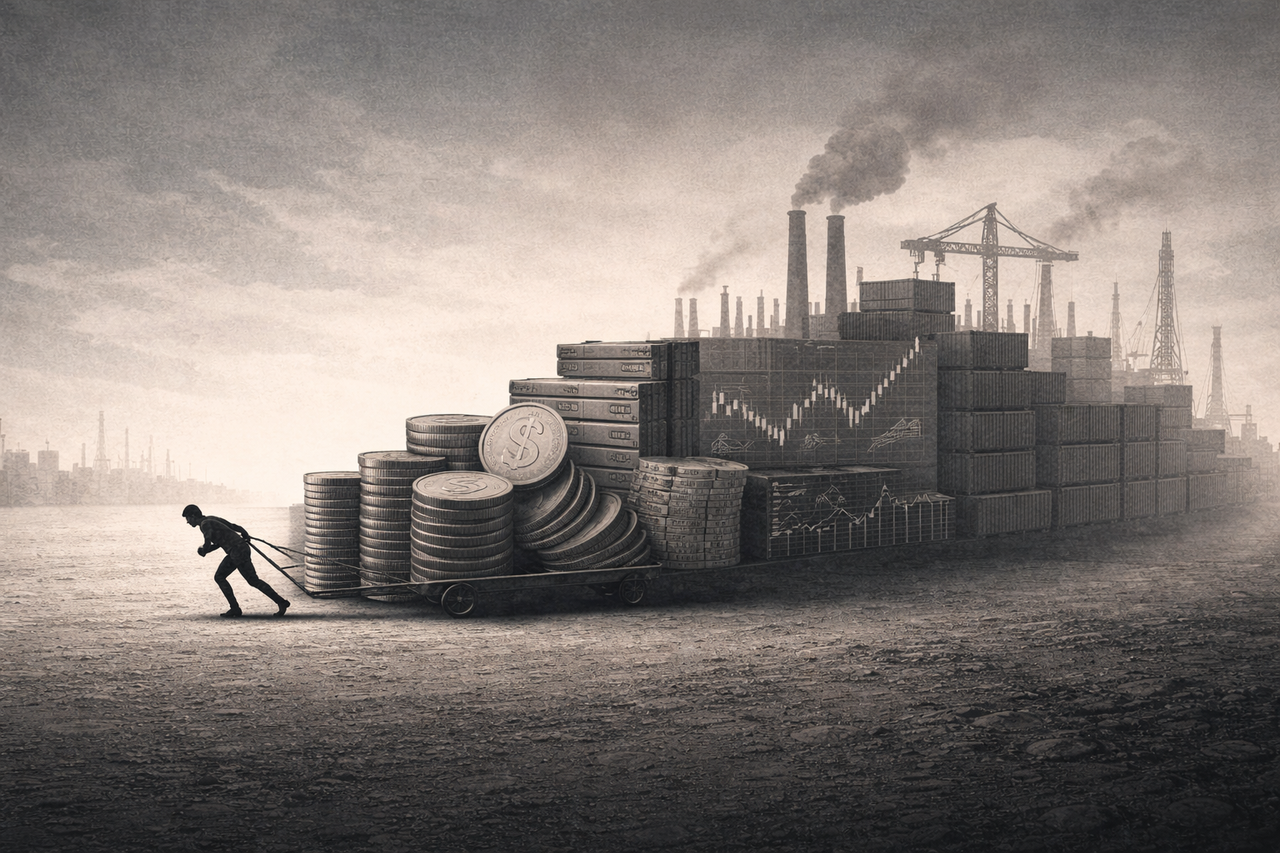
As I See It
Vayu Putra
Chapter 7
Capitalism Without Ethics
Capitalism did not begin as a moral failure.
It began as a tool.
At its core, capitalism is a coordination system designed to answer a practical question that becomes pressing as societies grow: how do you organise production, distribution, and exchange among people who do not know each other, who have never met, who may never meet? How do you decide who produces what, who receives it, and at what cost when personal relationships cannot mediate every transaction?
Markets emerged to solve the problem of scale. And they solved it remarkably well, enabling coordination across vast distances and among millions of strangers. This is not a small achievement. It is one of the most significant organisational innovations in human history.
But efficiency is not ethics. Coordination is not justice. And a tool that works is not necessarily a tool that serves human flourishing.
Understanding capitalism requires distinguishing between what it was designed to do and what it has become, between its function as economic mechanism and its transformation into comprehensive social system, between markets as tools for exchange and market logic as framework for existence.
This chapter is not an argument against exchange, trade, or economic coordination. It is an examination of what happens when a coordination mechanism becomes an ideology, when efficiency becomes the only value, when profit replaces purpose as the measure of success.
It is about capitalism without ethics. And why that absence matters more than most people recognise.
A day under capitalism: the invisible architecture of extraction
Consider Tuesday morning, 6:47 AM. Your alarm sounds from a smartphone assembled in Shenzhen by workers earning $3.15 per hour who live in factory dormitories, working 60-hour weeks. The cobalt in the battery was mined by children in the Democratic Republic of Congo, extracted by hand from tunnels that collapse regularly, killing dozens annually. Apple reported $394.3 billion in revenue in 2022. The miners' families earn perhaps $2 per day.
You make coffee. The beans were grown in Guatemala where farmers receive approximately 2% of the retail price you paid. The middlemen, processors, shippers, and retailers capture the rest. The plastic pod that holds the coffee will exist for 500 years, joining 39 million others produced daily. Nestlé, which owns Nespresso, reported $95.6 billion in profits in 2022 whilst coffee farmers struggle to afford food for their children.
The milk in your coffee comes from industrial dairy operations. The cows producing it are kept pregnant continuously, their calves removed within 24 hours. The waste from these operations pollutes waterways, whilst workers, predominantly undocumented immigrants, earn minimum wage for labour with injury rates three times the national average. Dairy corporations receive billions in government subsidies whilst small farms collapse under debt.
Your commute involves a car manufactured through supply chains spanning 30 countries. The steel came from ore mined in Brazil, where mining operations have created humanitarian disasters like the Brumadinho dam collapse in 2019, killing 270 people. The rubber in your tyres comes from plantations in Southeast Asia where labour trafficking remains endemic. The petroleum in your fuel was extracted by companies that spent $2 billion lobbying against climate legislation between 2000 and 2016 whilst their own scientists confirmed catastrophic warming.
At work, you open your laptop—more Congolese cobalt, more Shenzhen assembly lines, more planned obsolescence designed to force replacement every three years. Your productivity is monitored by software that tracks keystrokes, mouse movements, time between tasks. Amazon warehouse workers are fired automatically when algorithms detect productivity below target. Your white-collar surveillance is subtler but equally pervasive. The company pays you a salary whilst extracting value that shareholders capture.
Lunch arrives via delivery app. The restaurant pays 30% commission to the platform. The delivery worker, classified as independent contractor to avoid employment protections, earns less than minimum wage after expenses, receives no healthcare, no sick leave, no protection from arbitrary termination. The app's algorithms optimize delivery routes with no consideration for worker safety or wellbeing. The platform's founders are billionaires. The workers cannot afford medical care.
Your afternoon involves emails, meetings, reports—work that David Graeber documented as often meaningless, existing only to justify positions in organizational hierarchies. You know this but cannot acknowledge it openly. Surveys show that 37% of British workers believe their jobs make no meaningful contribution to the world. They continue because rent must be paid, because health insurance requires employment, because questioning is dangerous.
Evening brings packages delivered by drivers urinating in bottles because bathroom breaks compromise delivery quotas. The items inside—clothes from Bangladesh where garment workers earn $95 per month in buildings that collapse killing hundreds, electronics with programmed obsolescence, plastic products designed for single use then shipped to Ghana or the Philippines where "recycling" means burning them in open air, poisoning local populations.
You watch streaming entertainment, algorithms optimized for engagement keeping you watching past exhaustion. The platform harvests data about your viewing, your pauses, your searches, selling this behavioural information to advertisers. Shoshana Zuboff's research reveals that Google knows when people fall in love before they tell anyone, knows when they're developing depression before they consciously feel it, knows when they're about to make major life decisions before they've decided. This knowledge is sold to those who want to influence those decisions.
Before sleep, you scroll social media. The ads you see were selected by systems that know your insecurities, your aspirations, your vulnerabilities. You feel inadequate, anxious, lonely. This is not accidental. Platform profits depend on keeping you engaged, and negative emotions drive engagement more effectively than positive ones. Internal Facebook research, revealed by whistleblower Frances Haugen in 2021, showed the company knew Instagram increased depression and suicidal ideation among teenage girls by 13.5%. They continued anyway because engagement drove advertising revenue.
This is not a supply chain. This is a chain of invisibility. At every stage, harm is externalized whilst value is extracted. The profit flows upward to distant shareholders. The costs flow downward to workers, communities, environments that lack power to refuse them. The system is not failing. It is working exactly as designed.
You did not intend any of this harm. Neither did the billions of other people whose daily choices aggregate into systematic destruction. This is the genius and the horror of modern capitalism. It diffuses responsibility so completely that harm emerges without anyone feeling responsible. You are not cruel. You are complicit. And the system ensures you have no meaningful alternative whilst maintaining the illusion of choice.
When value replaced meaning: the historical transformation
Early economic exchange, in small-scale societies across human history, was embedded in social relationships. This is not romantic speculation but documented anthropological reality. Recall from Chapter 6 how pre-state societies maintained cooperation through reputation, reciprocity, and social consequence rather than through institutional enforcement. Economic activity operated within these same frameworks.
Marcel Mauss, in his foundational 1925 work "The Gift," demonstrated that in many traditional societies, economic exchange was inseparable from social obligation, reciprocity norms, and relationship maintenance. Gifts created bonds. Debts were social as much as economic. Trade built alliances.
Karl Polanyi, in "The Great Transformation" (1944), described how pre-modern economies were "embedded" in social relations. Economic activity occurred within frameworks of kinship, religion, and custom. Markets existed but were subordinate to social purposes rather than autonomous forces.
Work in such contexts had visible meaning. You saw the outcome of your labour directly. You knew who benefited from what you produced. You lived with the consequences, good and ill, of your economic activity. If you made poor-quality tools, your reputation suffered and you faced social sanction. If you cheated in trade, everyone knew and trust was withdrawn.
The industrial revolution and the emergence of capitalism as dominant economic system fundamentally severed these connections. Adam Smith recognised this in "The Wealth of Nations" (1776), though he viewed it differently than later critics would. The division of labour, Smith argued, dramatically increased productivity by breaking production into specialised tasks. A pin factory where each worker performs one small operation produces vastly more pins than individual craftspeople making entire pins.
But this efficiency came with costs Smith acknowledged less directly in that work, though he explored them in "The Theory of Moral Sentiments" (1759). Labour became abstract. Workers no longer created complete objects they could point to with pride. They performed repetitive motions whose purpose and outcome were distant from their experience.
Karl Marx, writing nearly a century later in "Capital" (1867), identified this as alienation. Workers were alienated from the products of their labour, which they did not own and often never saw completed. They were alienated from the labour process itself, which was controlled by capital rather than by workers. They were alienated from their own humanity, reduced to wage labourers selling their capacity to work as a commodity. They were alienated from other workers, set in competition rather than cooperation.
This alienation was not merely psychological. It was structural, built into the organisation of capitalist production. The worker at the Foxconn plant assembling iPhones performs one repetitive motion thousands of times daily. She does not design the phone, does not understand how the component she assembles functions, never sees the finished product, and certainly cannot afford to purchase what she makes. Her relationship to her labour is purely transactional. Time sold for money, meaning sold for survival.
Moreover, outcomes became geographically and temporally distant. The cotton picked by enslaved people in America became cloth in Manchester mills, becoming shirts worn in London. The chain of cause and effect stretched across continents. No individual actor could see the full picture or bear full responsibility for the system's consequences.
Responsibility dissolved across systems so large that no individual could comprehend the complete chain of production, let alone the ethical implications. You no longer knew who made what you consumed. You no longer saw who bore the cost of your convenience. You no longer felt the moral weight of efficiency optimised at global scale.
Value became numerical rather than moral or social. A product's worth was its price, determined by supply and demand in markets, not by the meaning it held for producer or user, not by the justice of its production process, not by its contribution to human flourishing.
If something generated profit, it was deemed successful. If it did not, it was inefficient and should be eliminated. The question "should this exist?" was replaced entirely by "does this grow?" The question "does this serve human needs?" was replaced by "does this serve market demands backed by purchasing power?"
Capitalism did not ask whether an outcome was good for communities, for workers, for the environment, for future generations. It asked whether it scaled, whether it returned profit to investors, whether it survived market competition.
This was presented, and genuinely experienced by many, as liberation from arbitrary traditional constraints. Markets were impersonal, blind to social status. In theory, anyone could succeed through merit and effort. The invisible hand of the market would coordinate self-interested behaviour toward efficient outcomes.
But efficiency toward what ends? Adam Smith assumed that moral sentiments, social bonds, and cultural restraints would continue to operate alongside market mechanisms, constraining the worst excesses. He was wrong. Or rather, the system that emerged bore his name but not his full vision.
Growth as belief system: the religion of GDP
Over time, particularly in the twentieth century, capitalism stopped being merely a tool for economic coordination and became a comprehensive worldview, a quasi-religious belief system complete with core dogmas, rituals, priesthoods, and eschatology. This transformation mirrors what we observed in Chapter 6, where early belief systems that facilitated cooperation became institutions that demanded obedience.
Growth became moral imperative. Economic expansion was not just desirable but necessary. Stagnation became failure, crisis, catastrophe requiring emergency intervention. Entire political careers rose or fell based on GDP growth rates. In the 2012 US presidential election, Mitt Romney's campaign stumbled when quarterly growth figures disappointed. In the UK, three consecutive quarters of negative growth, the technical definition of recession, triggered the fall of multiple governments in the 2000s and 2010s.
Expansion became virtue. Companies that grew were successful. Those that maintained stable size were stagnant. Markets that expanded were healthy. Those that reached equilibrium were dying. Amazon's Jeff Bezos famously stated "Your margin is my opportunity," expressing the doctrine that any profitability attracts competition requiring perpetual expansion to survive. Companies must grow or die. There is no steady state.
Competition became character-building. The struggle to succeed in markets was portrayed not just as economic necessity but as moral development, as what separated the worthy from the unworthy, the hardworking from the lazy, the winners from the losers. This framing transforms structural inequality into moral judgment, allowing those who benefit from the system to believe they earned their position through superior virtue.
This transformation into belief system was not accidental. It served specific interests whilst addressing genuine psychological needs, much as early religions addressed existential anxieties whilst legitimating social structures.
John Maynard Keynes, in "Economic Possibilities for our Grandchildren" (1930), predicted that his generation's grandchildren would work perhaps fifteen hours per week once productivity advances satisfied material needs. He was spectacularly wrong. Work hours in many economies have increased or remained stubbornly high despite productivity increases that should have dramatically reduced necessary labour. Between 1950 and 2020, US worker productivity increased by approximately 253%, yet average work hours decreased by only 10%. The gains went to capital, not leisure.
Why? Because capitalism requires continuous consumption to absorb continuous production. If people worked less and consumed less, the system would contract. Growth is not optional but existential necessity for capitalist economies. When the 2008 financial crisis caused contraction, central banks injected over $10 trillion into financial systems globally to restart growth. The alternative, accepting a steady-state or contracting economy, was literally unthinkable within the framework.
This creates what some economists call the "treadmill of production." Companies must grow to survive competition. Growth requires increased consumption. Increased consumption requires increased production. The cycle accelerates without endpoint, without question of sufficiency. Herman Daly, the ecological economist, noted that an economy in perpetual growth on a finite planet is either a Ponzi scheme or a cancer. Both descriptions fit.
Growth promises security in ways that mirror religious promises. Jobs depend on growth. Pensions depend on growth. Stock markets depend on growth. National power depends on growth. Like religion offering salvation, growth offers reassurance in an uncertain world: as long as the economy grows, tomorrow will be better than today. Your children will prosper. Progress is inevitable. This narrative persists despite evidence that growth beyond basic material security does not increase wellbeing and often decreases it through environmental degradation, social fragmentation, and time poverty.
And like religious belief systems explored in Chapter 6, capitalism's growth ideology discourages fundamental questioning. Doubting growth sounds like economic sabotage. Questioning profit sounds like dangerous radicalism or naive ignorance. Questioning efficiency sounds like weakness or sentimentality that markets will punish. Economist Larry Summers was forced to resign from Harvard's presidency in part for questioning whether unlimited growth was sustainable or desirable. The orthodoxy tolerates no heresy.
The language evolved to reinforce this framing. Herman Daly and John Cobb, in "For the Common Good" (1989), pointed out that economics shifted from discussing "welfare" and "wellbeing" to discussing "utility" and "growth." The former terms contain ethical content, implying questions about good lives. The latter are technical, measurable, seemingly neutral. This linguistic shift obscures moral questions beneath technical facades.
Ethics became "externalities," costs not reflected in market prices. The term itself is revealing. External to what? External to the accounting that matters, to the calculations that drive decisions. Harm to communities, to health, to environment, these are external to the core logic of profit and loss. They are somebody else's problem, or nobody's problem, or future generations' problem, but not the corporation's problem.
Environmental destruction became "environmental costs," suggesting they could be priced and traded like any commodity. Human suffering became "market corrections," temporary adjustments on the path to equilibrium. The deaths of workers in unsafe conditions became "acceptable risk levels" determined by cost-benefit analysis where a human life is valued at approximately $10 million in the United States—calculated based on earnings potential, meaning poor lives are literally worth less than wealthy ones in regulatory frameworks.
The system did not deny harm. It priced it. And having priced it, it could rationalise it. If preventing harm costs more than the harm itself, measured in monetary terms, then the rational choice is to accept the harm. Ford Motor Company's infamous internal memo about the Pinto, leaked in the 1970s, explicitly calculated that paying damages for burn deaths ($200,000 per death) cost less than redesigning the fuel system ($11 per vehicle). This was not corporate psychopathy but capitalism functioning exactly as designed. The efficient choice was to let people burn.
This produces grotesque outcomes. The monetary value of a human life in regulatory cost-benefit analysis is typically calculated based on earnings potential. A poor person's life is thus worth less than a wealthy person's. A child in a developing nation is worth less than a child in a developed one. These are not hypothetical calculations but actual methods used by governments and international organisations. The US Environmental Protection Agency valued American lives at $9.6 million in 2020 whilst the World Bank's cost-benefit analyses for projects in Africa often used values below $1 million. The disparity is not oversight but system logic.
Robert H. Frank and Philip J. Cook, in "The Winner-Take-All Society" (1995), documented how winner-take-all markets spread across the economy, concentrating rewards at the top whilst leaving the majority with stagnant or declining real wages. This was not market failure but market success, the system working as designed to allocate resources based on marginal productivity and market power rather than need or fairness. The result is CEOs earning 350 times average worker pay whilst workers' inflation-adjusted wages stagnate for four decades.
The disappearance of accountability: diffused responsibility
One of capitalism's most powerful features, from a social control perspective, is also its most ethically dangerous: the systematic diffusion of responsibility across complex networks until no identifiable actor bears clear moral accountability for harmful outcomes.
This mirrors the crowd psychology discussed in Chapter 4, but operates at larger scale and through institutional structure rather than temporary collective emotion. Where crowds dissolve individual responsibility through anonymity and emotional contagion, capitalism dissolves it through institutional distance and systemic complexity.
Consider a simple example. A company pollutes a river, harming communities downstream. Who is responsible?
The company operates within regulations that permit certain pollution levels. The regulations exist because lawmakers wrote them to balance environmental protection against economic interests. The lawmakers represent voters who demand jobs and economic growth. The voters work for companies that might reduce employment if environmental regulations become too stringent. The companies answer to shareholders who demand maximum returns.
Everyone participates in the system. No single person intended the harm. Each actor followed incentives that seemed reasonable from their position. The pollution emerges from structure, not from individual malice.
This is not to say no one is responsible. It is to say that responsibility is distributed in ways that make it difficult to identify and nearly impossible to redress through individual moral accountability.
Milton Friedman, in his influential 1970 essay "The Social Responsibility of Business Is to Increase Its Profits," argued that corporate executives have one duty: maximising shareholder value within legal constraints. Any other consideration is inappropriate. If society wants different outcomes, it should change the law. Within legal boundaries, pursuit of profit is not just acceptable but obligatory.
This framework explicitly rejects corporate moral responsibility beyond legal compliance. Ethics become whatever law requires, nothing more. And law, shaped by corporate lobbying and campaign contributions, tends to permit what corporations find profitable. Between 2010 and 2020, the fossil fuel industry spent over $2 billion lobbying the US Congress. The pharmaceutical industry spent $4.7 billion. The finance industry spent $6.4 billion. These are not bribes in the crude sense but systemic mechanisms ensuring that law reflects corporate interests rather than public welfare.
The 2008 financial crisis demonstrated this dynamic brutally. Subprime mortgages were packaged into securities, sold to investors, who sold them to others, creating chains of ownership so complex that no one understood the full risk. When the bubble burst, millions lost homes, jobs, savings. Yet almost no one faced criminal prosecution.
Why? Because individual actors at each stage had done what the system incentivised. Loan officers met sales targets. Banks maximised profits. Rating agencies provided the ratings clients paid for. Regulators applied rules written by industry. Investors sought returns. Politicians promoted homeownership and financial innovation.
The crisis was systemic. Punishment was individualised, falling on homeowners who could not pay mortgages they should never have been given, whilst institutions deemed "too big to fail" received bailouts totalling $700 billion in the United States alone, with global bailouts exceeding $10 trillion. Bank executives kept their bonuses. Homeowners lost everything.
This pattern repeats. Environmental destruction occurs because it is profitable and legal. Wage stagnation occurs because labour has insufficient bargaining power. Addiction-driven products proliferate because they generate revenue. In each case, diffused responsibility means no one feels personally accountable for aggregate harm.
Hannah Arendt's concept of the "banality of evil," developed in "Eichmann in Jerusalem" (1963), applies here. Great harm is done not by monsters but by ordinary people following systems, meeting quotas, doing their jobs efficiently. The bureaucrat who processes foreclosures is not cruel. They are following procedure. The executive who cuts healthcare benefits to boost quarterly earnings is not sadistic. They are meeting fiduciary duty. The engineer who designs addictive algorithms is not malicious. They are optimizing engagement metrics.
But the outcomes are nonetheless devastating. And the system ensures that those who suffer the consequences rarely have power to demand change.
Profit over consequence: the logic of externalities
In ethical systems across cultures and philosophical traditions, intention matters. Harm is weighed against awareness and responsibility. Actions are judged not merely by outcomes but by the care taken to avoid foreseeable damage, by the willingness to prioritise others' wellbeing over personal gain.
Capitalism does not operate according to this logic. It rewards outcomes regardless of consequences to those who cannot purchase protection from harm.
The concept of "externalities" is central here. An externality, in economic theory, is a cost or benefit that affects parties who did not choose to incur it. Pollution is a negative externality. The firm gains profit from production; communities bear health costs from contamination. Education generates positive externalities. Individuals benefit personally; society benefits from a more educated population.
In theory, government regulation should internalise externalities, making firms pay the true costs of their activities. In practice, this rarely occurs adequately. Why?
Because those who benefit from externalising costs have resources to resist regulation. They fund political campaigns, employ lobbyists, generate economic research supporting their interests, threaten to move operations to more permissive jurisdictions. Those who bear the costs, often poor communities or future generations, have little political power.
This creates systematic bias toward allowing harmful externalities to persist. The tobacco industry externalised health costs for decades whilst generating enormous profits. Internal documents revealed in litigation during the 1990s showed that tobacco companies knew since the 1950s that cigarettes caused cancer, knew nicotine was addictive, and deliberately manipulated nicotine levels to maintain addiction. They spent billions funding research to create false scientific controversy, lobbying to prevent regulation, and marketing to children. The health costs they externalised onto smokers, healthcare systems, and families exceeded $300 billion annually in the United States alone.
The fossil fuel industry externalises climate costs whilst blocking transition to alternatives. ExxonMobil's own scientists warned management about climate change in the 1970s. Internal documents show they understood the catastrophic risks. Between 1977 and 2015, ExxonMobil spent over $30 million funding climate denial organizations. The five largest oil companies spent $1 billion on climate lobbying and branding between 2015 and 2020 whilst publicly claiming commitment to sustainability. The climate costs they externalized will exceed trillions in damages, displacement, and deaths.
The fast fashion industry externalises environmental destruction and labour exploitation to countries with weak enforcement. Bangladesh, which produces 6% of global garment exports, has 5,000 garment factories employing 4 million workers, predominantly women. The Rana Plaza factory collapse in 2013 killed 1,134 workers and injured 2,500 more. Western brands whose clothes were made there claimed no responsibility because they contracted through intermediaries. This diffusion of accountability is structural, not accidental. The cost of ensuring building safety would have been approximately $500,000. The compensation paid after the disaster exceeded $30 million, but only after international pressure made continued business impossible.
Nicholas Stern, in "The Economics of Climate Change" (2006), called climate change "the greatest market failure the world has seen." Firms and consumers enjoy cheap fossil fuel energy whilst externalising catastrophic costs onto future generations and vulnerable populations. Markets alone will not solve this because the incentive structure rewards externalisation.
Moreover, capitalism's time horizon systematically favours short-term gains over long-term sustainability. Quarterly earnings reports drive corporate decisions. Political cycles favour policies showing immediate results. Discount rates in economic analysis make future costs appear negligible compared to present benefits. A cost occurring 50 years in the future, when discounted at typical rates of 3-7%, becomes essentially worthless in present-value calculations.
This creates what economists call hyperbolic discounting applied at societal scale. Humans naturally value immediate rewards over delayed ones. Capitalism institutionalises this bias, making it economically rational to sacrifice long-term wellbeing for short-term profit.
The result is predictable and observable. Companies that exploit labour more ruthlessly outcompete those with better working conditions. Firms that pollute more extensively reduce costs below those investing in environmental protection. Industries that create addictive products generate more revenue than those promoting genuine wellbeing.
The system does not need consciously malicious actors. It needs economically rational ones responding to incentives. And the incentives, absent strong countervailing regulation and social pressure, reward harm.
A company that produces addictive products is successful if sales rise, regardless of health costs to consumers. A firm that cuts costs by degrading labour conditions is competitive, regardless of human suffering. An industry that externalises environmental damage remains profitable, regardless of ecological collapse.
The moral question "should this exist?" becomes irrelevant if the market answer is "this generates profit." Ethics become optional, costs to be avoided when possible, accepted when necessary.
Why misery scales efficiently: the economics of exploitation
There is a brutally simple reason that suffering proliferates efficiently in capitalist systems operating without adequate ethical constraints or democratic accountability.
Misery is cheap.
Exploiting labour costs less than protecting workers. Paying subsistence wages costs less than paying living wages. Ignoring safety costs less than ensuring it. Breaking unions costs less than negotiating fairly. Replacing experienced workers with desperate ones costs less than retaining institutional knowledge.
Polluting costs less than not polluting. Dumping waste into rivers costs less than treating it. Emitting carbon costs less than reducing emissions. Destroying habitats costs less than preserving them. Mining without remediation costs less than restoration.
Creating addictive products is more profitable than promoting wellbeing. Processed foods engineered to maximise consumption generate more revenue than nutritious meals. Social media designed to capture attention generates more engagement than platforms respecting users' time. Gambling mechanisms in games extract more money than straightforward purchases.
Short-term extraction costs less than long-term sustainability. Clearcutting forests provides immediate revenue. Sustainable harvesting requires patience. Depleting aquifers enables current agriculture. Preservation requires limiting present use for future availability.
Thomas Piketty, in "Capital in the Twenty-First Century" (2014), demonstrated with extensive historical data that return on capital (r) consistently exceeds economic growth (g) over long periods. This means wealth accumulated through ownership grows faster than wealth earned through labour. Inequality is not accidental but structural, built into capitalism's fundamental dynamics.
Those with capital gain ever-larger shares of wealth and income. Those dependent on wages fall further behind. This is not because wealthy people are greedier or more talented. It is because the system is designed to reward capital ownership more than labour.
The result, visible in data across developed economies, is skyrocketing inequality. In the United States, the top 1% now control roughly 40% of national wealth, levels not seen since before the Great Depression. The top 0.1% own more than the bottom 90% combined. This is not natural or inevitable. It is the predictable result of policy choices that favour capital over labour.
Richard Wilkinson and Kate Pickett, in "The Spirit Level" (2009), demonstrated that inequality itself generates social harm beyond simple material deprivation. More unequal societies have worse health outcomes, higher crime rates, lower educational achievement, reduced social mobility, and decreased trust even among wealthy citizens. Inequality corrodes social fabric. Their research across 23 developed countries shows that inequality predicts social problems more reliably than absolute wealth.
But from capital's perspective, inequality is not a problem to solve but an outcome to accept or even accelerate. Desperate workers accept lower wages and worse conditions. Competitive labour markets keep compensation down. The threat of unemployment disciplines those employed. Marx called this the "reserve army of labour"—maintaining a pool of unemployed workers who compete with employed ones, preventing wages from rising.
David Harvey, in "A Brief History of Neoliberalism" (2005), documents how the political project since the 1970s deliberately shifted power from labour to capital through multiple mechanisms: undermining unions, deregulating finance, privatising public goods, cutting social programmes, embracing austerity. These were not inevitable economic requirements but political choices serving class interests.
Union membership in the United States peaked at 35% of workers in 1954. By 2022, it had fallen to 10.1%, with private sector unionization at just 6%. This decline was not natural but engineered through legal changes, corporate union-busting, and political assault. The Taft-Hartley Act of 1947 began restricting union power. Right-to-work laws in 28 states by 2022 weakened unions further. President Reagan's firing of 11,000 striking air traffic controllers in 1981 signaled that government would support employers against workers.
The ideology justifying these choices claimed that markets produce optimal outcomes if left unregulated, that inequality incentivises effort, that social programmes create dependency, that helping workers harms the economy. These claims were largely false but enormously influential because they aligned with powerful interests.
Naomi Klein, in "The Shock Doctrine" (2007), showed how economic crises are exploited to impose policies that would face resistance in stable times. Disasters become opportunities to privatise public assets, cut social spending, deregulate industries. The suffering created by crises becomes leverage for imposing capitalism's most extreme forms. Chile under Pinochet, Russia after the Soviet collapse, Iraq after the US invasion, each saw "shock therapy" privatization that transferred public wealth to private hands whilst populations were too traumatized to resist effectively.
What emerges is a system extraordinarily efficient at concentrating wealth whilst distributing misery. Not because individual participants are evil, but because the structure incentivises extraction and penalises compassion.
Global South and the geography of extraction: how capitalism maps onto colonialism
The patterns of capitalist exploitation are not geographically neutral. They map precisely onto colonial histories, transforming direct political domination into economic subordination whilst maintaining the same fundamental relationship: the Global North extracts value whilst externalising costs onto the Global South.
This is not metaphor. It is measurable economic reality with specific mechanisms, documented flows, and identifiable beneficiaries.
Debt colonialism: the IMF and structural adjustment. Between 1980 and 2000, the International Monetary Fund and World Bank imposed structural adjustment programmes on over 70 countries, predominantly in Africa, Latin America, and Asia. These programmes were ostensibly designed to promote economic development and fiscal responsibility. In practice, they transferred enormous wealth from South to North whilst devastating local economies.
Consider Mauritius, which experienced structural adjustment in the 1980s. The island nation was forced to devalue its currency by 30%, cut public sector employment by 5,000 positions, remove food subsidies that benefited the poorest citizens, and open markets to foreign competition that destroyed local industries. Sugar production, which employed 25% of the workforce, faced sudden competition from subsidised European beet sugar. The Export Processing Zone was expanded with minimal labour protections, creating low-wage manufacturing jobs predominantly employing women at 60% of male wages for similar work.
The IMF declared this a success because GDP grew and foreign investment increased. What the aggregate statistics obscured was that growth occurred in sectors controlled by foreign capital, profits were repatriated abroad, real wages for most workers stagnated or declined, and inequality increased dramatically. By the 1990s, Mauritius had transformed from a relatively egalitarian post-independence society to one where the top 10% captured 37% of income whilst the bottom 40% received just 14%.
This pattern repeated across Africa. Ghana's structural adjustment in the 1980s required removing subsidies on cocoa, the primary cash crop. Farmers' incomes collapsed by 40% within two years. Tanzania was forced to privatise state enterprises, with assets sold at fire-sale prices to foreign corporations. Zambia's copper mines, which generated 90% of export earnings, were privatised in the 1990s. Anglo American Corporation and Glencore acquired them for $400 million, approximately 10% of their estimated value. Within a decade, these companies had extracted over $9 billion in profits whilst paying minimal taxes through transfer pricing and offshore structures.
The debt these structural adjustments were supposed to resolve has only grown. Sub-Saharan Africa's external debt increased from $84 billion in 1980 to over $700 billion by 2020. Countries spend more servicing debt than on healthcare or education. Zambia spends approximately 30% of government revenue on debt payments, three times what it spends on health. This is not accident but design. Debt becomes mechanism of control, ensuring continued extraction and preventing autonomous development.
Resource extraction: the material basis of accumulation. The Democratic Republic of Congo contains approximately 70% of the world's cobalt reserves, essential for lithium batteries in smartphones, laptops, and electric vehicles. Annual cobalt production exceeds 100,000 tonnes, generating approximately $1.5 billion in export revenue. The DRC receives roughly 10% of the final value. The rest is captured through processing in China, manufacturing in East Asia, and sales in wealthy markets.
The human cost is extraordinary. Artisanal cobalt mining employs approximately 255,000 people, including an estimated 40,000 children according to UNICEF research from 2022. They work in hand-dug tunnels without safety equipment, experiencing tunnel collapses that kill dozens annually, chronic respiratory disease from dust exposure, and contamination from heavy metals. Average earnings are $2 to $3 per day. Glencore, which controls industrial cobalt mining in the DRC, reported $23.8 billion in revenue in 2022. None of this wealth reaches the miners or their communities.
This pattern extends across resource extraction. Nigeria produces approximately 2 million barrels of oil daily, generating over $60 billion in export revenue annually. Yet 70% of Nigerians live on less than $2 per day. Shell, ExxonMobil, Chevron, and other international oil companies extract the oil through production-sharing agreements that give Nigeria approximately 30% of revenues whilst the companies bear minimal risk and pay little tax through offshore structures. The Niger Delta, where extraction occurs, experiences chronic oil spills, gas flaring that poisons air and water, and environmental devastation that has destroyed fishing and farming livelihoods for millions.
The pattern is consistent: resources flow from South to North, profits flow from South to Northern shareholders, environmental and social costs remain in the South. This is not trade. It is extraction maintaining colonial relationships through economic mechanisms.
Export Processing Zones: manufacturing exploitation. Bangladesh's garment industry employs approximately 4 million workers in 5,000 factories, predominantly women earning $95 per month for 60-hour work weeks. These factories operate in Export Processing Zones with reduced labour protections, minimal taxation, and exemption from many environmental regulations. The zones were designed explicitly to attract foreign investment by offering cheap, compliant labour.
Bangladesh exports approximately $40 billion in garments annually. Western brands like H&M, Zara, Gap, and Primark source extensively from these factories. A t-shirt selling for $29 in London costs approximately $5 to produce, with $1.50 going to the Bangladeshi factory, $0.30 to the worker who made it, and the rest captured through brand markup, shipping, and retail. The factory owner earns perhaps $0.20 profit per shirt. The brand captures $15 to $20. The worker who spent 15 minutes making the shirt receives less than the cost of the coffee the consumer drinks whilst shopping.
Similar patterns exist across Export Processing Zones globally. Vietnam's 300+ zones employ 2.5 million workers producing electronics, textiles, and footwear for export. Mexican maquiladoras along the US border employ 3 million workers in factories owned or contracted by American corporations, producing goods for US markets whilst workers earn $8 per day. The Philippines' zones employ 1.4 million workers, predominantly in electronics assembly for companies like Intel, Texas Instruments, and Samsung.
These are not development zones lifting countries out of poverty. They are extraction zones where Northern capital exploits Southern labour, captures the value produced, and externalises all costs onto workers and communities who have no alternative because structural adjustment destroyed other economic options.
Illicit financial flows: the invisible haemorrhage. Global Financial Integrity, a research organisation tracking cross-border financial flows, estimates that developing countries lose approximately $1 trillion annually through illicit financial outflows. These include trade misinvoicing, profit shifting by multinational corporations, tax evasion through offshore structures, and corruption proceeds moved abroad.
Africa alone loses an estimated $88.6 billion annually according to the UN Economic Commission for Africa's High Level Panel report from 2015. This exceeds total foreign aid to the continent, which was approximately $54 billion in 2019. Africa is not aided by the North; it is drained by it.
The mechanisms are sophisticated. Transfer pricing allows multinational corporations to shift profits to low-tax jurisdictions. A mining company in Zambia sells copper to its own subsidiary in Switzerland at artificially low prices, declaring minimal profit in Zambia where taxes would be paid, then sells the same copper at market prices from Switzerland, declaring profit in a jurisdiction with 8.5% corporate tax rather than Zambia's 30%. The copper never physically goes to Switzerland; the transaction is purely accounting fiction designed to avoid taxation.
Research by economists Thomas Tørsløv, Ludvig Wier, and Gabriel Zucman published in 2018 estimated that approximately 40% of multinational profits are shifted to tax havens annually, costing governments $200 billion in lost revenue globally, with developing countries disproportionately affected because they depend more heavily on corporate taxation.
These flows are not illegal in technical terms. They exploit loopholes in international tax law, use structures considered legal in offshore jurisdictions, and benefit from financial secrecy that prevents enforcement. They are legal theft, sanctioned by international frameworks designed to facilitate capital mobility whilst preventing democratic control.
Waste colonialism: exporting destruction. The wealthy world generates approximately 50 million tonnes of electronic waste annually. Much of this is shipped to Ghana, Nigeria, India, Pakistan, and China where it is "recycled" through methods that poison workers and environments.
Agbogbloshie in Accra, Ghana has become one of the world's largest electronic waste dumps. An estimated 40,000 people work there burning computer monitors, phones, and circuit boards to extract copper and other metals. The burning releases dioxins, furans, and heavy metals. Soil and water contamination exceeds safe levels by factors of 100 or more. Workers, many of them children, experience chronic respiratory illness, heavy metal poisoning, and cancer rates far above national averages.
The Basel Convention of 1989 was supposed to prevent this by restricting export of hazardous waste from developed to developing countries. In practice, it is easily circumvented. Electronic waste is labeled as "donations" or "second-hand goods" destined for reuse. Much of it is broken or obsolete but documented as functional to evade regulations. The United States, which produces approximately 10 million tonnes of electronic waste annually, has not ratified the Basel Convention, allowing unrestricted export.
Similar patterns exist for plastic waste. Before 2018, wealthy countries exported millions of tonnes of plastic waste to China for "recycling." When China banned imports, the waste was redirected to Malaysia, Vietnam, Thailand, and Indonesia. These countries lack infrastructure for processing this volume of waste. Much of it is burned in open air, dumped in rivers, or buried in landfills that leach into water supplies. The Philippines receives approximately 350,000 tonnes of imported plastic waste annually whilst Manila Bay and other waterways become plastic-choked dead zones.
This is not unfortunate externality. This is deliberate externalisation, using poverty and weak governance in the South to dispose of problems the North creates but refuses to address. The pattern mirrors colonialism precisely: extract what is valuable, dump what is costly, maintain the relationship through economic and political pressure.
The cumulative reality: reverse development. When all these flows are aggregated, the picture is stark. According to research by economists Jason Hickel and Dylan Sullivan published in the journal New Political Economy in 2019, the drain from South to North through unequal exchange, capital flight, debt servicing, profit repatriation, and illicit flows amounts to approximately $2.2 trillion annually, dwarfing the $150 billion in foreign aid flowing the opposite direction.
The Global South does not need aid. It needs to stop being robbed. Poverty in Africa, Asia, and Latin America is not natural condition requiring Northern charity. It is produced by systems designed to extract wealth whilst externalising costs. Development discourse obscures this reality, framing the problem as Southern deficiency requiring Northern expertise rather than as Northern extraction requiring Southern resistance.
This is capitalism without ethics operating at global scale, maintaining colonial relationships through economic mechanisms that are technically legal, systematically unjust, and devastating in aggregate effect. The same logic that concentrates wealth domestically operates internationally, with the Global South playing the role that the working class plays within wealthy nations: producing value, bearing costs, receiving minimal compensation, lacking power to demand change.
The transformation of consciousness: from citizen to consumer
Perhaps capitalism's most profound impact is not economic but psychological, reshaping human consciousness and identity in ways that serve market imperatives whilst hollowing out other aspects of human existence. This connects directly to the consciousness burden explored in Chapter 2, showing how that burden is not merely existential but systematically exploited.
Erich Fromm, in "To Have or To Be?" (1976), described the shift from being-oriented existence, focused on experience, growth, and relationship, to having-oriented existence, focused on possession, accumulation, and consumption. Capitalism systematically cultivates having-orientation because consumption drives growth.
Identity formation through consumption. People increasingly define themselves through brands, purchases, lifestyle markers. The question "who am I?" becomes inseparable from "what do I own?", "what do I consume?", "what signals do I send through purchasing choices?" Your car, your phone, your clothes, your coffee choice, these become identity markers more salient than values, relationships, or character.
This is not accidental. Edward Bernays, nephew of Freud and pioneer of modern public relations, explicitly argued in "Propaganda" (1928) that corporations must shape desires, create needs, link products to identity and status. His work for the American Tobacco Company convinced women that smoking cigarettes was an act of feminist liberation, "torches of freedom" demonstrating independence. His campaign for bacon manufacturers convinced Americans that heavy breakfasts were healthier, creating cultural norms serving corporate interests. The goal was transforming citizens who thought of themselves as members of communities into consumers who thought of themselves as individuals satisfying personal desires through market transactions.
The result is identity increasingly constructed through consumption rather than through relationships, values, achievements, or character. You are what you buy. Your worth is demonstrated through possessions. Success is measured by lifestyle. The masks discussed in Chapter 3 become consumer personas, performed identities that must be continually purchased and updated.
Social relationships become transactional. Human interactions are increasingly mediated through commercial frameworks. Friendship requires consumer spending on shared activities. Romance involves purchased experiences. Even leisure revolves around consumption, with shopping centres replacing town squares as public gathering spaces.
Zygmunt Bauman, in "Liquid Modernity" (2000), described how solid, stable social bonds are replaced by liquid, flexible, disposable connections. Relationships become consumer goods, entered into and exited from based on immediate satisfaction rather than long-term commitment. Dating apps commodify romance, reducing people to profiles optimized for quick evaluation. Swiping left or right mirrors shopping, treating humans as products to be selected or rejected based on superficial presentation. This serves market logic by keeping people perpetually dissatisfied, seeking next purchase, next experience, next relationship.
Value systems oriented toward market metrics. Success is predominantly financial. Non-monetary contributions to society are systemically undervalued. Care work, teaching, art, community building, these generate little market reward despite enormous social value. Conversely, activities that extract wealth without creating value, financial speculation for instance, can generate enormous compensation.
This creates distorted priorities where genuinely valuable work is poorly rewarded whilst socially destructive activities are celebrated if profitable. Hedge fund managers earn millions moving capital around whilst teachers educating children struggle to afford housing. The average hedge fund manager in the United States earned $2.4 million in 2021. The average teacher earned $65,000. This disparity is not based on social value or difficulty but purely on market power and profit generation.
The commercialisation of formerly non-market domains. Healthcare becomes profit-generating industry rather than social right. Education becomes investment in human capital rather than public good. Cultural expression becomes content monetised through attention capture. Social connection becomes data harvested for advertising.
Shoshana Zuboff, in "The Age of Surveillance Capitalism" (2019), documents how digital platforms have created unprecedented systems of behavioural modification for profit. Every interaction is monitored, analysed, packaged, sold. Human experience itself becomes raw material for capitalist extraction. Google processes over 8.5 billion searches daily, each one providing data about desires, fears, plans, and vulnerabilities that is aggregated, analysed, and sold to those who want to influence behaviour.
This goes beyond earlier forms of advertising. It is systematic psychological manipulation at population scale, using unprecedented data and computational power to predict and influence behaviour in ways individuals cannot perceive or resist. The algorithms know when you are most vulnerable to particular messages, when you are most likely to make impulsive purchases, when you are feeling insecure and need validation through consumption.
Passive consumption replaces active creation. Entertainment is produced by specialists, consumed by masses. Few people make music; most stream it. Few write; most scroll through feeds. Few cook from scratch; most purchase prepared meals. The shift from active participation in culture to passive consumption serves capitalism by making leisure depend on purchased products rather than free activities.
Guy Debord, in "The Society of the Spectacle" (1967), argued that lived experience is replaced by representation, by images consumed rather than realities engaged. Life becomes performance for social media, validated through likes and shares. Authentic experience matters less than curated image. People photograph meals before eating them, concerts before experiencing them, trips before enjoying them. The experience becomes secondary to its documentation and display.
The erosion of non-market time and space. Advertising colonises every available surface. Commercials interrupt every broadcast. Marketing infiltrates schools, hospitals, previously sacred spaces. Even sleep becomes opportunity for products promising better rest. The average American encounters between 4,000 and 10,000 advertisements daily according to media research studies. This constant bombardment is not accidental but deliberate strategy to ensure markets saturate consciousness.
The smartphone enables work to intrude on personal time constantly. The boundary between labour and leisure dissolves, with workers expected to be perpetually available, constantly checking email, unable to fully disconnect. Research by the American Psychological Association shows that 53% of workers check work email outside work hours, 52% check on weekends, and 44% check on vacation. This is not individual choice but structural expectation enforced through fear of being perceived as uncommitted.
This produces populations psychologically shaped for consumption and compliance. Meaning is purchased rather than created. Identity is performed rather than developed. Connection is mediated through products rather than direct human relationship. Values align with market metrics rather than human flourishing.
The result is chronic dissatisfaction that capitalism simultaneously creates and offers to solve through further consumption. You feel inadequate; buy products promising transformation. You feel lonely; purchase experiences promising connection. You feel anxious; consume entertainment promising distraction. The cycle never resolves because resolution would end consumption.
Herbert Marcuse, in "One-Dimensional Man" (1964), described this as elimination of the oppositional consciousness necessary for social change. When all needs can supposedly be met through consumption, when all problems have market solutions, the possibility of imagining alternatives to capitalism disappears. People lose the ability to think outside the system because the system has colonized thought itself.
People are not made happier by this system. Studies consistently show that beyond basic material security, increased consumption does not increase wellbeing and often decreases it through time poverty, environmental anxiety, and social comparison stress. Yet the treadmill continues because the system requires it, and consciousness has been shaped to perpetuate it.
Distraction as stabiliser: keeping consciousness occupied
Capitalism's relationship with human consciousness, explored in Chapter 2, is complex and deliberate. The system does not need satisfied people. It needs people too busy and too distracted to question fundamental structures. The consciousness burden becomes tool for control rather than path to liberation.
When work exhausts, consumption provides relief. When meaning erodes, entertainment fills the void. When anxiety rises, products promise solution. When loneliness deepens, platforms offer connection. When identity fragments, brands provide coherence.
Capitalism does not resolve existential discomfort. It monetises it.
Loneliness becomes market opportunity. Dating apps commodify romance, generating $3 billion in revenue in 2021 from people seeking connection. Social media platforms profit from isolation by offering simulacra of connection. Facebook had 2.9 billion monthly active users in 2021, each spending an average of 38 minutes daily seeking connection through screens. Consumer products promise to fill emotional voids. The more isolated people become, the more they consume seeking remedy that never arrives because genuine connection cannot be purchased.
Insecurity becomes branding. Advertising systematically creates insecurity then offers products as solution. You are not thin enough, wealthy enough, successful enough, desirable enough. But purchase this and transformation is possible. The cosmetics industry generates $532 billion annually selling products that promise transformation whilst ensuring dissatisfaction continues through ever-changing beauty standards. The promise is never fulfilled because fulfillment would end consumption.
Identity becomes lifestyle choice. You express yourself through consumer selections. Political identity is performed through purchasing from aligned brands. Environmental concern is demonstrated by buying green products rather than reducing consumption. Rebellion is purchased through alternative brands that signal nonconformity whilst maintaining market dependence. The Che Guevara t-shirt, mass-produced in sweatshops and sold for profit, perfectly captures this contradiction.
This keeps populations docile and systems stable. People too exhausted from work have little energy for political organisation or collective action. People too distracted by entertainment do not analyse power structures. People too focused on individual consumption do not build movements for collective change.
Aldous Huxley, in "Brave New World" (1932), imagined a future where population control occurred not through oppression but through pleasure, through endless distraction and satisfaction of superficial desires. In many ways, contemporary capitalism has achieved what Huxley satirised. Social control operates not through force but through manufactured desire, constant entertainment, and psychological exhaustion.
The consciousness burden discussed in Chapter 2 is kept occupied, diverted from reflection that might generate resistance. Awareness is directed toward consumption choices rather than political choices, toward personal inadequacy rather than systemic failure, toward individual solutions rather than collective action. The default mode network that could generate critical reflection instead cycles through shopping lists, social media feeds, and product comparisons.
This is extraordinarily effective control mechanism. Traditional authoritarianism requires violence, surveillance, explicit oppression. Capitalism achieves compliance through making resistance psychologically difficult and materially risky whilst offering endless distraction from the need to resist.
Why protest when you have Netflix with thousands of shows optimized for binge-watching? Why organise when you might lose your job and with it healthcare, housing, survival? Why question the system when it provides smartphones and fast food and constant entertainment? The combination of material comfort for some and psychological exhaustion for most creates remarkable stability despite increasing inequality and ecological collapse.
Why capitalism resists ethics: the incompatibility thesis
It is sometimes argued that capitalism can be ethical, that markets properly regulated serve social good, that business can do well whilst doing good. There is some truth to this, but it misses a fundamental point.
Ethics introduce limits. Markets pursue growth. These goals are structurally opposed.
Limits slow growth. Environmental regulations increase costs. Labour protections reduce profits. Safety requirements decrease efficiency. Quality standards slow production. Every ethical constraint makes a firm less competitive against those who externalise costs. Companies that spend on environmental protection, worker safety, or quality control face higher costs than competitors who cut corners. Markets reward corner-cutting with higher profits and market share.
Limits reduce profit. Paying fair wages reduces margins. Respecting communities limits extraction. Acknowledging environmental costs changes investment calculations. Valuing worker wellbeing above productivity threatens shareholder returns. When Patagonia announced in 2022 that it would cap profit margins and focus on environmental sustainability rather than growth, financial analysts downgraded the company and investment funds divested. The market punished ethics.
Limits require restraint. The logic of capitalism is expansion. The logic of ethics is sufficiency. These are incompatible at fundamental level. Capitalism asks "how much can we take?" Ethics asks "how much should we take?" The first question has no upper bound. The second does. They cannot both be answered simultaneously.
Capitalism tolerates ethics only when forced, when regulation makes ethical behaviour mandatory, when consumer pressure or worker organisation creates costs to unethical behaviour exceeding costs of compliance. The history of labour rights, environmental protection, consumer safety, all demonstrate that corporations resist ethical constraints until forced to accept them, then work constantly to weaken or evade them.
Left alone, markets do not self-regulate toward ethical outcomes. They optimise toward profit within legal constraints. And those legal constraints are shaped by those who profit from weak regulation through lobbying, campaign contributions, regulatory capture, and political influence.
This is not moral judgment. It is structural analysis. Expecting capitalism to produce ethics spontaneously is like expecting gravity to choose kindness. The system is designed to reward profit maximisation, not moral consideration. Gravity pulls objects downward regardless of whether the fall causes harm. Capitalism extracts value regardless of whether extraction causes suffering.
Milton Friedman was honest about this. Corporate social responsibility, he argued, is fundamentally mistaken because it requires executives to tax shareholders (by reducing profits) without democratic mandate to fund social goals those executives select. If society wants corporations to behave differently, pass laws. Otherwise, profit maximisation is the sole appropriate goal. This logic is internally consistent and has won dominant position in corporate governance.
Corporate governance is explicitly structured to prioritise shareholder value above all other considerations. Executives have fiduciary duty to maximise returns. Stakeholder models that consider workers, communities, environment are considered quaint or inefficient. When B Corps attempt to codify multiple stakeholder consideration into corporate charters, they remain marginal, representing less than 1% of corporations globally.
The result is systematic externalisation of costs and systematic resistance to ethical constraints. Every regulation is fought. Every protection is challenged. Every limit is evaded where possible, removed where feasible. This is not because individual executives are especially greedy or cruel but because the system rewards such behaviour whilst punishing restraint.
This is rational within capitalist logic. It is devastating for human and ecological wellbeing.
The human cost: how capitalism measures people
People internalise capitalist logic, measuring themselves by metrics designed for markets and machines.
Worth becomes productivity. Your value is your output. Disabled people are burdens. Elderly people are drains. Children are future workers. Those who cannot participate in production are disposable. This logic appears in policy debates where social programmes are evaluated based on whether recipients "contribute" economically rather than whether human needs are met.
Identity becomes occupation. The first question strangers ask is "what do you do?", meaning "how do you earn money?" Unemployment is not just economic hardship but identity crisis. Retirement is loss of purpose. Your job defines who you are more than relationships, values, or character. When people lose employment, they often describe feeling they have lost themselves, that they no longer know who they are without the role work provided.
Rest becomes guilt. Leisure time must be justified. Relaxation requires productivity framing as "recharging" for future work. Doing nothing feels wasteful, shameful, evidence of moral failure. The concept of work-life balance itself frames non-work time as secondary, something to be balanced against the primary activity of work rather than as life itself with work as instrumental necessity.
Poverty becomes personal failing. Those who struggle financially are blamed as individuals rather than recognised as casualties of structural inequality. The poor made bad choices, lacked discipline, refused responsibility. The system is blameless; individuals are defective. This framing persists despite evidence that poverty is overwhelmingly determined by circumstances of birth, economic structure, and policy choices rather than individual character.
This is psychologically devastating. David Graeber, in "Bullshit Jobs" (2018), documented how even those with secure employment often experience their work as meaningless, as contributing nothing of value. Yet they cannot stop because survival depends on wages and identity depends on employment. His survey research suggested that 37% to 40% of workers believed their jobs made no meaningful contribution to the world. They continue anyway because the alternative is poverty.
The resulting alienation, anxiety, and depression are not individual pathologies but predictable responses to a system that treats humans as resources to be exploited rather than beings whose flourishing matters intrinsically.
Burnout has become epidemic, particularly among younger workers who entered labour markets during or after the 2008 crisis. They work harder for less reward than previous generations, burdened with student debt averaging $30,000 to $40,000, unable to afford housing in cities where jobs exist, facing climate catastrophe their elders created, whilst being told they are lazy and entitled for requesting basic security their grandparents took for granted.
The suicide rate, particularly among working-age men, has increased significantly in many developed economies. In the United States, suicide rates increased by 33% between 1999 and 2017. Deaths of despair, from suicide, drug overdoses, and alcohol-related illnesses, have risen dramatically in communities where economic opportunities have collapsed. Research by economists Anne Case and Angus Deaton documented that mortality rates for middle-aged white Americans without college degrees increased between 1999 and 2015, reversing decades of improvement, driven primarily by deaths of despair.
This is not natural or inevitable. It is the predictable result of a system that values profit over people, efficiency over dignity, growth over sustainability. People are dying from capitalism whilst being told the system serves their interests.
Historical alternatives: capitalism is not inevitable
The claim that capitalism is natural, inevitable, the only viable economic system, is ahistorical nonsense. For most of human existence, people organised economic life differently. Various alternatives have been attempted with varying success. Just as Chapter 6 demonstrated that religion existed in very different forms before institutional alignment with power, economic systems have existed in forms very different from contemporary capitalism.
Pre-capitalist market economies. Markets existed long before capitalism. Medieval guilds regulated production and protected workers, ensuring quality standards and preventing exploitation through collective organisation. Islamic economic systems prohibited usury and required charitable giving, embedding markets within moral frameworks. The hawala system of informal value transfer operated for centuries without central institutions, based on trust and reciprocity. Many societies had robust trade without capital accumulation dominating social organisation.
Socialist experiments. The Soviet Union, China, Cuba, and others attempted alternatives to capitalism. Results were mixed at best. Many became authoritarian, bureaucratic, inefficient, repressive. Central planning often failed to match supply with demand. Political oppression was severe. Economic stagnation was common.
But their failures do not prove capitalism's superiority so much as demonstrate the difficulty of fundamental economic transformation, especially under hostile international conditions and often without democratic foundations. The Soviet Union faced constant military threat from Western powers, economic embargo, and sabotage. Cuba has operated under US embargo for over 60 years. China faced civil war and Japanese invasion. These conditions made democratic, humane development extraordinarily difficult regardless of economic system.
Social democracies. Nordic countries demonstrate that strong social safety nets, powerful unions, high taxation on wealthy, and robust public services can coexist with market economies whilst producing better outcomes on health, education, happiness, equality than less regulated capitalism. This is not socialism but highly regulated capitalism oriented toward social welfare.
Sweden, Denmark, Norway, and Finland consistently rank highest on measures of wellbeing, happiness, social mobility, and equality. They have extensive public services, strong labour protections, progressive taxation, yet also market economies with private enterprise. Corporate tax rates are comparable to or lower than the United States, but personal income taxes on high earners reach 50% to 60%, and this revenue funds universal healthcare, free education, generous parental leave, and comprehensive social safety nets.
The Nordic model demonstrates that alternatives to unregulated capitalism exist within democratic frameworks and produce superior outcomes on most measures that matter for human flourishing.
Cooperatives and commons. Mondragon in Spain's Basque Country, founded in 1956, is a federation of worker cooperatives employing over 80,000 people across 257 companies. Workers own the companies, elect management democratically, and share profits. The pay ratio between highest and lowest earners is capped at 6:1, compared to 350:1 in typical American corporations. During economic downturns, Mondragon cooperatives reduce hours for everyone rather than laying off workers, spreading hardship rather than concentrating it. They maintain higher employment stability, greater worker satisfaction, and comparable productivity to capitalist firms.
Cooperatives across Italy, particularly in Emilia-Romagna region, represent 30% of GDP and demonstrate that democratic worker ownership can operate at significant scale. Communal land management in Switzerland maintains forests, pastures, and water resources through democratic governance without privatisation or state control.
Elinor Ostrom won the Nobel Prize in Economics in 2009 for demonstrating that communities can sustainably manage common resources without privatisation or state control when certain conditions are met: clear boundaries, participatory rule-making, monitoring by community members, graduated sanctions for violations, conflict resolution mechanisms, and recognition by external authorities. Her research contradicted the "tragedy of the commons" narrative that justified privatisation.
Gift economies. Open-source software powers most of the internet's infrastructure despite being produced through commons-based peer production rather than capitalist ownership. Linux runs 90% of cloud infrastructure, 85% of smartphones through Android, and most supercomputers. No company owns it. Thousands of programmers contribute freely. Wikipedia, created through unpaid contributions, has replaced encyclopedias that once cost thousands of dollars and required corporate production.
These projects prove that people will contribute substantial labour without individual monetary compensation when motivated by intrinsic satisfaction, community recognition, and belief in project value. They function on principles of giving rather than exchange, producing enormous value without price mechanisms or profit motives.
None of these is perfect. All face challenges. But collectively they demonstrate that alternatives exist, that capitalism is not the end of history, that other ways of organising economic life are possible and often produce better outcomes for human flourishing.
Contemporary possibilities: reform or revolution?
Given capitalism's destructive trajectory, particularly regarding ecological sustainability and social cohesion, what alternatives exist?
Robust regulation and taxation. Strengthening labour protections, environmental standards, antitrust enforcement, and progressive taxation could constrain capitalism's worst excesses without replacing the system entirely. This is politically difficult but theoretically possible within existing democratic frameworks. The mid-20th century demonstrated that capitalism could be heavily regulated whilst remaining dynamic. Top marginal tax rates in the United States reached 91% in the 1950s. Strong unions bargained for middle-class wages. Antitrust enforcement prevented excessive concentration. The economy grew whilst inequality remained relatively contained.
Returning to such regulation requires overcoming corporate political power, which has grown dramatically since the 1970s. But the precedent exists. It is not utopian fantasy but documented history.
Stakeholder capitalism. Requiring corporations to consider workers, communities, and environment alongside shareholders could redirect corporate behaviour. This requires legal changes to fiduciary duty and corporate governance structures. Germany's co-determination model gives workers seats on corporate boards. Evidence suggests this produces more stable employment, longer-term strategic thinking, and better labour relations without sacrificing competitiveness.
Universal basic income or services. Guaranteeing basic material security through cash payments or public provision of housing, healthcare, education could reduce labour's desperation and give workers more bargaining power whilst ensuring survival independent of market participation. Pilot programmes in Kenya, Finland, and Stockton, California showed modest positive effects on wellbeing, employment, and community engagement. Larger scale implementation faces political obstacles but demonstrates feasibility.
Democratic ownership. Expanding worker cooperatives, public banking, sovereign wealth funds, and community land trusts could democratise capital ownership and redirect profit toward social benefit rather than private accumulation. Alaska's Permanent Fund distributes oil revenue to all residents as dividends, averaging $1,000 to $2,000 annually. Norway's sovereign wealth fund, worth over $1.4 trillion, belongs collectively to Norwegian citizens, providing universal benefit from resource extraction rather than private enrichment.
Degrowth and ecological economics. Recognising that infinite growth on finite planet is impossible requires fundamental rethinking of economic goals, measuring success by wellbeing, sustainability, and equality rather than GDP growth. This means accepting reduced material throughput whilst improving quality of life through redistribution, reduced working hours, stronger communities, and restored ecosystems. Research shows that beyond GDP per capita of approximately $25,000, further growth adds little to wellbeing whilst environmental costs accelerate.
Abolition and replacement. More radical approaches argue capitalism cannot be sufficiently reformed and must be replaced with democratic socialist or anarchist alternatives. This faces enormous practical challenges of transition, of preventing bureaucratic ossification, of maintaining motivation without profit incentives, of coordinating complex economies without market signals. But these challenges must be weighed against the certainty that unregulated capitalism is driving ecological collapse and social disintegration.
Which path is correct, achievable, or desirable remains contested. What is clear is that the status quo trajectory is unsustainable ecologically and increasingly intolerable socially. Change is coming whether planned or through collapse. The question is whether transformation occurs deliberately through democratic choice or chaotically through system failure.
The data of inequality: measuring capitalism's distributive failure
Abstract arguments about capitalism require grounding in empirical reality. The data on inequality, wealth concentration, and declining social mobility paint a clear picture of system failure to deliver on promises of broadly shared prosperity.
Wealth concentration has reached extraordinary levels. According to Oxfam's 2023 report, the richest 1% of the global population now owns 45.6% of all global wealth. The bottom 50% owns just 0.75%. In the United States, the wealthiest 400 individuals own more than the bottom 150 million people combined. Jeff Bezos, Elon Musk, and Bill Gates together own more wealth than the bottom 50% of Americans, approximately 165 million people.
This is not natural or inevitable. Wealth concentration has increased dramatically since the 1980s following deliberate policy choices: tax cuts for the wealthy, financial deregulation, union suppression, privatisation of public assets, erosion of social programmes. The top marginal tax rate in the United States was 70% in 1980. By 2020, it was 37%. Corporate tax rates fell from 48% in 1980 to 21% in 2020. The lost revenue, approximately $1.5 trillion annually by 2020, represents direct transfer from public coffers to private wealth.
Income inequality has similarly exploded. Thomas Piketty's exhaustive research demonstrated that the ratio of capital to income has returned to levels last seen in the early 20th century before world wars and Great Depression temporarily disrupted accumulation patterns. The top 10% of earners in the United States now capture more than 50% of all income, a share not seen since the 1920s. The top 1% captures 20% of income, up from 10% in 1980.
Real wages for the bottom 60% of workers have stagnated for four decades despite massive productivity increases. Between 1979 and 2020, productivity increased 61.8% whilst hourly compensation for typical workers grew only 17.5%, adjusted for inflation. The gap represents value produced by workers but captured by capital. In 1965, the typical CEO earned 20 times the average worker's salary. By 2020, that ratio exceeded 350 to 1. This is not because CEOs became seventeen times more skilled but because power shifted decisively toward capital.
Social mobility, the promise that anyone can succeed through effort, has collapsed. Research by Raj Chetty and colleagues at Harvard's Opportunity Insights project demonstrates that children born in 1940 had a 90% chance of earning more than their parents. For children born in 1980, that probability fell to 50%. For children born in 2000, preliminary data suggests the probability has fallen below 40%. The American Dream of upward mobility is increasingly myth rather than reality.
Intergenerational wealth transmission now determines outcomes more than individual effort. Being born to wealthy parents predicts success more reliably than intelligence, education, or hard work. Children from families in the top income quintile have a 40% chance of remaining there as adults. Children from the bottom quintile have only a 7% chance of reaching the top. This is not meritocracy but inherited oligarchy.
Precarity has become normal for workers. The "gig economy" represents capitalism's latest innovation in worker exploitation. Uber, Deliveroo, TaskRabbit, and similar platforms classify workers as independent contractors to avoid providing employment protections, minimum wages, healthcare, or other benefits. Workers bear all risks whilst platforms extract profit. Uber drivers in major US cities earn an average of $9.73 per hour after expenses according to 2020 analysis by the Economic Policy Institute, below minimum wage in most jurisdictions.
Zero-hour contracts, temporary employment, forced part-time work, these have proliferated even in supposedly healthy economies. In the United Kingdom, zero-hour contracts increased from 250,000 in 2008 to over 1 million by 2022. Workers lack stable schedules, predictable income, or job security. This keeps them desperate and compliant whilst maximising employer flexibility and minimising costs.
Debt has become mechanism of control. Student debt in the United States exceeds $1.7 trillion, with average borrowers owing $30,000 to $40,000. This debt shapes life choices, forcing graduates into higher-paying jobs they might not want, delaying family formation, preventing home ownership, eliminating risk-taking that might lead to innovation or social contribution. The burden falls disproportionately on Black and Latino borrowers, who typically owe more and default at higher rates, perpetuating racial wealth gaps.
Household debt generally, including mortgages, credit cards, and personal loans, keeps workers bound to employment regardless of conditions. Cannot afford to strike. Cannot afford to quit. Cannot afford to demand better. Debt discipline is as effective as any formal coercion. US household debt totalled $16.9 trillion in 2022, with average households carrying $145,000 in debt.
Health outcomes correlate with class. Life expectancy in wealthy neighbourhoods of American cities can exceed life expectancy in poor neighbourhoods by 10 to 20 years. In Chicago, residents of Streeterville live an average of 90 years whilst residents of Englewood, just 9 miles away, live 60 years. This gap is wider than the gap between many developed and developing nations. Class position literally determines how long you live.
Mental health crises are concentrated among working and middle classes struggling with economic insecurity. Depression, anxiety, substance abuse, suicide, these track economic desperation not individual pathology. Countries with greater inequality have higher rates of mental illness, social problems, and premature death even among wealthy citizens.
Ecological destruction follows similar patterns. The wealthiest 10% of the global population produces roughly half of all carbon emissions through consumption patterns. The poorest 50% produces only 10% of emissions yet bears disproportionate consequences of climate change through increased droughts, floods, crop failures, and displacement. Research published in Nature Climate Change in 2021 showed that the richest 1% globally emit over 100 times more carbon than the poorest 50%.
Environmental destruction is class issue as much as ecological one. Polluting industries locate in poor communities with little political power. Waste disposal, toxic sites, air pollution, these are externalities pushed onto those least able to resist. In the United States, communities of colour are exposed to 40% more particulate pollution than white communities according to EPA data. Cancer Alley in Louisiana, an 85-mile stretch along the Mississippi River, has over 150 petrochemical plants and some of the highest cancer rates in the nation. The population is 80% Black and 40% live below the poverty line.
This is not accidental. It is how capitalism without ethics operates. Costs are externalised onto those with least power to refuse them whilst benefits concentrate among those with most power to capture them.
Case study: the pharmaceutical industry and engineered need
The pharmaceutical industry provides a clear case study of how capitalism without ethics operates, creating suffering to generate profit whilst claiming to serve health.
Drug pricing illustrates pure extraction. Insulin, discovered in 1921 and cheap to manufacture, costs Americans hundreds of dollars monthly while available in other developed countries for a fraction of that price. A vial of insulin that costs $6 to produce sells for $300 in the United States. People die rationing insulin because they cannot afford it. At least 1 in 4 Americans with diabetes report rationing insulin. Companies justify prices through research costs that were often publicly funded whilst profits go to shareholders. The three companies controlling 90% of the insulin market—Eli Lilly, Novo Nordisk, and Sanofi—generated combined revenues of $60 billion in 2022.
Martin Shkreli became notorious for increasing the price of Daraprim, a decades-old drug, from $13.50 to $750 per pill overnight after acquiring rights to it. This was not an aberration but capitalism functioning exactly as designed: extract maximum value from captive markets. When questioned before Congress in 2016, Shkreli invoked his Fifth Amendment rights but later stated publicly that he wished he had raised prices higher.
The opioid crisis was manufactured. Purdue Pharma and others deliberately created the opioid epidemic through systematic lies about addiction risk, aggressive marketing to doctors, and financial incentives for prescribing. They knew OxyContin was highly addictive. Internal documents revealed in litigation show that Purdue Pharma executives knew by 1997 that the drug's 12-hour pain relief claim was false and that patients were experiencing withdrawal, creating addiction. They marketed it as safe for routine pain anyway.
The result: over 500,000 deaths in the United States from opioid overdoses between 1999 and 2019, with deaths continuing to rise past 80,000 annually by 2021. Families destroyed. Communities devastated. All to generate profit. Purdue Pharma earned $35 billion from OxyContin between 1995 and 2015.
When finally held accountable, the Sackler family, which owned Purdue Pharma, protected personal wealth through bankruptcy whilst victims received pennies in compensation. The settlement allowed Sacklers to extract $10 billion from Purdue whilst granting them immunity from future civil litigation. Criminal charges were largely avoided. The system protected those who profited from mass death whilst punishing victims who became addicted.
Disease-mongering creates markets. Pharmaceutical companies fund research, medical education, and patient advocacy groups to expand definitions of disease, lower treatment thresholds, and create anxiety about conditions that may require minimal intervention or none at all. Between 2009 and 2018, pharmaceutical companies spent $4.7 billion lobbying the US government and $6.5 billion on physician payments for speaking, consulting, and meals.
Conditions like "restless leg syndrome," "pre-diabetes," or "low testosterone" become medical problems requiring expensive pharmaceutical intervention even when evidence for treatment benefit is weak or absent. The goal is creating patient pools for drug sales. Pre-diabetes affects 84 million Americans according to expanded diagnostic criteria promoted by pharmaceutical companies. Most will never develop diabetes, but treating them generates billions in revenue.
This is not conspiracy theory but documented business practice. Former editor of the British Medical Journal Richard Smith wrote extensively about how disease-mongering works, creating fear and expanding markets for products of questionable value. Journal articles are ghostwritten by company employees, published under physicians' names, creating false impression of independent research supporting drug use.
Access follows ability to pay, not medical need. Life-saving treatments are withheld from those who cannot afford them. Rare disease research is neglected because patient populations are too small for profitable markets. Tropical diseases affecting hundreds of millions in developing countries receive minimal investment because sufferers are poor. Of 1,556 new drugs developed between 2000 and 2011, only 4% targeted neglected tropical diseases affecting billions in the Global South.
The system produces drugs for wealthy consumers' minor ailments, male pattern baldness or erectile dysfunction, whilst neglecting diseases that cause massive suffering because victims lack purchasing power. Pfizer's Viagra generated $1.93 billion in revenue in 2012 whilst drugs for tuberculosis, which kills 1.5 million annually, remain underdeveloped because patients are poor.
This is capitalism without ethics: profit determines what research occurs, what treatments are developed, who receives care. Suffering that is unprofitable is suffering ignored.
The psychological research: capitalism's mental health toll
Empirical research in psychology and public health documents capitalism's psychological costs, contradicting claims that free markets maximise human wellbeing.
Work-related stress and burnout. Christina Maslach's research on burnout identifies three key dimensions: emotional exhaustion, depersonalisation, and reduced sense of accomplishment. These are not individual failings but responses to work environments that demand more than humans can sustainably provide. Her Maslach Burnout Inventory, used in over 10,000 research studies, consistently shows burnout resulting from structural workplace factors: excessive demands, insufficient resources, lack of control, inadequate compensation, and absence of meaningful recognition.
Burnout has increased dramatically across professions, particularly in teaching, healthcare, social work, and retail. A 2021 survey by Indeed found that 67% of workers believed burnout had worsened during the pandemic, with 52% reporting burnout overall. The common factors are excessive demands, insufficient resources, lack of control, inadequate compensation, and absence of meaningful recognition.
This is structural problem created by workplaces maximising extraction from workers whilst minimising investment in their wellbeing. The solution is not individual resilience training but fundamental restructuring of work. Yet corporations increasingly offer mindfulness apps and yoga classes rather than reducing workload or increasing staffing, treating symptoms whilst intensifying causes.
Precarity and mental health. Guy Standing's research on the "precariat," a growing class lacking job security, stable income, or occupational identity, shows strong correlation with anxiety, depression, and stress-related illnesses. His work documents how precarious employment creates chronic stress through unpredictability, inability to plan, and constant threat of income loss.
When employment is unstable, when income fluctuates unpredictably, when planning becomes impossible, mental health deteriorates. This is rational response to material insecurity, not individual pathology requiring medical intervention. Research published in Social Science & Medicine in 2016 found that workers in precarious employment had 50% higher odds of poor mental health compared to permanent employees, even after controlling for income.
Social comparison and status anxiety. Robert Sapolsky's work on stress in primates and humans demonstrates that social hierarchy itself generates chronic stress, particularly for those in lower positions. His research with baboons showed that low-ranking individuals have chronically elevated cortisol levels, suppressed immune function, and higher rates of stress-related illness—patterns that translate directly to human hierarchies.
When status is constantly evaluated and displayed, when comparison is inescapable, psychological wellbeing suffers. Capitalism intensifies this through consumer culture that constantly signals who has more, who is succeeding, who is failing. Social media amplifies comparison, showing curated highlights of others' lives whilst your own feels inadequate. Research shows that time on social media correlates with increased depression, anxiety, and body dissatisfaction.
Richard Layard's research in happiness economics shows that once basic needs are met, further income increases generate minimal wellbeing gains whilst increasing inequality decreases overall societal happiness even for the wealthy. Status competition is zero-sum; your gain is my loss. This creates societies where everyone works harder for relative position that cannot improve collectively, generating stress without benefit.
Meaninglessness and alienation. Karl Marx's concept of alienation has been validated by contemporary research showing that work experienced as meaningful correlates with better mental health outcomes whilst work experienced as pointless or harmful correlates with depression and anxiety.
David Graeber's research on "bullshit jobs" found that significant proportions of workers believe their jobs make no meaningful contribution, generating psychological distress from spending life on pointless tasks. His survey research suggested 37% to 40% of workers fell into this category. These include administrative roles that exist only to manage other administrative roles, compliance jobs created by regulations themselves lobbied for by industries, and service positions that serve no genuine human need.
Conversely, work that clearly benefits others, that allows creativity and autonomy, that aligns with values, produces better mental health outcomes regardless of pay level. Meaning matters more than money beyond subsistence, but capitalism systematically destroys meaning whilst maximising extraction.
Anxiety about the future. Climate anxiety, particularly among young people, reflects rational response to ecological crisis caused by capitalism's growth imperative. Survey data shows majority of young adults feel pessimistic about future prospects, expect lower living standards than parents, and question having children given environmental trajectory. A 2021 survey published in The Lancet Planetary Health found that 75% of young people aged 16-25 thought "the future is frightening" and 56% agreed that "humanity is doomed."
This is not irrational fear but reasonable assessment of situation created by prioritising profit over planetary sustainability. The anxiety is symptom of system failure, not individual pathology. Yet young people are offered therapy for their distress rather than political change addressing causes.
Consumerism and dissatisfaction. Tim Kasser's research on materialism and wellbeing demonstrates inverse correlation between materialistic values and life satisfaction. Those who prioritise acquisition, status display through possessions, and financial success report lower wellbeing than those prioritising relationships, personal growth, and community contribution. His research published in Psychological Science shows that materialistic individuals experience more depression, anxiety, and physical health problems.
Yet capitalism systematically cultivates materialistic values through advertising, status competition, and linking identity to consumption. The system creates the dissatisfaction it then offers to solve through further consumption, generating cycle of desire and disappointment. Americans spend over $250 billion annually on advertising designed explicitly to create insecurity and desire.
This is not accident but design. Satisfied people do not consume endlessly. Capitalism requires dissatisfied consumers perpetually seeking fulfilment through purchases that never quite deliver.
Environmental collapse: capitalism's existential contradiction
Capitalism's fundamental logic of infinite growth on finite planet represents not merely ethical failure but existential contradiction, a system driving toward its own destruction and ours with it.
Climate change is capitalist crisis. The scientific consensus is unambiguous. Global average temperatures have increased approximately 1.1°C above pre-industrial levels. Without dramatic reduction in greenhouse gas emissions, temperatures will rise 2.5°C to 4°C by century's end, producing catastrophic consequences: ecosystem collapse, agricultural failure, sea level rise displacing hundreds of millions, extreme weather intensifying, mass extinction accelerating.
This is not natural disaster but result of deliberate choices to prioritise profit over sustainability. Fossil fuel companies knew their products caused climate change as early as the 1970s. Exxon's own scientists warned management in 1977 that burning fossil fuels would cause "dramatic environmental effects" within decades. Shell's internal documents from 1988 predicted "changes of even greater magnitude" than current models suggested. They funded denial, lobbied against regulation, and continue extracting whilst the planet burns.
The scale of deception is staggering. Between 1998 and 2014, the five largest publicly traded oil companies—ExxonMobil, Shell, Chevron, BP, and ConocoPhillips—spent over $3.6 billion on lobbying and campaign contributions to prevent climate action. ExxonMobil alone spent over $30 million funding climate denial organizations between 1998 and 2014 according to analysis by the Union of Concerned Scientists. The American Petroleum Institute, representing the oil industry, spent over $65 million on lobbying in 2019 alone.
Research published in Climatic Change journal in 2017 identified the "carbon majors," 100 companies responsible for 71% of global greenhouse gas emissions since 1988. These include ExxonMobil (4.7% of global emissions), Shell (3.6%), BP (2.5%), Chevron (3.5%), and others. They knew the consequences. They profited anyway. They blocked solutions systematically.
Why? Because stopping is unprofitable. Fossil fuels generate massive returns. Transition requires massive investment. The costs of climate change are externalised onto future generations and poor countries. The logic of capitalism rewards continued extraction. ExxonMobil reported $413 billion in revenue in 2022. Shell reported $381 billion. The profits are immediate and private. The costs are delayed and public.
Even more perverse, some companies now profit from climate disasters. Insurance companies raise premiums. Reconstruction firms profit from rebuilding. Disaster capitalism exploits catastrophe for private gain whilst socialising losses through government bailouts and public insurance.
Resource depletion accelerates. We are using renewable resources faster than regeneration, depleting non-renewable resources without planning for scarcity, generating waste faster than absorption. Earth Overshoot Day, when humanity has used more resources than planet can regenerate in a year, arrives earlier annually. In 2023, it fell on August 2nd, meaning humanity used 1.75 Earth's worth of resources. This is physically impossible to sustain.
This is physically unsustainable. You cannot extract infinitely from finite stocks. You cannot generate waste faster than ecosystems can process it indefinitely. These are not opinions but material realities that capitalism's growth imperative ignores. Fish stocks are collapsing globally—90% of large fish populations have been depleted since 1950. Topsoil is eroding faster than formation—a third of the world's arable land has been lost in the past 40 years. Aquifers are being depleted—the Ogallala Aquifer, which irrigates 30% of US farmland, is being drained 8 times faster than natural recharge.
Biodiversity loss threatens ecosystems. We are in the sixth mass extinction event, the only one caused by single species. Species disappear at rates 100 to 1,000 times natural background rates. Ecosystems that took millions of years to evolve are destroyed in decades for short-term profit. The Living Planet Index, which tracks vertebrate populations, shows a 69% decline since 1970.
Rainforests are cleared for cattle ranching and palm oil plantations. The Amazon lost 10,476 square kilometres of forest in 2022, an area larger than Lebanon, primarily for beef production and soy cultivation. Oceans are depleted through industrial fishing—88% of fish stocks are fully exploited or overfished. Wetlands are drained for development—87% of the world's wetlands have been lost since 1700, with half lost since 1900. The services these ecosystems provide, water filtration, pollination, climate regulation, these are treated as free and infinite until they collapse.
Pollution exceeds planetary boundaries. Stockholm Resilience Centre identified nine planetary boundaries necessary for safe human existence. We have transgressed several: climate change, biodiversity loss, nitrogen and phosphorus cycles, land-system change. Crossing these boundaries creates risks of irreversible, catastrophic Earth system changes. Research published in Nature in 2022 concluded that 6 of 9 planetary boundaries have been exceeded.
Chemical pollution, plastic contamination, air and water degradation, these affect every ecosystem and human population. The costs are externalised; the profits privatised. Approximately 400 million tonnes of plastic are produced annually, with only 9% recycled. The rest accumulates in landfills, oceans, and ecosystems. Microplastics have been found in human blood, placentas, and lungs. The health consequences remain unknown but cannot be benign.
The growth imperative makes solution impossible within capitalism. Solving climate change requires reducing consumption, ending fossil fuel use, accepting material limits. This contradicts capitalism's fundamental requirement for growth. The system cannot function without expansion. Recession is crisis requiring intervention to restore growth. Steady-state economy is unthinkable within capitalist framework.
Green capitalism, the idea that we can grow our way out of environmental crisis through sustainable technologies, is largely fantasy. While renewable energy and efficiency improvements help, they do not reduce overall consumption to sustainable levels. Rebound effects mean efficiency gains get consumed through increased use rather than reduced impact. More fuel-efficient cars led to more driving, not less fuel consumption. LED lighting reduced electricity costs, which increased use of lighting.
Jason Hickel's research on "green growth" demonstrates that no country has achieved absolute decoupling of growth from environmental impact at necessary scale and speed. Growth and environmental destruction remain tightly linked. Even countries like Sweden with aggressive environmental policies show only relative decoupling—environmental impact per unit of GDP decreases, but total impact continues rising because GDP grows faster than efficiency improves.
Degrowth, deliberately reducing material throughput to sustainable levels, is incompatible with capitalism. The system requires growth. Without growth, it enters crisis. Debt cannot be serviced. Pensions collapse. Unemployment rises. Solving ecological catastrophe requires economic system capable of steady-state or contracting material economy whilst maintaining or improving human wellbeing. Capitalism cannot do this.
This is the ultimate indictment. Capitalism is driving us toward collapse whilst making the changes necessary for survival economically impossible within its logic. We face choice between abandoning capitalism or abandoning habitability.
Surveillance capitalism: the latest evolution
Shoshana Zuboff's concept of "surveillance capitalism" describes the latest phase of capitalist development, where human experience itself becomes raw material for profitable extraction.
The business model is behavioural modification for profit. Digital platforms like Google, Facebook, Amazon, and countless others do not sell products to users. They sell users to advertisers. More precisely, they sell predictions about user behaviour to those who want to influence that behaviour.
Every click, search, pause, purchase, location, relationship, communication is recorded, analysed, and fed into machine learning systems that build detailed behavioural profiles. These profiles predict what you will do and enable intervention to shape what you do toward profitable outcomes. Google processes over 8.5 billion searches daily, each one providing data points. Facebook tracks users across the internet even when not logged in through embedded pixels and tracking cookies. Amazon's recommendation algorithms analyse billions of customer interactions to predict and influence purchasing.
This represents unprecedented asymmetry of knowledge and power. Corporations know vastly more about you than you know about yourself. They can predict your actions, emotions, and vulnerabilities with uncanny accuracy. Research shows that Facebook can predict personality traits, political leanings, sexual orientation, and relationship status with over 80% accuracy from likes alone. They use this knowledge to manipulate behaviour whilst you remain unaware of manipulation occurring.
This is not traditional advertising, which could be recognised and resisted. This is systematic application of behavioural psychology and computer science to modify human behaviour at population scale. A/B testing allows platforms to experiment with billions of users, determining which design choices, which content presentations, which timing maximises engagement, purchases, or any other desired behaviour.
Privacy has been systematically eliminated. The collection is pervasive and inescapable. Smart devices listen constantly—Amazon admitted that Alexa recordings are reviewed by human employees and stored indefinitely. Cameras track movement through cities—London has over 600,000 CCTV cameras. Platforms monitor all digital activity—Google's data centres process over 100 petabytes of data daily. Even offline behaviour is captured through connected devices, credit card transactions, loyalty programmes.
This data is aggregated, sold, and used in ways users never consented to and cannot control. Terms of service are deliberately incomprehensible—the average privacy policy requires college-level reading ability and takes 20+ minutes to read. Opt-out is practically impossible. The choice is participate in surveillance economy or exclude yourself from digital life, which increasingly means exclusion from economic and social participation generally. Job applications require internet access. Government services move online. Social relationships occur through platforms.
The psychological effects are profound. Constant surveillance modifies behaviour. People self-censor knowing they are watched. Conformity increases as deviation becomes trackable. Experimentation and risk-taking decline when everything is permanently recorded. Research on the "chilling effects" of surveillance shows that mere awareness of being monitored changes behaviour, reducing dissent and unconventional thinking.
The attention economy, where platforms profit from capturing and holding attention, systematically exploits psychological vulnerabilities. Platforms are designed to be addictive, using variable reward schedules (you never know when the next interesting post appears), social validation metrics (likes and shares trigger dopamine release), and algorithmic content selection to maximise engagement time regardless of user wellbeing.
The result is populations spending hours daily on platforms that make them anxious, envious, angry, and distracted whilst generating enormous profits for platform owners. Average American adults spend over 7 hours daily on screens. Teenagers average over 9 hours. This is not leisure but compulsion, driven by design choices that exploit human psychology for profit.
Democracy itself is threatened. When behaviour can be modified at scale through personalised manipulation, when information environments can be shaped individually to reinforce existing beliefs and prevent exposure to alternatives, when political campaigns can microtarget voters with messages designed to exploit specific fears and desires, democracy as informed self-governance becomes impossible.
The Cambridge Analytica scandal revealed just one instance of systematic use of psychological profiling and behavioural targeting for political manipulation. The company harvested data from 87 million Facebook users without consent, built psychological profiles, and microtargeted political advertising in the 2016 US election and Brexit referendum. The infrastructure for such manipulation is built into the advertising model of digital platforms. What Cambridge Analytica did is what these platforms enable as their core business model.
Regulation lags hopelessly. Laws governing privacy, data collection, and algorithmic manipulation were written for previous eras and cannot address the scope and speed of surveillance capitalism. The US has no comprehensive federal privacy law. Europe's GDPR represents progress but remains inadequate to the scale of extraction.
Moreover, companies have enormous resources to lobby against regulation, to find loopholes, to shift operations to permissive jurisdictions. Google, Facebook, Apple, and Amazon spent over $55 million on lobbying in 2021. They claim regulation stifles innovation whilst extracting unprecedented value from human experience without compensation or consent.
This represents capitalism's purest form. Surveillance capitalism extracts value from human existence itself, from attention, from relationships, from emotion, from thought processes. Nothing is outside commodification. Every aspect of life becomes data point in profit-generating systems.
If earlier capitalism alienated workers from products they created, surveillance capitalism alienates humans from their own experiences, which are extracted, analysed, and sold back to them as targeted content and products designed to generate further extraction. Your thoughts become products. Your relationships become data. Your experiences become raw material. And you receive nothing in compensation whilst corporations become some of the wealthiest entities in human history—Apple, Microsoft, Alphabet (Google), Amazon, Facebook combined market capitalisation exceeded $8 trillion in 2021.
Resistance and alternatives: movements against capitalist logic
Despite capitalism's dominance and systematic suppression of alternatives, resistance persists. Understanding these movements provides hope and direction.
Labour organisation. Despite decades of union decline in many countries, worker organisation continues. Amazon workers in Staten Island, New York voted to unionize in 2022 despite one of the most aggressive anti-union campaigns in modern history, including mandatory captive audience meetings, anti-union consultants earning $3,400 per day, and surveillance of organizing activity. Amazon spent $4.3 million on anti-union consultants in 2021 alone. Workers organised anyway.
Teachers across multiple US states struck in 2018 and 2019 for better pay and school funding, winning significant concessions. Healthcare workers, service employees, and graduate students continue organizing despite hostile legal environments. Platform workers organise across national boundaries—Uber and Deliveroo drivers in multiple countries coordinate actions demanding employment protections and fair pay.
These movements recognise that individual workers lack power against concentrated capital but collective action can redistribute power. Strikes work by creating costs to capital that exceed costs of meeting demands. The 2023 Hollywood writers and actors strike shut down production for months, costing studios billions, forcing concessions on AI use and streaming residuals.
The success of labour organisation depends on solidarity, the willingness of workers to sacrifice individually for collective gain. This directly challenges capitalism's individualistic logic and demonstrates that humans can organise around principles besides self-interest.
Cooperative economics. Worker cooperatives, where employees collectively own and democratically control enterprises, demonstrate that production can occur without capitalist hierarchy. The Mondragon Corporation in Spain, a federation of worker cooperatives, employs over 80,000 people across 257 companies whilst maintaining relatively egalitarian compensation structures and democratic decision-making.
Cooperatives generally show lower pay gaps between highest and lowest earners (6:1 at Mondragon versus 350:1 at typical US corporations), more stable employment during economic downturns (Mondragon reduced hours rather than laying off workers during 2008 crisis), and greater worker satisfaction compared to capitalist firms. They are less likely to relocate to lower-wage jurisdictions or engage in short-term extraction at the expense of long-term sustainability.
They are not perfect or without challenges. Democratic decision-making can be slow. Worker-owners may prioritize job security over innovation. But they prove that alternatives to capitalist organisation can function at scale whilst producing better outcomes for workers and communities.
Commons-based production. Open-source software demonstrates that valuable products can be created through commons-based peer production rather than capitalist ownership. Linux, Wikipedia, and countless other projects prove that people will contribute labour without individual monetary compensation when motivated by intrinsic satisfaction, community recognition, and belief in project value.
This challenges capitalism's fundamental assumption that only profit motive generates productive activity. Humans have many motivations beyond personal enrichment. Creating systems that activate those motivations can produce valuable outcomes whilst distributing benefits broadly rather than concentrating them. Wikipedia, created through unpaid volunteer contributions, has 60 million articles in 300+ languages, dwarfing any commercial encyclopedia ever produced.
Degrowth movements. Growing recognition that infinite growth is impossible on finite planet has spawned degrowth movements advocating for deliberate reduction in material throughput to sustainable levels whilst improving quality of life through redistribution, public goods expansion, and re-emphasis on non-market sources of wellbeing.
This represents fundamental challenge to capitalism's growth imperative. It argues for sufficiency rather than endless expansion, for regeneration rather than extraction, for wellbeing rather than wealth accumulation. Research shows that countries can maintain high quality of life with much lower resource consumption—Costa Rica has life expectancy comparable to the United States whilst using one-third the resources per capita.
Critics argue degrowth would cause unemployment, poverty, and social collapse. Advocates respond that managed degrowth is preferable to chaotic collapse from ecological overshoot and that negative social effects can be prevented through redistribution, reduced work hours (sharing available work among more people), and expanded public goods. The four-day work week experiments in Iceland, UK, and elsewhere show maintained productivity with improved worker wellbeing.
Mutual aid networks. Community organisations providing support through voluntary cooperation rather than market exchange or state provision demonstrate alternatives to both capitalism and bureaucracy. Food banks, time banks, skill-sharing networks, community gardens, these create value through reciprocity and solidarity.
During COVID-19 pandemic, mutual aid networks proliferated as people organised to support neighbours, particularly vulnerable populations abandoned by state and market. Hundreds of mutual aid groups formed in UK alone, delivering food, medicine, and support to isolated individuals. This demonstrated latent human capacity for non-market cooperation that capitalism typically suppresses.
Prefigurative politics. Movements attempting to embody in their own organisation the principles they advocate for the broader society. Consensus decision-making, rotating leadership, rejection of hierarchy, these demonstrate that alternative organisational forms are possible and functional, at least at certain scales.
The Zapatista communities in Chiapas, Mexico, have maintained autonomous self-governance for decades since their 1994 uprising, organised around indigenous traditions, direct democracy, and rejection of state and capitalist authority. They provide existence proof that alternatives can persist even under hostile conditions—constant military pressure, economic embargo, paramilitary attacks—whilst maintaining healthcare, education, and food sovereignty.
System change movements. Extinction Rebellion, Fridays for Future, Sunrise Movement, and similar climate justice organisations explicitly argue that reforming capitalism is insufficient. They demand system change that addresses both ecological crisis and social inequality. Their protests have mobilised millions globally, shifted political discourse, and pressured governments toward more ambitious climate action.
These movements connect climate action to justice, recognising that those least responsible for environmental destruction suffer first and worst—Pacific island nations face extinction from sea level rise whilst contributing negligible emissions—whilst those most responsible possess resources to avoid consequences. Solving climate crisis requires redistribution of power and resources, not just technological fixes.
The common thread. All these movements, despite different tactics and immediate goals, share recognition that capitalism as currently constituted is incompatible with human flourishing and ecological sustainability. They seek to build alternatives based on cooperation, solidarity, democracy, and ecological limits rather than competition, accumulation, hierarchy, and growth.
Their success is far from guaranteed. They face enormous opposition from entrenched interests. They struggle with internal challenges of organisation, strategy, and vision. But they demonstrate that resistance is possible, that alternatives exist, that capitalism's dominance is not inevitable or irreversible.
Why this matters for the book's argument
Capitalism without ethics connects to every theme explored in previous chapters.
Consciousness (Chapter 2) becomes burden that capitalism exploits, keeping awareness occupied through work and consumption rather than allowing reflection that might generate resistance. The default mode network that could generate critical insight instead cycles through productivity anxiety, shopping lists, and social comparison.
Masks (Chapter 3) are weaponised as personal brand, as professional persona, as consumer identity performed for markets rather than chosen for authentic connection. Your LinkedIn profile, your Instagram aesthetic, your consumer choices become the faces you present, optimised for market visibility rather than human relationship.
Crowds (Chapter 4) are mobilised as markets, as consumer demographics, as labour pools, with individual identity dissolved into aggregate demand and supply curves. You become data point in market segmentation, target for advertising algorithms, unit of productivity measured against benchmarks.
Indoctrination (Chapter 5) operates through education systems teaching capitalist assumptions as natural law, through media normalising consumption, through culture industry making alternatives unthinkable. Economics courses teach markets as neutral mechanisms, business schools teach profit maximisation as ethical duty, media celebrates entrepreneurs whilst ignoring workers.
Early belief systems (Chapter 6) that once facilitated cooperation without coercion are replaced by economic systems that facilitate extraction through making resistance economically suicidal. Where early religions helped groups restrain themselves through shared meaning, capitalism disciplines through debt, precarity, and survival pressure.
Capitalism is not separate from these patterns. It exemplifies them. It is indoctrination claiming to be freedom, crowd control claiming to be individual choice, consciousness occupation claiming to be liberation. Understanding capitalism reveals how power operates in contemporary societies—not primarily through violence or explicit domination but through systems that make exploitation appear natural, resistance appear futile, and alternatives appear impossible.
Understanding this is essential for understanding how modern systems operate, why resistance is difficult, and what alternatives might look like.
Conclusion: beyond blindness
This chapter is not anti-market. Markets can be useful tools for coordination. Exchange is not inherently problematic. Specialisation creates efficiencies that can improve material wellbeing.
This chapter is anti-blindness. It is opposition to treating capitalism as natural, inevitable, or ethical by default. It is refusal to accept that profit justifies harm, that efficiency excuses suffering, that growth supersedes all other values.
Markets can serve humans. But markets without ethical constraints, without democratic control, without recognition of limits, serve only accumulation whilst destroying the social and ecological foundations that make human flourishing possible.
When profit becomes the only language, ethics disappear. And when ethics disappear, systems no longer serve life. They consume it.
The task ahead is not abolishing exchange or coordination. It is rebuilding economic systems that serve human and ecological wellbeing rather than treating both as resources to be extracted for private gain.
This requires more than policy adjustment. It requires recognising that capitalism is not neutral mechanism but comprehensive social system shaping consciousness, relationships, values, and possibilities. Changing it requires changing ourselves, our assumptions, our measures of success, our visions of good life.
That work is difficult. The system actively resists challenge through making alternatives invisible, through occupying consciousness with trivia, through making survival depend on participation, through offering endless distraction from the need to resist. The machinery of compliance is sophisticated, adaptive, and largely invisible.
But the alternative is continuing on a trajectory that is ecologically catastrophic and socially corrosive, that produces material abundance for some whilst creating misery for many, that promises freedom whilst delivering alienation, that celebrates choice whilst eliminating alternatives.
Capitalism without ethics is not sustainable. The mathematics are inexorable. Infinite growth on finite planet is impossible. Wealth concentration beyond certain thresholds destabilises societies. Externalities accumulate until ecosystems collapse. The only question is whether we change the system deliberately through democratic choice or wait for ecological and social collapse to change it for us.
The evidence presented in this chapter is not complete—no single chapter could be—but it is representative and verifiable. The patterns are clear. The mechanisms are documented. The alternatives are demonstrated. What remains is political will, collective organisation, and courage to imagine and build different futures.
The choice, limited as it is, remains ours. For now.
End of Chapter 7